





























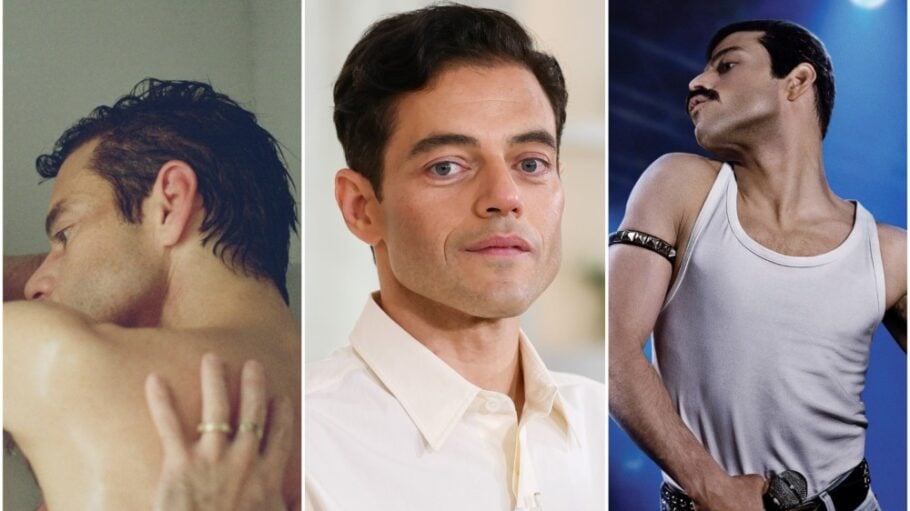
Rami Malek had been itching to work with Ira Sachs for some time — going as far as to ask his representatives to get him a meeting with the filmmaker. But when he got the script for Sachs’ next movie, “The Man I Love” — about a New York theater performer navigating life, love and his devotion to his art after being diagnosed with AIDS — Malek admits he hesitated at first, because he was fresh from his Oscar-winning portrayal of Freddie Mercury in “Bohemian Rhapsody.”
“When I read the script, I said, ‘I can’t do this. There’s too many similarities. It could be problematic,’” Malek told reporters on Thursday at a press conference following the film’s world premiere at the Cannes Film Festival.
“There was a certain sense of fear,” Malek continued. “I started to really think about what I was afraid of. Was it the similarities? Was it the singing? Was it what was going on in the period? … I knew I had to address the fear. If there’s anything Freddie taught me, it was [to] address the fear.”
As Malek contemplated what to do, he kept in mind that Sachs “makes unique cinema unlike any other.”
“I knew I was in extraordinary hands, and that if he was choosing me, I could rely on him,” he said of the “Passages” and “Keep the Lights On” director. “Not only to depend on him throughout the film, but to elevate it, to push myself, to force myself to race into that fire. When I raced into it, I started to discover that these men were similar, but they were also worlds apart.”

Love Film & TV?
Get your daily dose of everything happening in music, film and TV in Australia and abroad.

Getty Images
Playing Jimmy in “The Man I Love” would require him to sing on camera again. But those intimate performances weren’t like playing the Queen frontman playing to crowds of thousands in “Bohemian Rhapsody.”
“We have a legend in Freddie, who really had a destination, whereas Jimmy is just searching for creativity and love and intimacy and joy and pleasure in every moment,” Malek said. “He can sing. Does he sing as well as Freddie? No. If he needs to learn kabuki, he’s going to throw himself into it, and [throw himself] into Onnagata, and I did. Was it ever going to be perfect? Didn’t have to be. It was just about this element of creating and living and joy. New York, in that period, was a very different time.”
While audiences can draw similarities between the two queer men, Malek added, “I see them as two radically different figures altogether — especially as I have some more distance from it.”
Sachs — who appeared on the press conference dais alongside Malek, his co-stars Tom Sturridge and Luther Ford, as well as the film’s artisans — offered his take on the comparison.
“I love how you describe Jimmy specifically as someone who does have ambition, but it’s almost internal ambition,” Sachs said as he turned to face Malek. “As opposed to someone like Freddie, who’s looking for external.”
As a character, Jimmy represents a period in 1980s New York and the artists who inhabited it, where “there was a courage to do things because they wanted to impress the person who lived next door.”
“There was not this fantasy of globalization. It was a very local time,” Sachs said. “Being as ambitious as someone like Jimmy is, but with the idea of proving things for yourself and for the artist who lives in the hall next door to you, who lives just around the corner. This is something which, in a way, gives me a kind of courage, because you need to aim small in a certain way, and you need to aim into yourself.”
Malek chimed in: “There are a lot of people who aspire to be someone like Freddie Mercury, there are a lot of artists in the world who don’t get to that level, but still have an immense abundance of talent and skill, and a world to offer that just maybe is unseen by the masses, but communally gets some recognition. Or they recognize it in themselves. And perhaps that can be almost as gratifying. And I think that was for Jimmy, in a sense.”
The gratification of landing the cover of the Village Voice — as Sachs and Malek believe would be Jimmy’s ultimate goal — is certainly wonderful, but receiving an eight-minute standing ovation in the Palais des Festivals — which “The Man I Love” did after its debut in competition on Wednesday night — just might top that. Malek shed a tear during the massive applause for the deeply emotional film, which has been described as a “musical fantasia of a city under duress.”
During the press conference, Sachs, who co-wrote the script with frequent collaborator Mauricio Zacharias, revealed why Malek was his top choice for the role.
“With a film like this, you needed someone who had a certain kind of mystery, a certain kind of potential for the unexpected, but also truly a star quality,” he said. “Because there is a whole universe which revolves around Jimmy and Rami in the film. A star is someone who emits light and also asks to be seen.”
Malek and Sachs further discussed “The Man I Love” during a special Kering Women in Motion conversation earlier this week. During the talk, Malek credited Sachs for bringing out “a performance in me that I don’t think I would give in another situation,” adding: “Ira is an actor’s director, among all the other things he can do. We believed in each other.”
He also reflected on his historic Oscar win for “Bohemian Rhapsody” and how becoming the first Egyptian actor to take home the prize inspired future generations.
From Variety US