




























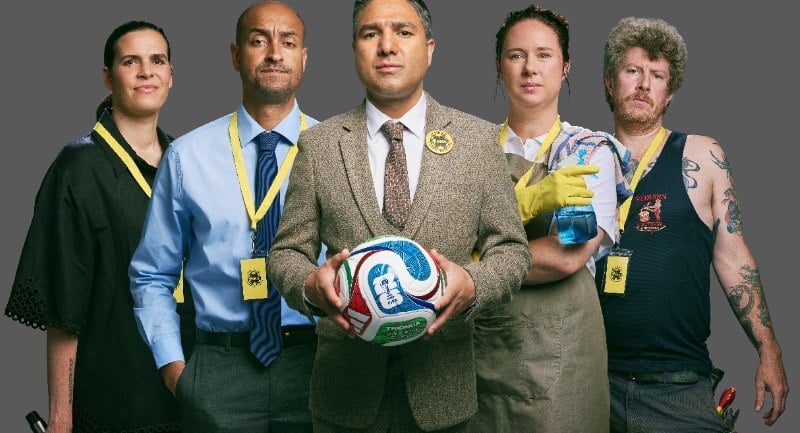
SBS knows the importance of the World Cup and has recruited “Ted Lasso” star Nick Mohammed to help share the message.
The broadcaster has launched a cheeky advocacy campaign – complete with a fake rights association – to solve a very real scheduling problem: most of the 2026 FIFA World Cup falls squarely within the Australian workday.
The broadcaster unveiled the World Cup Watchers’ Rights Association (WRA), appointing Mohammed as its honorary executive chair.
The campaign directly addresses the fact that more than 65% of live matches from the FIFA World Cup 2026 – running from 12 June to 20 July – will air during Australian business hours, given the tournament is hosted across North America.
SBS acting director of marketing and audiences, Uma Oldham, told Mediaweek that Mohammed’s appointment was the centrepiece of a broader strategy to drive reach beyond the already-converted football faithful.
“We are a challenger brand in the market, and the World Cup is the biggest sporting event in the world,” Oldham said. “So when it comes to the marketing campaign, we wanted something to drive talkability and impact in the market, and for that, you need the right talent.”
The campaign was developed with agency partners Droga5, Poem, and Hearts and Science.
A survey of 1,041 Australian adults conducted by The Strategies between 21–24 April 2026 found that three in four Australians plan to watch the World Cup – and many are already gaming the system to do so.
Some 33% admitted to booking a meeting specifically to watch sport, 38% have watched sport while on a work call, and 1 in 10 have hidden under their desks to do so.
The data gave SBS both the creative ammunition and the social licence for the campaign’s comic premise.
“The fact is, 70% of people are watching sport at work anyway, and the SBS World Cup Watchers’ Rights Association is a cheeky little nudge,” Oldham said.
Support for flexible viewing is strong on both sides of the desk: 71% of Australians agreed employers should allow staff to watch matches during work hours, while 53% of Australian bosses said they would actively make arrangements to accommodate it.
Mohammed – best known as Nate in “Ted Lasso” – leaned fully into the bit.
Oldham said Mohammed’s casting was deliberate – his association with football through “Ted Lasso” gave him the cultural credibility the campaign needed, without alienating casual fans.
“We also really wanted someone who had that cultural connection with football without being too hardcore, which you get with ‘Ted Lasso,’” she said.
“We needed someone who could straddle both of those worlds because we know the fanatics will come – we don’t need to work on them.”
She was candid about how unlikely the coup felt internally: “We can’t actually believe we got him.”
Joining Mohammed as WRA ambassadors are comedians Matt Okine, Mel Buttle, and John Cruckshank, as well as former Matildas goalkeeper Lydia Williams.
Oldham framed the campaign’s targets broadly, extending beyond traditional sports venues to schools, community organisations, and government bodies.
“Workplaces are not just workplaces – they’re schools, communities, and government – and we want them to get on board and really encourage staff to get behind it,” she said.
The stakes for SBS are both commercial and cultural. “It’s strategically important for SBS. We need to drive audience growth not only for our commercial growth, but also to deliver,” Oldham said.
She also positioned SBS as the natural home for the tournament, highlighting the network’s multicultural mandate as a key point of differentiation.
“When you think about the FIFA World Cup, there is no other sporting event on the planet that brings communities and cultures together quite like the World Cup,” Oldham said.
“I don’t know how it could be anywhere else.”
From Mediaweek