





























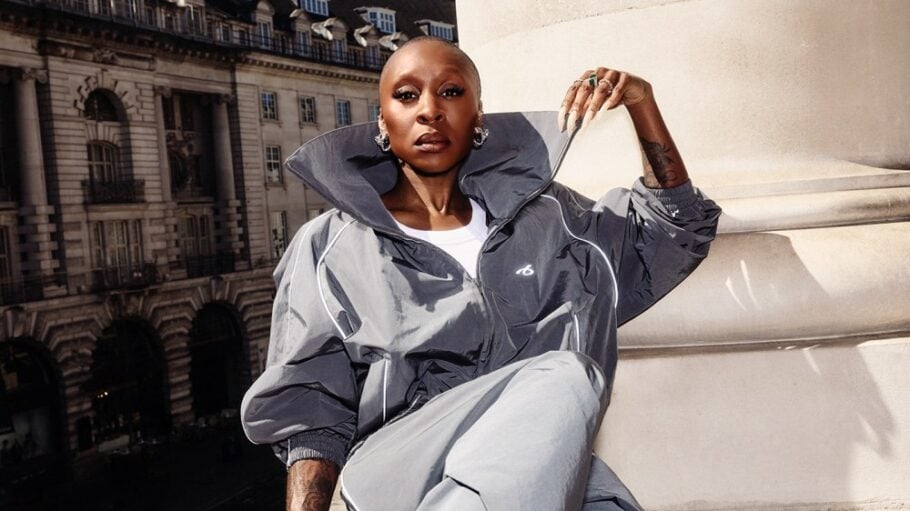
When Cynthia Erivo describes life inside the “Wicked” machine — the double-feature adaptation of the long-running Broadway musical — it’s hard not to picture a woman swept up by a cyclone. “We were holding on by threads,” Erivo says of the past four years, “and we were really trying to take care of each other.”
“We,” of course, refers to Erivo and her co-star, Ariana Grande, the Glinda to Erivo’s Elphaba. As she and I meet on a balmy April morning at the Hotel Café Royal in London, Erivo is six months past the release of “Wicked: For Good,” the sequel that would turn the two-movie franchise into a $1.2 billion juggernaut. Currently, Erivo is appearing on stage in “Dracula,” her one-woman show at the Noël Coward Theatre in London. But Erivo — a queer Black woman who made one of movie history’s iconic characters into her own — is clearly still processing what turned out to be an extraordinarily challenging experience.

“It’s very interesting, watching what people’s perception is versus what the reality actually is,” she says, a note of sarcasm creeping into her voice. “Lots of psychologists seated at home deciding who we were, what we were going through, what we were doing and why.”
The casting of Erivo and Grande, as yin-and-yang besties Elphaba and Glinda, ignited the internet. Early on, the two women made a “really conscious decision” to nurture their relationship, Erivo says. During their first press tour, in November 2024, they did almost all their interviews together and leaned into matchy-matchy red carpet cosplay to reflect their characters: black or green in Erivo’s case while Grande stuck to shades of pink. Despite the obvious harmony, their friendship was endlessly dissected online.
“I think that people didn’t really believe that we were actually friends,” Erivo says. “But that’s also because people don’t know me very well. If I’m a friend, then I’m a friend. If I’m not, then I’m not.” She says the two still text almost every day.
Love Film & TV?
Get your daily dose of everything happening in music, film and TV in Australia and abroad.

In some ways, with her elegant composure and trademark super long acrylic nails — painted pearlescent pale peach when we meet — Erivo cultivates an air of unknowability. Her answers are thoughtful and candid, but there is a sense she is, not unreasonably, shielding an inner layer. And why wouldn’t she? Not only would it be a way to cope with the intense scrutiny that arose during “Wicked,” but it lends itself to the job.
“That’s the nature of the work, to truly embody and be different people,” she says in soft tones, punctuating her sentences with flutters of her fingers. “Because I think sometimes, if I’m honest, people thought I was being myself, even though I was green.”
It was perhaps inevitable that the obsessive interest in Erivo and Grande would turn into something darker. Maybe it’s because audiences really were confusing Erivo with Elphaba, who is scapegoated and banished from society in the films. Maybe it’s because by the time 2025 rolled around, both “Wicked” and its leading ladies felt, well, a little overexposed, considering they’d started promoting the film a full nine months earlier when Erivo and Grande (clad in their respective green and pink) presented together at the 2024 Oscars. Or maybe it’s just because the internet loves a backlash, especially when it involves cutting a woman down to size (a phenomenon known aptly, given the Oz of it all, as “tall poppy syndrome”).
Whatever the reason, as that first press tour steamrolled out of Sydney through L.A., Mexico City, New York and London, every gesture became magnified, turning “Wicked” into a whirlwind. Erivo was not prepared for it.
Hers is not an overnight success story. Growing up in South London, she loved performing as a child but had never heard of the Royal Academy of Dramatic Art, one of the U.K.’s most prestigious drama schools, before a mentor insisted she apply. Her response was “I’m not getting into anywhere that has ‘royal’ or ‘academy’ in it. It’s not happening.” But she did.
Six years after graduating, she won her first Tony for her role as Celie in the 2016 musical revival of “The Color Purple.” A daytime Emmy and a Grammy followed; five years later she was nominated for her first best actress Oscar, for the portrayal of abolitionist Harriet Tubman in Kasi Lemmons’ 2019 film “Harriet” (she lost out to Renée Zellweger for “Judy”).
Her second Academy Award nomination was for Elphaba in 2025; “Wicked” was nominated in nine other categories, including supporting actress for Grande. In the end, the film took home only two awards, for costume design and production design. In hindsight, perhaps it was the first sign of a storm on the horizon. Because if “Wicked” was the crosswind that elevated Erivo into popular consciousness, its sequel, “Wicked: For Good,” became the counterweight that threatened to send her crashing back down.
Once again, there was a global whistle-stop tour, starting in São Paulo at the beginning of November 2025, followed by Paris, London, Singapore and New York over 13 days. This time, though, things went awry. Grande was grounded due to an aircraft issue and missed the Brazilian launch. Then there was the Singapore premiere, where a man vaulted over the barrier and grabbed Grande, who had been diagnosed with PTSD after a suicide bomber killed 22 people at her 2017 concert in Manchester, England.
“Nobody moved. Nobody moved,” Erivo recalls, the horror still palpable in her voice. “So I moved because my brain went, ‘Get him away! Get him out of here!’ My immediate reaction was ‘Get him away from us.’ And what people couldn’t see is that he wouldn’t let go [of Grande]. He wouldn’t let go. So I just kept pushing at him to get him off.”
Most people saw Erivo as a hero, leaping in to save a friend with no thought to her own safety. But some dismissed the episode as an overreaction. Erivo is unequivocal. “A stranger is a stranger. Personal space is still personal space. It doesn’t belong to anyone, even if you feel you know the person,” she says. “In that moment, we were all terrified.”
While much of the coverage of the incident praised her fast reflexes, it also prompted jokes, memes and TikTok videos portraying Erivo as Grande’s “bodyguard.”
“I think that we haven’t really come to terms with the insidious nature of how we view Black women. And I’m sure people will read this and think, ‘Oh, for goodness’ sake, it’s not about that.’ But it is,” Erivo says. “Because that’s what was being made fun of. It was my physique; it was my shape; it was the fact that I was bald; it was about what I looked like. And because of that, there was this assumption that I was bigger than my co-star and so I had to be controlling or protecting, and that was my role. I would hazard a guess that it would not have been the same had it been the other way around.”
By the time awards season rolled around again, Erivo was done. Did the reverberations from Singapore put her off campaigning for an Oscar? “I think maybe in a way it did, actually,” she says. “I just felt like my humanity had been bastardised. I felt like something I did instinctively had been made to be something that it simply was not because of the way people see women who look like me, and because of the assumptions that are made, and I just didn’t want to be a part of that, really and truly. I didn’t want to put myself through it. I didn’t feel like I deserved it.” It didn’t help, she adds, that “it felt like there was already a sort of upturned nose at the second instalment, even though we all knew there was a second film coming and we were just doing our jobs.”
It’s true: “Wicked: For Good” was snubbed by the Academy across the board. (More generally, Erivo notes, the Oscars campaign window goes on for a “long time,” particularly in the post-COVID era, when the ceremony is often pushed into mid-March. “If it was a shorter stint of time, there is less potential for things to turn sour, and also there’s more energy to keep it going.”)
At the beginning of this year, while Oscar campaigning was in full swing, Erivo went into rehearsals for “Dracula.” “I guess it’s like a reemerging again, putting my feet back on the ground again,” she says of returning to the West End. “Because ‘Wicked’ was its own storm in a teacup. It took over everything and — beautifully — changed my life.”
“Dracula” is intense in a different way. Erivo plays 23 characters and recites approximately 20,000 words of dialogue over the course of two hours. On the night I attended, midway through the 16-week run, Erivo received a standing ovation as the nearly sold-out show drew to a close. At the stage door, 60 or so fans clamoured to catch a glimpse of her, and when she finally emerged — a tiny figure in an oversized khaki hoodie and blood-red jacket accompanied by hulking security — she made a point of signing something for just about everyone. Another security guard said she comes out after almost every performance.
Given the show runs six nights a week, plus at least one matinee, Erivo must be exhausted, I say, clocking the jar of vitamins on the table in front of her. “I am,” she replies. “It’s a weird sort of adrenaline-and-exhaustion combination, which ends up being more exhausting than just pure exhaustion.”
The day after our interview, Erivo cancels both the matinee and evening performances of “Dracula.” Fans express their disappointment online, with some putting it down to her running the London Marathon the following day (she completes it in 3 hours and 35 minutes). Her rep declines to comment when I ask why the shows were cancelled. But being a performer and a marathon runner are not mutually exclusive: Erivo once ran a Brooklyn half-marathon before doing two Broadway shows later that day.
Months after the release of “Wicked: For Good,” has Erivo had time to reflect on the experience? “I haven’t had that much distance,” she replies wryly. “And I guess I’ve not necessarily looked back that much at it, because distance does make the heart grow fonder, you know?”
Considering the success of the franchise — and the fact that Elphaba survives — there’s inevitably been chatter about a third movie. “It’s too soon to even begin to have the conversation about it,” Erivo says, adding, “It would take a lot to get me back to do it. It has to make sense.” So far, she claims, there has been no discussion. And anyway, there are so many other roles she’s dreaming of sinking her teeth into: a monster for Guillermo del Toro; Storm from the X-Men, which she calls a “childhood fantasy of mine.” Next up is Studiocanal’s “The Road Home,” in which she’ll star as South African singer and civil rights activist Miriam Makeba, “which I’m really excited and scared about.”
But even at the height of the storm around “Wicked,” there were silver linings. Erivo giggles as she recalls the debate over Elphaba’s “sex sweater” in “Wicked: For Good,” calling it the “fun part” of social media. Not least because it meant audiences were invested in her and Jonathan Bailey — both proudly gay actors — as a heterosexual leading couple.
“He and I had talked about it often, that the two of us could play these characters and be ostensibly two straight characters who are played by two queer people without any issue, and actually still be able to tell the story of love and closeness,” she says. “There’s something really special about that.”
As we wrap up, Erivo sweeps out of the hotel, the security guard by her side the only hint of a lingering cloud. Outside, the sun is bright. The skies are clear.
Charity Spotlight: The Shameless Fund
With so much focus on Cynthia Erivo’s friendship with Ariana Grande, it would have been easy to overlook the rapport she also established with their “Wicked” co-star Jonathan Bailey, who played Fiyero in the adaptation. As well as being British, both are gay, which made their casting as the lead romantic interests in a billion-dollar hit all the more significant. “I think it was a big deal that it was the two of us,” Erivo says.
But Bailey and Erivo are acutely aware that not every member of the LGBTQ community is able to exist in a place where they’re not only accepted but celebrated. Which is why, in 2024, Bailey launched The Shameless Fund, a charity that aims to help people live their authentic lives, free of fear and judgment. It does that by harnessing star power to raise money for grassroots organisations that provide support for LGBTQ communities across the globe.
Bailey asked Erivo to get involved early on. “I said yes because I understood that he truly wanted to do something good for humanity,” she says. “I think because I’ve been able to live as me for very long and I feel comfortable in my skin, I really want other people to feel that comfortableness as well.”
Location: Hotel Cafe Royal; Production: Joel Gilgallon/Joon; Styling: Jason Bolden; Styling assistant: Abby White; Grooming: Joy Adenuga/ Forward Artists; Jacket and pants: Balenciaga; Shoes: Christian Louboutin; Jewelry: Marli
From Variety US