




























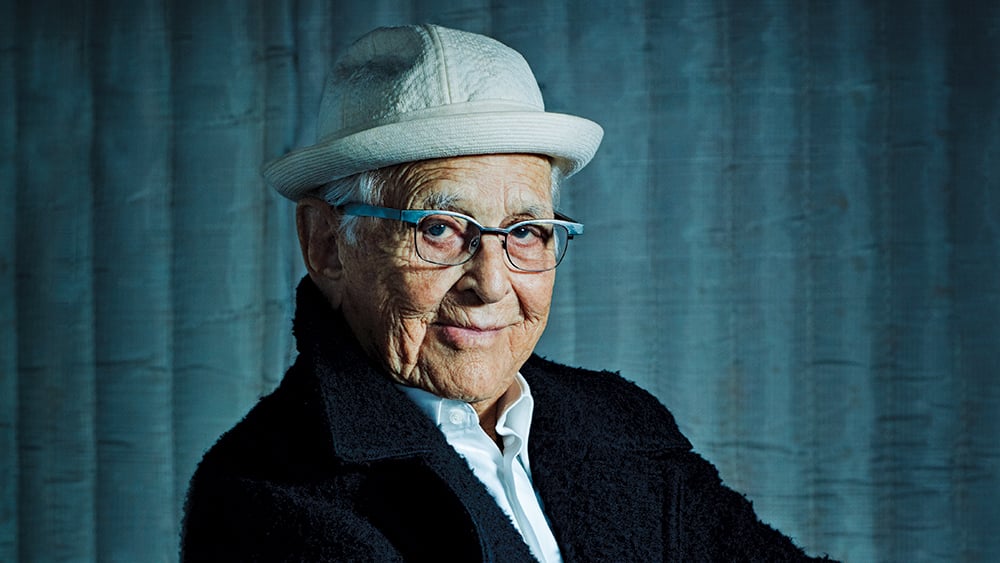
Norman Lear changed television. That, we know, is an absolute fact, and I’ll get to it in a moment. But what really saddens me at the news of Norman Lear’s death, at 101, is he won’t be here anymore to serve as a voice of reason as the United States continues to lose its mind.
Lear was a World War II hero who spent much of his life defending democracy via what he put on our television screens and also in his high-profile advocacy work. He often talked of what inspired him to be politically active: At 9 years old, Lear was tinkering with his radio when he discovered the bile spewing from anti-Semitic broadcaster Father Charles Coughlin over the airwaves.
“I think about it all the time,” Lear told me in 2019, when I had the pleasure of interviewing him multiple times for a Variety cover (among the several times I had the pleasure and honor of interviewing Lear over the last several years). Our country is now regressing to an earlier era of enmity, and it deeply concerned Lear. “The hate that is being spewed, the racial hate, the religious hate. I sure remember the feeling of this creeping hatred and racism back then, and I feel it all around us today.”
Lear said Coughlin and his ilk “scared the shit out of me.” That fueled a patriotism that led him to ultimately enlisted during World War II and fly 52 combat missions. Later, inspired by the idea that Coughlin’s rhetoric wasn’t “in the American way,” he founded People for the American Way in 1980 to combat hate speech and right-wing propaganda. Later, Lear and his wife, Lyn, helped found the Environment Media Association in 1989 to build awareness of environmental issues; the couple also created the Lear Family Foundation in 1997 to support a wide range of causes.
Last year, when the Supreme Court overturned Roe v. Wade, I immediately thought of the famous episode of Lear’s “Maude,” in which the title character made the difficult decision to have an abortion, and how in the time since that episode aired in 1972, we had seen women’s right to autonomy over their bodies finally come to fruition… only to be pulled away again. And now, with democracy hanging in the balance, we may very well lose more fundamental rights in the coming years. Lear fought for so much; we must fight even harder now that he is gone.
Even as this country grew darker in its recent years, Lear didn’t lose optimism. Yes, he was worried about the state of our nation, and he wanted us to know we needed to be vigilant. Even at 100, Lear was still regularly posting on social media to rally Americans to exercise their civic duties and remind each other that we can’t take democracy for granted. We have to fight for it and remind each other why it’s important.
Lear’s attitude was always inspiring, and perhaps that’s what makes losing him at this moment in our country’s history all the more heartbreaking. Marty Kaplan, who founded and runs USC Annenberg’s Norman Lear Center, told me a few years ago that “one of my fondest prayers is that Norman is flourishing when this current period is behind us, and we come back to our civic senses.”
Love Film & TV?
Get your daily dose of everything happening in music, film and TV in Australia and abroad.

In 2000, Norman and Lyn were among a group that purchased a copy of the Declaration of Independence and toured it around the country for citizens to see it up close — and hopefully be inspired by what it means. That is also where Lear became close with his production partner Brent Miller, leading to a bit of a renaissance for Lear and his Act III Prods. company.
It’s pretty incredible to think about how reboots and remakes of Lear’s signature 1970s series had such resonance in the modern day. The reimagining of “One Day at a Time” under Gloria Calderón Kellett and Mike Royce honored the original, and went even further in telling critical stories of representation and acceptance. And then the “Live in Front of a Studio Audience” specials helmed by Lear and Jimmy Kimmel were striking in how those scripts from that era, from shows like “All in the Family,” “The Jeffersons” and “Good Times,” felt so relevant even now.
It’s not hard to find a TV writer (both in drama and comedy) who was inspired by how Lear reinvented the TV sitcom. Ryan Murphy, Phil Rosenthal, Kenya Barris and more learned how to pair great characters and hysterical situations with moments that really mean something, all thanks to growing up on a diet of Norman Lear series. And Lear often returned the favor, lavishing praise on shows that hoped to carry on his mantle, like NBC’s under-appreciated “The Carmichael Show.”
“He showed you that you can put on a television show that’s funny, really funny, and tackle some real issues that affect real people,” Chuck Lorre once told me. “That was woven into my DNA, watching that stuff as I was growing up.”
Lear continued to be active right up to 100, going to his office and regularly attending events. He was so inspiring in his energy and how much life he packed into every day, and always living in the moment. (He was fond in pointing out how everything in his life had led to that very point in time he was now at.) During the early days of the pandemic, I asked Lear how he was handling being quarantined at home. “’I fucking hate it’ is the way I’m handling it,” he quipped.
I also once asked Lear what he thought his legacy might be, and it turns out that wasn’t the right question. Norman Lear wasn’t done. He was never done.
“Legacy is what other people draw from the life you’ve led,” he said. “I don’t think about the legacy.”
Leave it to the rest of us, then. Norman Lear’s legacy will be how we all keep his spirit and mission alive — both on the television screen and throughout our nation.
From Variety US