
























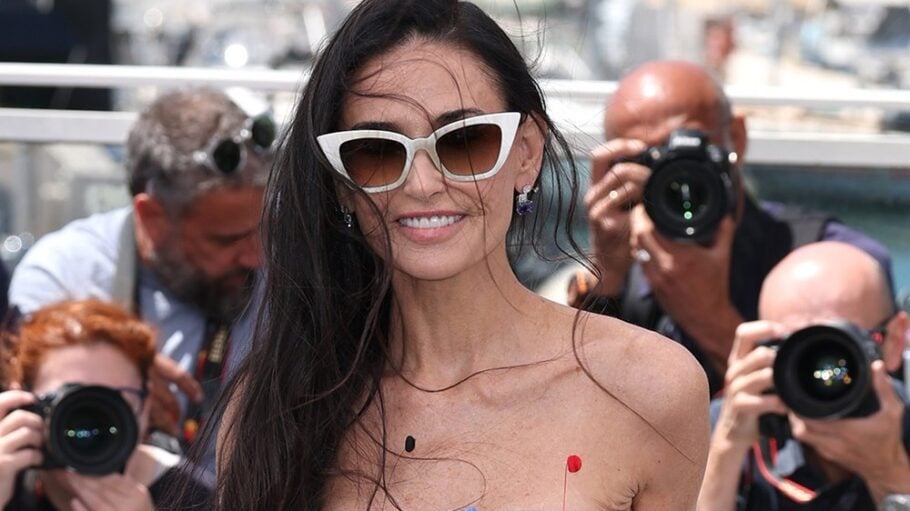
Demi Moore weighed into the debate surrounding artificial intelligence during the Cannes Film Festival jury press conference on Tuesday, saying that “AI is here” and Hollywood should “find ways in which we can work with it.”
Asked by Variety her thoughts on how AI is impacting the movie business and if there should be more regulation in place, Moore said: “Wow, that’s a big question. I think the reality is that to resist — I always feel that against-ness breeds against-ness. AI is here. And so to fight it is to fight something that is a battle that we will lose. So to find ways in which we can work with it I think is a more valuable path to take.”
She added, “To your question of, are we doing enough to protect ourselves? I don’t know the answer to that. And so my inclination would be to say probably not.”
Moore, who was last at Cannes with her body horror hit “The Substance,” went on to say that “there’s beautiful aspects to being able to utilize” AI, but it can never replace the human experience or touch. “The truth is there really isn’t anything to fear because what it can never replace is what true art comes from, which is not the physical, it comes from the soul,” Moore said. “It comes from the spirit of each and every one of us sitting here, to each and every one of us who creates every day. And that they can never recreate through something that is technical.”
Earlier in the conference, Moore was asked if she believes speaking freely about politics can be detrimental to the movie business, to which she responded: “I would hope not.”
“Part of art is about expression, so if we start censoring ourselves then I think we shut down the very core of our creativity, which is where we can discover truth and answers,” said Moore, who was last at Cannes with her body horror hit “The Substance.”
Moore is on this year’s competition jury alongside president and “No Other Choice” director Park Chan-wook; Irish actor Ruth Negga (“Loving,” “Passing”); Belgian director and screenwriter Laura Wandel (“Playground”); Chilean director and screenwriter Diego Céspedes (“The Mysterious Gaze of the Flamingo”); Ivorian actor Isaach de Bankolé (“Muganga”); Irish-Scottish screenwriter Paul Laverty (Ken Loach’s “The Wind That Shakes the Barley” and “I, Daniel Blake”); Oscar-winning helmer Chloé Zhao (“Hamnet”); and Swedish actor Stellan Skarsgård (“Sentimental Value,” “Mamma Mia”).
Love Film & TV?
Get your daily dose of everything happening in music, film and TV in Australia and abroad.

Park also made a statement about politics, saying that he doesn’t believe it should be separated from art when questioned about the fierce debate that was sparked at Berlin Film Festival earlier this year.
“I think it’s a strange concept to think that they’re in conflict with each other,” he said through a translator. “Just because a work of art has a political statement, it should not be considered an enemy of art. At the same time, just because a film is not making a political statement, that film should not be ignored. Even if we are to make a brilliant political statement, if it’s not expressed artfully enough, it would just be propaganda. So what I want to say is that art and politics are not concepts that are in conflict with each other, as long as they are artistically expressed, they are valuable.”
The Cannes Film Festival is set to kick off on Tuesday night with the premiere of “The Electric Kiss,” Pierre Salvadori’s French comedy-drama about a young painter who tries to contact his late wife through a psychic. This year’s edition has a notable lack of Hollywood movies, though Cannes chief Thierry Fremaux said in a press conference on Monday that this is due to the industry “undergoing a major shake-up.”
“After COVID, the writers’ strike, which, incidentally, is linked to issues surrounding artificial intelligence, followed by restructuring, mergers, acquisitions and so on,” he said. “Amid all of this, the triumph of that brilliant invention known as streaming platforms — all of this necessitates a restructuring.”
From Variety US