





























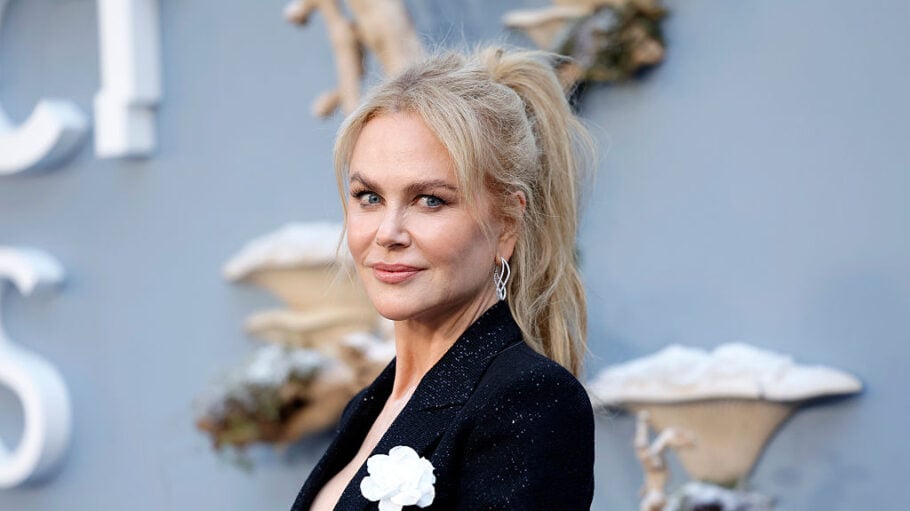
It’s Saturday in Nashville, and in the affluent suburb of Green Hills, that means heading to the mall. The neighborhood has turned up to revel in the unseasonable heat, just weeks after an icestorm brought the city to its knees.
The place to be is the Restoration Hardware Café, where yoga moms pick at salads and ogle sleek furniture.
No one bats an eye when their local off-duty movie star, Nicole Kidman, comes through wearing stonewashed jeans and an oversize sweater vest and toting a quilted Chanel bag. The only paparazzi in this town is a nearby newlywed couple, photographing a leather couch for inspiration.
Kidman loves it here, as does her neighbor and “Big Little Lies” co-star Reese Witherspoon. It’s as unpretentious as Kidman herself. The Australian grazes on a kale Caesar with her fingers, not a fork. She responds often in sounds, not words — great, dramatic trills like birdcalls. She’s never more animated than when she’s telling a story, whether it’s about winning an Oscar or meeting a pack of sea lions.
This is why we love her. Kidman digs into her work and lives to play, constantly transforming physically and emotionally to bring us new stories — especially from the women directors and writers she’s championed and relied on throughout her career. In the nearly 25 years since she won the best actress Oscar for her devastating turn as Virginia Woolf in “The Hours,” Kidman has become Hollywood’s preeminent (in her words) “worker bee.” And 2026 will be another banner year.
This month brings the long-brewing screen adaptation of “Scarpetta” on Prime Video, where she plays the hardened medical examiner from Patricia Cornwell’s popular book series. In the fall comes “Practical Magic 2,” a sequel almost 30 years in the making that reunites Kidman with Sandra Bullock in a tale of sister witches. She’s shooting the third season of “Lioness,” from creator Taylor Sheridan, and will close out the year with a supporting role in the latest horror film from Osgood Perkins.
Longevity like Kidman’s is rare, especially as an actress telling original stories in a business increasingly informed by algorithms and averse to risk. It occasionally comes at a price. The 58-year-old will once again run the press gauntlet for various projects as she emerges from a high-profile divorce from country star Keith Urban.
Love Film & TV?
Get your daily dose of everything happening in music, film and TV in Australia and abroad.

Here we discuss Kidman’s new personal priorities, relive Academy Awards glory and discuss, for her, the impossible: taking an actual vacation.
Why will 2026 be the year of Nicole Kidman? But every year is probably the year of Nicole Kidman.
Well, not last year. I was quiet. I had other things going on. I was in my shell.
Are you ready to come out of your shell?
Now I’m in a place of saying, “2026. Here we go.” I have “Practical Magic” with Sandy. I’ll be in full witch mode.
Let’s talk about you and the Academy Awards. Before we get to these performances, you resonate in Oscar history on the red carpet. In 1997, your chartreuse John Galliano dress changed the game for what to wear to the Oscars.
Well, it ignited European couture for the carpet. It was never like that before. The clothes were nice, but the idea of combining the couture houses with something as prestigious as the Oscars? That’s just a given now. What comes out of that is those dream images that little girls look at — or people try to find versions of it for their lives. Or, as my mom would do when I was little, she would make the dress for me.
Your mom made your clothes?
I would pull something out of a magazine, or I would see something on Grace Kelly from a book. My mum and grandmother both could make the dress. They could sew buttons, beautifully corseted down the back. They could embroider.
Did you think you would make a kind of history that night with a dress?
I remember being nervous because of the color, and then seeing Madonna that night and she said, “Best dress!” All I could say back was “You smell so good.” She did. She had the softest skin. You know who else smells so good? Rihanna. Intoxicating. I sat next to her at the Met.
What was your first awareness of the Academy Awards? Did you watch as a kid in Australia?
As a little girl. I’d watch Shirley MacLaine and Meryl Streep and Jack Nicholson and Ellen Burstyn. I’d be in my pajamas and dressing gown and slippers.
Did that get the wheels turning that you wanted to be an actor?
To me, the show was Hollywood. The acting I was pursuing was studying plays, like Chekhov. And the show was about what Hollywood made. I think I have those two worlds colliding in me. I love independent filmmaking and intellectual work, and you show up wherever it is. And then there’s the glamour of Hollywood, which is completely beguiling. It can hypnotize you and it’s exciting. It’s gorgeous. We need a bit of gorgeous. And then it all goes away after the show; it’s very Cinderella. Everything gets packed up in boxes, and you’re on set the next day.
Your first nomination was —
“Moulin Rouge!”
Did you watch the nomination announcement that year?
I was doing the film “Dogville.” I was in the middle of a scene with Paul Bettany. Production held up a sign behind the camera saying I’d been nominated.
Did you lose it when you saw the sign?
No. I was in the scene. I finished the scene; then I lost it.
Incredible. What was it like going through the campaign process for the first time?
It was very different then. There wasn’t much to do. It got more and more intense throughout the years. I don’t really remember there being much with “The Hours.” There were a few Q&As, but it wasn’t a lot. Now it starts in September and finishes in March. If you do Cannes, it starts in May. Like, what? How did that happen?
Let’s talk about your big night, winning in 2003 for “The Hours.” You won the Oscar four days after the U.S. led an invasion on Iraq. Some people opted not to go to the ceremony that year.
Well, it wasn’t just the days before the Oscars — it was throughout that whole period. I remember at the BAFTAs that year, we all wore black. It was a dampened-down ceremony, appropriately so. But there was still an incredible embracing of art and continuing the show in line with the legacy of Hollywood.
Look at all the other parts of the Academy. We have to remember that these people have devoted their lives to artistic merit. They get rewarded that night. Them getting up onstage to be acknowledged by their peers is important for us as a community. They’re our crews, our artists, our costumers, editors, makeup, sound, special effects, stunts. We get the glitzy star moments, but they’re the reason we’re there. When you’ve worked in this industry so long, you want to honor them.
So Denzel Washington reads your name. Then what happens?
Well, everything goes dark for a minute. And then I didn’t thank my dad, who was sitting right there.
You hugged and kissed your mom.
I did, yeah.
My mom passed a few years ago. It’s the worst thing in the world. I’m so sorry about your recent loss.
There’s still pain. We’re motherless now. But I thanked her, and honestly, I don’t remember much after that.
Is it intimidating up there?
Yeah, and there’s a strange thing that happens where you go, “I don’t deserve this. I’m scared. How do I acknowledge everybody?” I’m so much a part of the team; I want to make sure my director, my writer, all the other people are thanked. I’m just a cog in the wheel. Yes, I did something in it. But if you really take it down, it’s everyone together. Stephen Daldry and I crafted that performance because David Hare wrote beautiful words. Ann Roth gave me the support through costumes and ideas. We built the world. And the actors I was working with, Miranda Richardson and Stephen Dillane, they should be winning too.
What was it about your Virginia Woolf that resonated?
Her battle within. Her fight to have her voice and to not have it muted or changed. The fact that every human being has the right to choose what they want for their life. That reverberates on the deepest level. It’s human. Virginia wanted to stay in her consciousness, not to have it muted. Whatever you would have diagnosed her with, Virginia had the right to say, “No. I write from this place, and you’re not taking that away from me. It’s actually why I’m here.” I so relate to that. That a doctor isn’t going to tell me what I have to do. And no other person — even if you’re my husband — is going to tell me. Reading her novels, you realize more and more as you get older, her writing deals with all of the places we don’t go. The labyrinth of darkness and visceral pain.
Let’s talk about the prosthetic nose for a second. At the time, there was conversation that you were being rewarded for being a beautiful woman who made herself less so for her art. The same thing happened a year later with Charlize Theron and her facial prosthetics in “Monster.” Was that fair?
Whatever. People are always going to say whatever. The performance was there. Ann Roth, Stephen Daldry and David Hare all agreed they wanted Virginia to have a different profile than mine. My profile is very distinct, and it needed to be different. I have a very particular nose. I like when I’m able to change up my appearance, as someone trained to be a character actor. Some people are employed to look and be exactly themselves. I’ve been trained as a character actor, so therefore when I’m working, I’m not here to be Nicole. On a talk show, I am, but not in a film or play or TV show. If that means changing my physical appearance? Of course. You have to walk differently, breathe differently, talk differently. The timbre of your voice has to change. All of the internal mechanisms affect the external.
In your speech, you said you’d worked your whole life to make your mother proud. Do you feel like you accomplished that?
I hope. I continue to carry it forward. “Proud” is more of me wanting a pat on the back. I’ve moved into a different place now, which is to pull through both my father and mother’s essence. They cared about others far more than they cared about themselves, at times. They were generous with spirit and whatever they had. They were never judgmental. My father never swore. The worst thing I’d ever heard him say was “This is bad behavior.” My mother came from a generation where she couldn’t fulfill her intellectual and professional ambition. She was incredibly bright and didn’t come from a family that had the means to give her the path to create her dreams. So I’m trying to carry that forward.
This will sound “woo-woo” —
I don’t mind a bit of “woo-woo.” I’m playing a witch this year — give it to me. Isn’t Mercury in retrograde right now?
It is. Do you see any signs from your mom in your daily life? I see ladybugs; that was my mom’s thing.
Ladybugs! I do that too! I said that to my daughter the other day. We saw one and I said, “Grandmama’s here!” My daughter looked at me like I was crazy and said, “No, Mom. That’s a ladybug.” I said, “Absolutely not. It’s your grandmother.” Whether it’s true or not, it’s soothing. I’ll accept that.
You mentioned earlier that last year was a rough one. I think a lot of people would ask, are you doing all right since your separation?
I am, because I’m always going to be moving toward what’s good. What I’m grateful for is my family and keeping them as is and moving forward. That’s that. Everything else I don’t discuss out of respect. I’m staying in a place of, “We are a family,” and that’s what we’ll continue to be. My beautiful girls, my darlings, who are suddenly women.
Your series “Scarpetta” also hits in March. It’s a ride. One second, it’s a stark procedural. Then, you and Jamie Lee Curtis are having a drunken family feud in a kitchen.
Jamie Lee and I have a physical fight in this show. Sisters go at it. Someone recently told me they could watch us fight until the end of time.
Why did it take so long for someone to crack Patricia Cornwell’s books for screen? They’ve been popular forever.
I know. It’s interesting taking it out to a true crime audience. I’m just beginning to understand the genre. I’ve never done a crime show like this, and there’s such a fan base for the books. I loved the autopsy scenes. I can actually perform an autopsy now. I have a medical background; I watched a lot of medical films growing up. I don’t have a problem with blood.
As someone who works so much, how do you diversify your characters?
Work on the interior and the motivation. I build the character from within first; then I find the glasses or other things around that will help me morph. It’s important to switch it up. After “Scarpetta,” I did this weird flip and shot a small role in “Young People” with Osgood Perkins, who is insane and a genius and I love him. With “Scarpetta,” she’s investigating death. She needs to be right. As a medical examiner you owe that to the families. They need answers. There’s a kernel from her own life that we see, a need to have control over death because her father was murdered. There’s a deeply emotional reasoning as to why she does her job.
You’ve embraced series in a big way. What do you like about working in TV?
Well, I love being able to do both. Big screen, small screen, long form, short form, indie and studio films. I rally against limitations. I can explore all these things — and I’m like that in my personal life. This year and my next few years are for the adventures. I’m at a certain time in my life. I’m going to do the things I’ve always dreamt of doing that are not anything to do with work. Just to do with exploration.
What does that look like?
I went to Antarctica. We’re going to head to the Galápagos and then hike Machu Picchu. I took my sister, nieces and nephews and loads of friends on a cruise. We met so many good people that we didn’t know. We saw penguins and sea lions. I’ve worked so hard since I was 14 on this exploration of the human spirit, and I’ve loved being global. I’ve gone to the Algerian border with Werner Herzog to ride camels. My kids have gotten to live in Morocco and see so much more of what the world is. The different tastes, smells, languages, ideas. All three of us have done seven continents.
I was raised to be able to mix in any circles, to really operate where everyone is equal and sit in all walks of life. I came from very socially conscious parents. We would always have people staying at our house. There was just a lot of rigorous conversation and exposure to many, many things.
Is that a tradition you carry on with your daughters?
Yeah. We’re all very different, but we’re deeply connected and close. My daughter is in Paris right now working for Dior.
We have to talk about “Practical Magic.” It’s an all-timer.
Are you a Gillian [Kidman] or a Sally [Bullock]?
I’m a Sally, I’m afraid. But don’t we all want to be a Gillian?
I want to be a Sally. I’ve had too much Gillian.
What made you come back for another film almost 30 years later?
I love Sandy. I love her. And we’re so different. I’m like [makes a wild noise with her mouth] and she’s so measured and together. We’re like sisters. I have so much protection and love for her. We also have incredible chemistry. We produce differently. She’s incredibly hands-on, and I love delegating. We have different skill sets that become complementary. It’s amazing that we still know each other. Joey King and the new cast are amazing, and Stockard Channing and Dianne Wiest are coming back.
I’m told it was a priority for you to have Susanne Bier direct this sequel, just as working with female directors has been a priority for you for some time now.
It’s so good to have found a purpose in terms of that work, being able to shift something culturally at a time where you just go, “Well, yeah, I work a lot, and I’m hoping to be able to give female directors and writers far more of a chance through my own showing up and being in the thing.” And then I also produce when I’m not in them. I love working with men too — like David Gordon Green on “Scarpetta,” Osgood, obviously Baz Luhrmann. Men’s voices are very distinct. They’re able to edit. They’re able to operate a camera. They love shots. They’re cinephiles, and they’re fantastic to work with because we have the same language.
You’ve long talked about this principle you have, that film is a director’s medium. I got a little choked up when you named every single director you’ve ever worked with in your AFI lifetime tribute in 2024.
I’ve lived and died [by this]. … There’ll be a point sometimes when I’m producing and I want to disagree, but the idea of taking something from the director and not having their ultimate vision realized? That’s just not right. I should direct if I want to control that.
Have you ever thought about directing?
I’ve circled it. But then I’ve been too busy or too tired. There are still things I want to do as an actor. I want to do theater again. I’ve done Broadway and the West End a couple of times. But I’m interested in Off Broadway and even some regional theater at some point, like in Chicago. Those things are different and exciting; you just need to get your children to a certain age to be able to do it. Right now is not the time for me to do that; I’ve got to take care of these kids. That’s sort of in my “Future” folder. I’ve got to fill this summer with kid stuff.
Do you think you’ll remain in Nashville even though your personal situation has changed over the past year?
Yes. We have our life here. I’m part of the city and community for 20 years. It’s my home.
What do you do when you’re not working?
We go away. I’m very close to my sister in Sydney, and all my nieces and nephews. My sister and I are a bit like the aunts in “Practical Magic.”
What a dream way to grow old, with your best friend.
My sissy.
So you love to travel. But tell me what you’d do if you had, say, the next 12 hours free?
I’d go for a walk. Just this morning, I went for a long walk with Reese. We live opposite each other. Isn’t that weird? That’s why “Big Little Lies” exists.
Is “Big Little Lies” still the project people approach you most about?
I get a lot about “Lioness” right now. It’s crazy. My character Kaitlyn is very tough. She doesn’t have an emotional response in her, just a strategic response. That’s the opposite of me. I always have to go, “I’m about to have an emotional response here. I’m going to cry, and then I’ll be all right.”
This year, you also produced “Margo’s Got Money Troubles” and have a small part in it.
There were such good roles for Michelle Pfeiffer and Elle Fanning. I wanted to be involved and help get this thing made to watch them shine. And all women directed it. This is what we’re trying to put into the world. I get to do something that I love, and so many other people benefit. I’m in a position where I can choose what I do, which is lucky. And if that goes away? I go back to just being a worker bee.
From Variety US