





























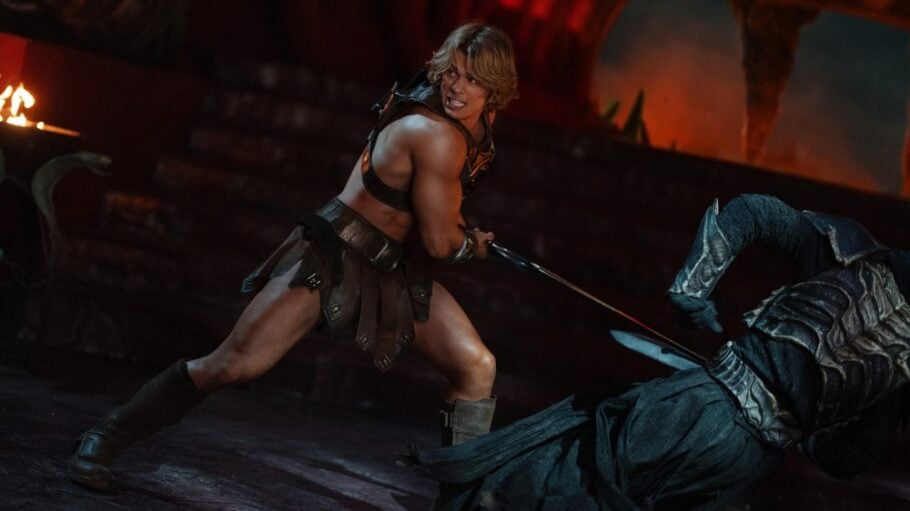
Nearly 40 years have passed since the colossal financial failure of Cannon Films’ live-action feature “Masters of the Universe” signaled the cultural falloff of Mattel’s successful sci-fi sword-and-sorcery media franchise — which had, for five years, held undiscriminating Eighties kids like this critic in its thrall, before we mostly moved onto other things. But in Mattel media, as in “Masters of the Universe,” no one ever really dies: The denizens of Castle Grayskull have since lived on, in faintly undead form, through sundry comics and toy line revivals and, most recently, a morass of animated Netflix content. And so, with the “maybe this time” mentality that colors much Hollywood studio decision-making these days, we’ve come round to another live-action “Masters of the Universe” feature: bigger in all dimensions, certainly, and better if the unabashed badness of the first one isn’t especially dear to your heart.
Does anyone really need it, though? If a “He-Man” movie was missing from the marketplace in 2026, would you note and mourn its absence? Travis Knight‘s film is so loaded with jokes about its own out-of-time uncoolness that it occasionally seems to be apologizing for its very existence: “Yeah, I know, but that’s what they went with,” says flaxen warrior Adam, on identifying his signature Sword of Power weapon in an introductory voiceover. (Adam, of course, is better remembered as He-Man, though the film shies away from that lame moniker, too, until its closing minutes.) The green-screen effects are knowing in their outright fakery; the nerdiness of the whole enterprise is lampshaded with a whole setpiece in a comic-book store. At a certain point, this wink-wink quality feels dated, but not in a way that recalls the 1980s: Instead, the early Obama-era quippery of the nascent Marvel Cinematic Universe comes heavily to mind.
Any sense of good-humored humility in this “Masters of the Universe” largely dissipates, however, as it sprawls toward and then way past the two-hour mark: At 141 minutes, it assumes an event status belied by its initial air of kidding around. Knight, the animator behind Laika’s inspired stop-motion spectacular “Kubo and the Two Strings,” has form in crafting improbably engaging fare from unpromising franchise debris: His sparky live-action debut “Bumblebee” remains the only “Transformers” film that is remotely a keeper. His liveliest instincts are finally thwarted, however, by a multi-headed script — credited to parties including Laika’s Chris Butler, “The Lost City’s” Aaron and Adam Nee and action franchise workhorse Dave Callaham — that attempts at once to be earnest tribute and ironic sendup. Can we really care about our hero’s battle for the soul of his kingdom while we’re also nodding and laughing at his dinky leather loincloth?
When the film does come close to pulling off that impossible double, it’s largely thanks to the man wearing said loincloth. British star Nicholas Galitzine has already proved himself a game comic performer in “Bottoms” and “100 Nights of Hero,” undermining his jockish masculinity with hapless doofus energy; as an interplanetary warrior whose powers have been diminished by years in exile — and, worse, in a dead-end desk job — on Earth, his deft, bewildered swapping of alpha and beta male personae carries a thin premise further than most would manage.
We first encounter Adam as a delicate, tow-headed preteen (played by Artie Wilkinson-Hunt), prince of the idyllic planet Eternia, still overwhelmed by the combat training foisted on him by his scornful father, King Randor (James Purefoy). He forms a closer bond with chief general Duncan (Idris Elba) and his daughter Teela (Eire Farrell), though he’s on his own when Eternia is invaded by skull-faced villain Skeletor (a wholly digitized and very fruitily accented Jared Leto), who takes his parents captive; a sorceress (Morena Baccarin) manages to spirit him away to Earth, together with the kingdom’s crucial Sword of Power, which he promptly loses in the cosmic flight.
And this is the backstory that Adam (now a strapping Galitzine) has been telling baffled earthlings for the last 15-odd years, as he attempts to live a normal office-drone life while seeking the sword that can take him back home. When it’s eventually located, a signal is beamed to the now-grown Teela (Camila Mendes) to collect him — as the last hope for an Eternia all but razed under Skeletor’s rule. “Masters of the Universe” is most enjoyable as a fish-out-of-water tale on either side of the planetary divide, as Adam’s insistence on his otherworldly origins alienates others both at the workplace and on the dating scene; once back in Eternia, meanwhile, his corporate-minded suggestions to “de-escalate tension” and “start a dialogue” cut little ice with knuckle-headed fighters named things like Ram-Man and Fisto. (This is the year’s second blockbuster, after “Project Hail Mary,” to feature a running fisting joke, and one must wonder which coming attraction will officially make it a trend.)
Yet once Adam is fully in command of his sword, so to speak, and subjected to a brawny He-Man makeover that at least spares him the lank bowl cut of the original model, things get rather less spry. The film unhurriedly lurches from one markedly similar fight scene to the next, with only Skeletor’s occasional injections of ripe innuendo to liven them up a bit. He’s particularly awed by Adam’s now super-sized thighs, as you probably would be if you were, well, Skeletor; either way, there’s more frisson between them than there is in Adam’s colorless romance with Teela. (Adam’s twin She-Ra, incidentally, is almost entirely absent from proceedings, pending a sequel that isn’t an altogether welcome prospect by the time things finally wrap up here.)
Love Film & TV?
Get your daily dose of everything happening in music, film and TV in Australia and abroad.

There are flashes of wit and amusing kitsch here and there — principally in Guy Hendrix Dyas’ suitably garish production design, which conjures a semblance of medieval splendor while never forgetting that this story’s natural world is plastic, and in composer Daniel Pemberton’s spirited revival of the fantasy-metal sound that defined the franchise’s original era. But it’s a nostalgia trip that never quite belongs to the present, and never rouses any real, cherished memory of the past. The over-40s likeliest to recognize everything here surely don’t require such an extended reminder; everyone else might just be bemused that He-Man ever had such power in the first place.
From Variety US