





























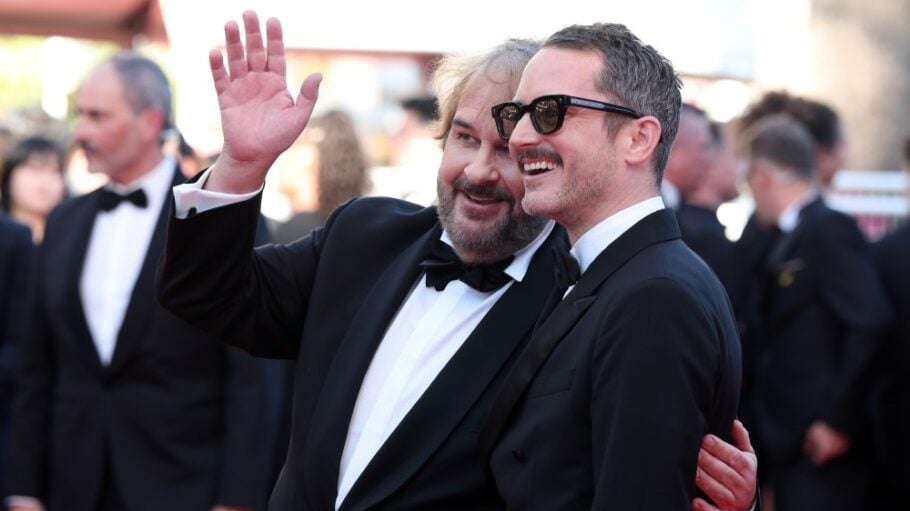
The 79th edition of the Cannes Film Festival, which launched on Tuesday night, is missing big studio movies and Hollywood stars. But at least it had a visitor from Middle Earth. Peter Jackson, the director of the “Lord of the Rings,” touched down in the South of France to accept an honorary Palme d’Or ahead of the opening night movie, “The Electric Kiss,” a French romantic comedy set in the 1920s.
On a sunny and windy afternoon, he walked the red carpet alongside a smattering of celebrities that made their way to Cannes (from Diego Luna to “Emily in Paris” star Lucas Bravo to Tyrese Gibson) and a jury that includes Demi Moore, Chloé Zhao, Ruth Negga, Stellan Skarsgård, and Park Chan-wook, the latter of whom serves as its president. Without as many A-list arrivals, the flashing cameras from the wall of photographers stationed outside the theater remained dark for long stretches of the muted opening ceremony.
What it lacked in star power, the first night in Cannes made up for in controversial appearances. James Franco, whose career was derailed by allegations of sexually inappropriate behavior, was mobbed by fans in the lobby of the Palais in the break between the ceremony and opening night screening. He took selfies before ducking into the outdoor smoking patio where Luna grabbed his arm. “How are you, man?” Luna asked as Franco, in sunglasses, nodded at him.
Jane Fonda brought some much-needed movie glamour in a shimmering black dress and bejeweled necklace that looked like the Heart of the Ocean from “Titanic.” Jackson, flanked by “Lord of the Rings” star Elijah Wood, flashed a thumbs up to the paparazzi. There was light applause inside the Palais as the cast of “The Electric Kiss” ascended the theater steps.
Wood was on hand to present Jackson with his prize, recounting the impact that the director’s massively successful J.R.R. Tolkien adaptations, shot in his native New Zealand, had on cinema. “You showed the world something it had never seen before, and nothing was ever the same,” Wood, who played Frodo Baggins told his director, adding, “He helped build an entirely new filmmaking culture at the far edge of the world.”
A buoyant Jackson accepted the honor while remembering the bold decision to shoot most of the “Lord of Rings” trilogy simultaneously. “It was a huge gamble,” he admitted.
The media dubbed the project a “folly” and predicted the expensive bet might not pay off if the first movie fell flat. That narrative, Jackson noted, was upended after a rapturously received screening of 20 minutes of footage from “The Fellowship of the Ring,” at Cannes in 2001. “It changed the perception of the film,” he said.
Love Film & TV?
Get your daily dose of everything happening in music, film and TV in Australia and abroad.

This year marks festival director Thierry Fremaux’s 25th edition at the helm, a tenure during which Cannes has weathered streaming wars, a pandemic and political upheaval while fiercely defending its status as cinema’s ultimate global stage.
But the chatter around the Croisette feel unusually charged this year — for good reasons. Hollywood is in flux, studios are pulling back from splurging at festivals, A.I. looms over creative jobs, wars are raging in different corners of the world, and fears over hantavirus are mounting. Perhaps economic uncertainty played a part, but this year’s lineup lacks major blockbusters, in marked contrast to previous editions of Cannes where Tom Cruise premiered sequels to “Mission: Impossible” and “Top Gun” and Harrison Ford unveiled “Indiana Jones and the Dial of Destiny.”
There had been hopes that Christopher Nolan or Steven Spielberg might bring “The Odyssey” or “Disclosure Day” to the festival, but they opted not to touch down on the Côte d’Azur. That’s left Cannes leaning on a lineup of international auteurs like Pedro Almodóvar (“Bitter Christmas”), Paweł Pawlikowski (“Fatherland”) and Cristian Mungiu (“Fjord”) to fill the void.
The ceremony’s host Eye Haïdara sounded a political note in her introductory remarks, welcoming “dear guests here with us; dear viewers; and dear internet users around the world — or rather, everywhere where the internet hasn’t been cut off; everywhere where artificial intelligence hasn’t replaced reality… all of you who are trying to resist, here and elsewhere.”
Fonda, on hand to declare Cannes officially open, picked up the mantle.
“I believe that cinema has always been an act of resistance, because we tell stories and stories are what make a civilization” she said. “Stories that bring empathy to the marginalized, stories that allow us to feel across difference. Stories that let us see that there is an alternative future that is possible.”
From Variety US