





























Watching a biopic, or reviewing one, I can’t say that I’ve ever spent much time wondering what the subject of the movie might think of it. Would James Brown have liked “Get On Up,” the superb 2014 drama about him? He would probably have found something in it to gripe about. Elton John lovingly endorsed “Rocketman,” the 2019 film about him that I thought was a laughably inauthentic piece of junk.
But as I watched “Tony,” Matt Johnson’s drama about the young Anthony Bourdain and the summer he spent in Provincetown working in a restaurant kitchen for the first time, I couldn’t help but wonder what Bourdain himself would have made of the movie. How could you not wonder? He was too opinionated, too no bullshit, too much of a movie fanatic, too much the kind of guy who would greet a film about him not by feeling flattered but by pissing all over it because it had missed the real story. To me, if an Anthony Bourdain biopic can’t clear the bar called “Bourdain would have liked it,” it’s probably not a good movie.
“Tony” clears that bar. It’s true to what happened to Bourdain in 1975, when he was a restless 19-year-old college student spending the summer in Provincetown. The movie is structured as a romance, and some of it is fictionalized, but it’s true to the person he was and was becoming: a charmer, a troublemaker, a middle-class Jersey refugee with some serious demons, an aspiring writer with an extraordinary gift of gab, a sweet kid, a hustler, and an asshole. “Tony” has been framed as the origin story of how Anthony Bourdain became Anthony Bourdain. But one of the many things that Matt Johnson, the director of “Blackberry” and “Nirvana The Band the Show the Movie,” understands is that Anthony — or, as he called himself then, Tony — already was Anthony Bourdain.
In the opening scene, he’s trying to impress a panel of English professors at Vassar College, pitching them the novel he wants to write, so that he can be chosen for a summer writing fellowship. He’s giving them a spiel, but it’s brilliant, and you feel the electricity of his talent — his subversive and funny desire to stir the pot. We can already hear his voice, which sounds like the voice of a flaked-out post-counterculture brainiac bohemian crossed with Howard Stern.
The movie is based on several early chapters from “Kitchen Confidential: Adventures in the Culinary Underbelly,” the extraordinary my-life-in-restaurants memoir, published in 2000, that made Bourdain an overnight celebrity. For some of us, his voice in that book was transcendent — the way he was so cathartically honest about the life he’d led, his pursuit of pleasure and appetite and escape (to the point that he became a functional heroin addict), and his unprecedented evocation of what it’s really like to work in a restaurant kitchen, which he depicted as a rough-and-tumble sweatshop of discipline and ball-busting and perfectionistic culinary fetishism. He made you want to be there, in the heat, on the line; he also made you think at times, There but for the grace of God…
Bourdain tapped into our collective obsessive belief in food as something holy, but he also showed you the truth of that world as if it were a movie: the funk and the flavor, the addiction and abuse, the cold-beer-at-midnight glory. Even before he became the preeminent television rock star of celebrity chefs, Bourdain captured the seductive rock ‘n’ roll of life in the kitchen; he was a hipster in chef’s whites who could see through everyone in the room. In “Tony,” he’s a lot more innocent, but the story is built around a terrifically layered irony. The movie is all about how Tony knows, in his bones, that he wants to be a writer, but discovers that he was meant to be a chef. And yet…he really was meant to be a writer. He falls in love with restaurant work, but what he’s falling for isn’t just the food — it’s the drama.
To me, one of the most pleasurable things in movies is that moment when you see an actor become a movie star. That’s what happens to Dominic Sessa in “Tony.” I don’t care if the film is a summer indie smash or not (though it deserves to be) — it shows you that Sessa has the goods, in the way his breakout performance in the likable but overly soft faux-’70s movie “The Holdovers” did not. What a movie star needs (among other qualities) is anger, and Sessa plays Tony as an eager, voluble, simmering bad boy who is playing out his inner turmoil in the real world. His Tony, tall under a curly ’70s moptop and sideburns, has the look of a hungry dog. At his family’s home, when he’s waiting to hear whether he’s been chosen for the writing fellowship, we see the dynamic that has made him the outspoken yet emotionally bottled-up soul he is. His mother, Gladys (Dagmara Domińczyk), is brilliant and exacting, but she’s also the chief critic of everyone around her. She has given Tony his voice of judgment, which he turns on the world but also, compulsively, on himself.
Love Film & TV?
Get your daily dose of everything happening in music, film and TV in Australia and abroad.

Sessa gives Tony the charisma of anger, and he also shows us the youthful confusion that sent him spiraling to Provincetown. Back at Vassar, at a bar, he hits on Nancy, played by Emilia Jones with a toughness as radiant as it is savvy. He’s already half in love with her, and his mixture of awkwardness and aggression has an effect on the audience, as it does on her. In a way it’s cringe, yet you can’t take your eyes off him. Tony is a mess, but he’s sly, with the magnetism of someone who can talk his way past shame.
When he doesn’t get the fellowship, it leaves him in a rage of discontent. He’s an entitled son-of-a-bitch, but his egomania is part of what’s going to take him far. That, and his ability to make stuff up. He’s a compulsive liar, and he decides, on a WTF whim, to head to Provincetown, where Nancy is spending the summer, and to basically spend his time there stalking her. He tells everyone there that he’s got the writing fellowship, which for Tony is a class-snob thing; it makes him feel worthy. But he has no fellowship, and no money. The first night, seated at a bar, he spends the last of his cash on a tray of raw oysters and half a dozen beers (he tries to woo the bartender by explaining how eating an oyster as a kid in France changed his life — a formative Bourdain anecdote), and he makes a drunken spectacle of himself. He gets thrown out on his ass by the owner.
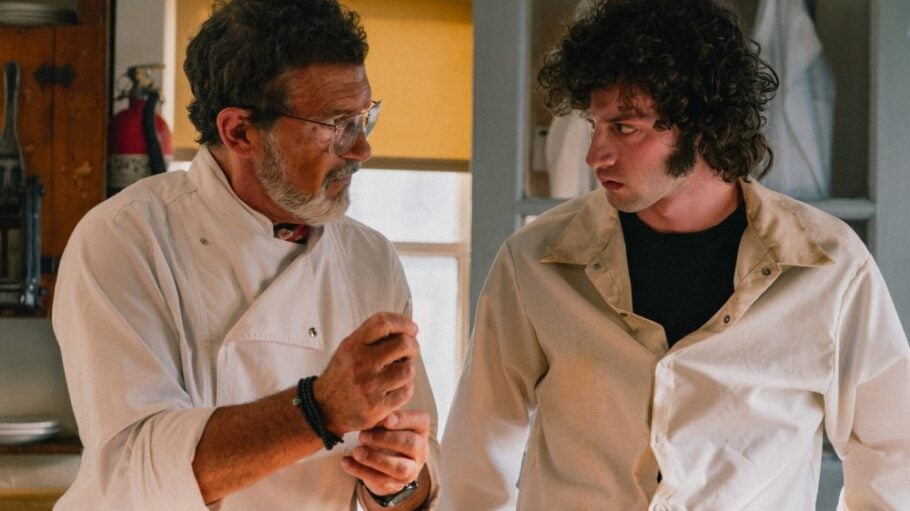
But the next day he swings by to apologize, and the owner, who is known only as Chef (Antonio Banderas), takes pity on him and gives him a job washing dishes, as well as a place to crash (the hammock on his back porch, where he awakens Tony each morning by dousing him in a bucket of seawater). Provincetown was a less chic place then than it is now, and Tony doesn’t see working in the cramped, messy kitchen of a bare-bones seafood restaurant called the Flagship — they have four things on the menu, notably lobster rolls — as a ticket to anything. He thinks what he’s doing is lowly. The film introduces us to the screw-loose types who work there, although they’re never portrayed as cartoons: the blitzed slob Stavros (Stavros Halkias) and Sal (Leo Woodall), a ladies’ man so aggro he’s a complete sociopath (he carves a shard of wood out of the wall as a trophy each time he scores, which is often — it’s the hook-up ’70s). The movie follows them to late-night house parties, but the real action is in the kitchen, where they fight their hangovers with morning lines of coke, and where Johnson stages the combustible goings-on with an existential, at times violent spontaneity that takes these scenes to a level of unwashed kitchen-sink reality that I’ve never felt “The Bear” quite got to.
The beauty of “Tony” is that it doesn’t make anything feel predetermined. It’s the story of an old-school American summer — those months when a college kid like Tony, doing a job because he needs a job, has the drifting freedom to fall into random experiences, because that’s the enchantment of being in a Cape Cod beach town in 1975. Tony ambles around, gets into fights, does hard drugs, fruitlessly pursues Nancy (who has a boyfriend in the pizza shop she works at), sinks into the scuzzpit of washing dishes, then graduates to food prep, all under the tutelage of Chef, the foodie task-master.
Through it all, Tony doesn’t realize that this is his real school; that’s the way the summer that changes your life works. “Tony” has an enchanted spirit of discovery that reminded me of “Adventureland,” Greg Mottola’s winsome gem about working at an amusement park in the summer of ’87. Like that film, it’s a nostalgic dream that’s alive to the moment. More than that, though, “Tony” has the organic flow and humanity, and the craft so light it’s invisible, of a Richard Linklater film. It might be the best Linklater movie Linklater never made.
It’s Chef who presides over the controlled chaos, and Antonio Banderas invests him with a delectable blend of gentleness and cutthroat authority, as well as an undercurrent of mystery. Who is this man who shucks oysters as if preparing the Eucharist? Banderas gives a fantastic performance, showing us how Chef becomes Tony’s mentor by being everything he’s not: calm, contained, devoted to the task at hand, attuned to something higher. As Tony learns on one privileged day in the otherwise empty restaurant, the man even makes his own ketchup! Yet Tony awakens something in Chef too — an ambition he left behind. The movie shows you that there’s a Zen to the kitchen, and that all of life can grow out of that. As Tony’s troubled soul comes to the fore, acted out in ways both big and small, what’s revealed is that though he wants to be a writer, he believes in nothing. “Tony” is about how he finds himself by crawling out of himself. The kitchen wounds him, heals him, and becomes his crucible of faith.
From Variety US