





























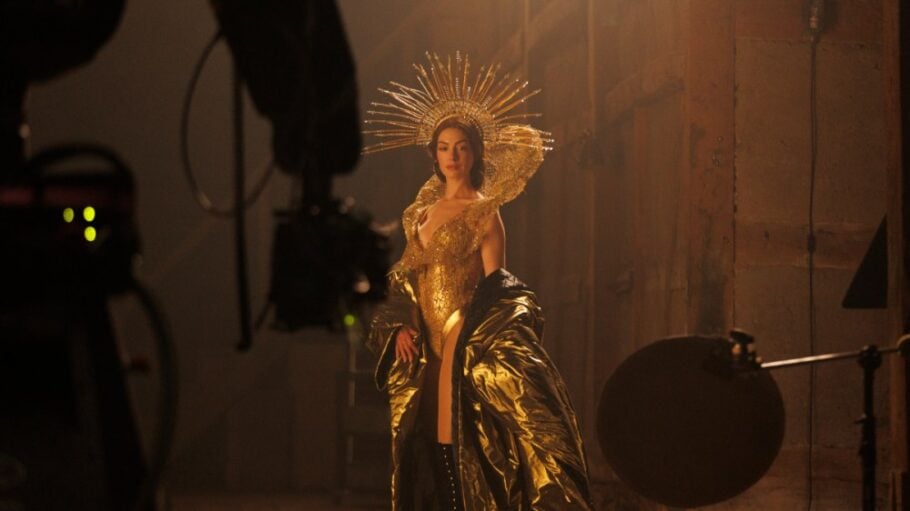
In “Mother Mary,” the title character (Anne Hathaway), a global pop superstar who you could say is based on a lot of people but is most directly and obviously a riff on Lady Gaga (maximalist dance pop; extravagant postmodern wardrobe; air of transgressive Catholic rapture), has a close encounter with Sam Anselm (Michaela Coel), the British fashion designer who created Mary’s visionary costumes. She was her hand-in-distressed-glove collaborator — and the two were closer than that. But they’re estranged now, and haven’t seen each other for 10 years. So cataclysmic was their breakup that in all that time, Sam has never once listened to Mother Mary’s music.
But now, out of the blue, Mary shows up at the English country manor that’s the headquarters of Sam’s fashion empire. She’s there because, in her words, “I need a dress.” A visionary dress. A dress for the big summing-up-of-her-career concert that she’s about to give. The two go into the large stone barn out back where Sam does her designing, and there, by themselves, they talk: about their partnership and their past, about their wounding breakup, about the complicated brew of love and bitterness that still holds their dual spirits together.
The talk stretches on for a while, and since the two actors are vivid and on point, we’re fine with settling into one of those movies that’s essentially a two-hander — in this case, broken up by flashbacks to Mother Mary onstage, where she performs before her adoring throng. I’ve always been partial to movies about conversation, because I think it’s one of the most pleasurable activities there is, and the fact that “Mother Mary” strikes such a familiar chord — Mary and Sam unpeeling their history like an onion, circling around it until they reach its inner core — is not, in my book, a strike against the movie.
That will come later.
At no point do Mary and Sam say they were lovers. The film’s press material coyly describes them as “friends.” And maybe they were just friends — friends intimate enough to be spiritual lovers. In a sense, it doesn’t really matter. “Mother Mary” is not a roman à clef. The character of Mother Mary may be a fictional gloss on Lady Gaga, but it’s not as if she’s supposed to be Gaga. And at this point, there wouldn’t be anything revolutionary in portraying a famous pop star with a private life that’s bisexual. That’s not the point of the movie.
What is the point? For a while, we think “Mother Mary” is going to be a talky, angsty, back-and-forth relationship drama, mixed in with heady footnotes on fame and creativity. Mary, named for a Beatles lyric, has composed a new song, which she says “might be the best song ever written in the history of songs.” It’s called “Spooky Action,” which is a reference to Einstein’s principle of “spooky action at a distance” — the idea that separated particles, even when they’re light-years apart, can have an effect upon each other. That’s a rather ponderous metaphor for what in another movie might come down to, “I still think about you.”
But never mind. Hathaway, in disheveled straight blonde hair parted down the middle to its thick dark roots, does a convincing job of showing us that Mary, while devoted to her art (and her fame — the two can’t be separated), is a mere mortal who wears her onstage persona like a cosmic costume. Her trademark is to sport some version of her signature halo, a circular head piece attached to the neck, and this connects to the religious nature of her stardom — that she’s no mere celebrity, and not just an artist either, but a kind of pop demigod channeling our collective fantasies of saintliness and sin.
Love Film & TV?
Get your daily dose of everything happening in music, film and TV in Australia and abroad.

The film shows us that Sam, the offstage muse, is an awesome creator as well. Her visionary designs forged Mother Mary as an image (Mary once paraded down a red carpet wearing honey), so she shares in her identity. Coel, as she proves in the marvelous new Steven Soderbergh movie “The Christophers,” is a great debater — she knows how to use those penetrating large eyes, and her profile that’s like a Picasso come to life, to project an insinuating perception, the sense that she’s reading her antagonist like a psychic. In this case, Sam views Mary with ultimate wariness and knowledge, still smarting from the scars of abandonment and what they revealed.
But all of that — spoiler alert! — winds up being very much beside the point. David Lowery, the writer-director of “Mother Mary,” is a hard filmmaker to pin down, but he is, among other things, a reliably highfalutin trickster-showman who likes to tease the audience with a nearly avant-garde sense of play. I’ve liked some of his films, like “The Old Man & the Gun” and “The Green Knight,” even if the latter fused its intoxicating roots-of-King-Arthur mythology with too much head-scratching magical realism for my taste. In “Mother Mary,” the director gives in to that side of himself completely. This is the David Lowery-est David Lowery movie ever made. Which is to say that by the end of it, you may be scratching your head to the point of wanting your money back.
Mother Mary dances on the barn floorboards, and Sam says things like “You give people the gift of giving a shit about you.” But what the movie really comes down to is a séance. And the stabbing of flesh. And a ghost. Yes, a ghost. In the form of a floating piece of red material that looks like a blanket made of organza. Is this the ghost of their relationship? Or a real ghost? That’s a question that will be debated by moviegoers for maybe four seconds. Because “Mother Mary,” as it takes the leap into Gothic metaphysical fantasy, becomes almost completely incoherent, and stays that way. It’s like an exorcist movie where the devil is a piece of bolt fabric.
The movie does have a few additional in-concert scenes, but the songs, written and produced by Jack Antonoff and Charli xcx, just sound like a bland version of what they’re supposed to be. To my ears, the music conjured Taylor Swift trying to be Enya. If this were a sustained two-hander, it might have been the story of a beloved pop superstar and her genius designer, and how they forged a connection that was creative and spiritual and romantic. It might have been about how they broke up (because the pop star became too big and thought she could do it on her own), and about how that breakup was a betrayal (because it was based on the pop star’s narcissism). Instead, “Mother Mary” turns into the most befuddlingly pretentious movie about a pop star since Brady Corbet’s “Vox Lux.” It heads down a blind alley of cosmic meaning that, in the end, means nothing.
From Variety US