





























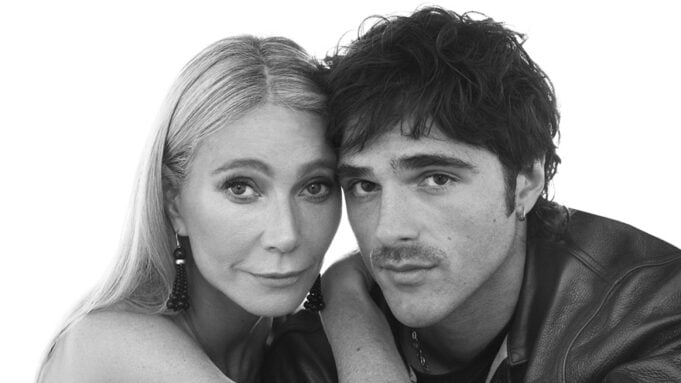
It doesn’t matter how high you climb the Hollywood ladder, there’s always room to grow. Ask Gwyneth Paltrow, the perpetual A-list star and fashion icon whose 1999 best actress win for “Shakespeare in Love” still reverberates in Oscar history. These days, Paltrow has been plenty busy as the CEO of the lifestyle brand Goop. But later this month, she ends her semi-retirement from acting to play a seasoned movie star in 1950s New York opposite Timothée Chalamet’s ping-pong phenom in “Marty Supreme,” directed by Josh Safdie.
Her anticipated return to screen comes as Jacob Elordi, on an astounding run as Hollywood’s new “it boy,” discovered his own footing as the creature in Guillermo del Toro’s “Frankenstein.” Elordi, 28, shares with Paltrow how he found the violence and the grace to play the classic movie monster, as she imparts stories from the cinema’s wild west (aka the ‘90s) and the advice she would have given herself at his age.

Gwyneth Paltrow: It’s so nice to be here talking to you. My children are very jealous. My son looks up to you; my daughter is in love with you. I probably will be too, by the end of this.
Jacob Elordi: Well, that’s the thing you always get. Every person says, “Oh, my mom loves you. My daughter loves you. My girlfriend loves you.” It’s never, “I love you.”
Paltrow: I love you, Jacob. My first entrée to you and your incredible talent was “Euphoria.” My kids cautioned me against watching it, but you are so good in that show.
Elordi: Thank you for saying. Was it alarming as a parent? It seems so extreme to me. I don’t how it’s relatable.
Love Film & TV?
Get your daily dose of everything happening in music, film and TV in Australia and abroad.

Paltrow: I wasn’t alarmed. My kids weren’t going down those paths. Some things they felt were right — the relational and social media aspects.
Elordi: I finished filming a new season just recently, and it’s a completely different thing.
Paltrow: Is your character nicer?
Elordi: I really do think so. Whether it works or not, I don’t know. There’s a chance that what I’ve done is not good. So “Marty Supreme” is a very good movie. Were you familiar with “Uncut Gems”?
Paltrow: I had not been involved in the world of cinema for a while, and I wasn’t up on who the great new people are. I watched “Uncut Gems” and thought it was so bold. Josh Safdie has such a specific style. I met with him and he’s just awesome at creating worlds in his head.
Elordi: Have you always approached movies that way, filmmaker first? Your list! I mean: Paul Thomas Anderson, Alfonso Cuaron, Steven Spielberg, David Fincher.
Paltrow: Wes Anderson, Anthony Minghella.
Elordi: Was that conscious? I don’t really know what your relationship is to movies. You grew up around them. How do you end up in a spot where you’ve worked with every single person in the recent history of cinema who has had something to say.
Paltrow: I got really lucky. Paul Thomas Anderson had never made a movie [before “Hard Eight”]. There were a lot of firsts and directors I got in their early careers. Wes, for example, I was almost in “Rushmore,” but it didn’t work out. I was very excited to be in “The Royal Tennenbaums” with that amazing cast.
Elordi: That character is stamped forever.
Paltrow: She defined a certain genre of cool girl — disaffected, smoking in the bathtub, writing a play. It’s amazing. But I also made a bunch of weird choices, too, and some not-so-good movies. What about you?
Elordi: I first booked this movie “Swinging Safari,” about the ’70s in Australia. Then I booked this Netflix film called “The Kissing Booth” when I was around 18. I came to America and thought I was really about to do something, and I get to Los Angeles. And it was ….
Paltrow: It can be sobering.
Elordi: Yes. Two years after that I got “Euphoria.” It’s not a long time in the scheme of things but for me it was like nails on a chalkboard.
Paltrow: Who gave you the idea that a movie career in Hollywood was possible?
Elordi: I was quite loud as a kid, which is every actors’ thing. They didn’t know what to do with me. There was a teacher at school, Mrs. McMahon, who decided to cast me as the cat in “The Cat in the Hat” musical.
Paltrow: You nailed it.

Elordi: As soon as I was singing and dancing with the big hat on, I knew that that was what I wanted to do. I also saw Heath Ledger in “The Dark Knight” when I was about 12. I realized he was from Australia and then the cog started turning that this could be a viable thing for me to do.
Paltrow: You are so fantastic in “Frankenstein.” I was so impressed by your physicality — it was almost like watching a ballet dancer, how you emerged into this creature. This dynamic between incredible tenderness and violence. I was really impressed.
Elordi: Thank you. My sister is a ballet dancer, so I’ve grown up around that kind of movement. It was a reference point for how to use my body. I’d dreamed of working with Guillermo del Toro since I saw “Pan’s Labyrinth” as a kid. Later, I was shooting this movie “Priscilla,” where I play Elvis Presley, so I had a kind of unnatural pluck and confidence. The hair and makeup team told me they were going to do “Frankenstein” next, and I remember I said, “I’m supposed to be in that movie.”
They asked if I was serious, because they already had a different actor. I laughed it off as a joke, and then a year later the actor dropped out. The hair person went to Guillermo and said, “I don’t know if you know who this is, but maybe you should think about it.”
Paltrow: What’s so interesting about being an artist is that you feel lucky enough to make a living at your art, your passion, but it can become work.
Elordi: It does start to become a job. I used to be one of those people who thought, “The worst day on a movie set is still better than the best day in the real world.” And that’s bullshit. That’s a fucking lie. But it was nice to have [a project like “Frankenstein”] to ignite that feeling again. You took a seven-year break, was that a feeling of “I have to get away from this?”
Paltrow: I felt a lot of loneliness when I was doing it in my 20s. I didn’t know myself well yet, and I was traveling all the time. I needed to grow up and understand who I really was, and I got a lot of those answers through my family. Then I started a business. “Marty Supreme” came about in an incredible way because our boys were going off [to college] and I was left with this feeling of shock and disbelief. Like, “Who am I?” Then I met Josh Safdie and I knew this would be worthwhile. This felt like the movies we used to make in the ‘90s.
Elordi: You have this moment in the film when you step out on to a stage and are facing away from the audience, then the light comes up and you say your first line and the audience erupts. I just started weeping. The look on your face was so sincere and sad at the same time. This whole person’s life was in the cheer of that audience. Was there an old movie star transatlantic accent on your character?
Paltrow: I was watching Hitchcock movies from the ‘50s and people really did speak with that transatlantic thing. I brought that in a little bit. So, the internet is abuzz about “Wuthering Heights.”
Elordi: They should be. Although, someone will pull their phone up and I’m like, “Get that away from me.” When was the last time you were on stage? [What led me to director Emerald Fennell] was “Saltburn.” What’s interesting is when I read “Saltburn,” my thought on it was, “I have to be Jude Law in this movie because of ‘Ripley’.” But then I realized these aren’t similar at all. I shouldn’t use that as a reference. When was the last time you were on stage?

Paltrow: Too long ago. It was when I did “Proof” in London in 2002.
Elordi: Do you think you’ll ever make it back?
Paltrow: I would love to. I promised my mother [Blythe Danner] I would do a play at some point.
Elordi: I would love to watch you on stage, especially after that moment in “Marty Supreme.”
Paltrow: Hopefully my reviews wouldn’t be as bad as my character.
Elordi: It’s so crippling, when the camera cuts to you crying over that review.
Paltrow: The writers actually scripted out the entire review, and it’s so brutal. Yeah, that would make me sob.
Elordi: Timothée is incredible in “Marty Supreme.” He’s brilliant. He’s genuinely unbelievable. And there’s the final frame of him is one of the more devastating things. You’ve worked with some of the greatest male movie stars in the history of cinema. How has that experience working with someone that is sort of the age of these guys that you worked with in the ‘90s?
Paltrow: It was great. I wasn’t so familiar with his work either, so I did a little bit of a deep dive. He absolutely blew me away. The bravery around playing somebody with no moral center. Most times when an actor plays someone unlikeable, you can see them couching [it] — but he just drives through it. He’s just a dick.
Elordi: He makes me feel good about the state of things. If people keep putting care into movies in each generation, you can keep them alive. My great fear is that movies lose their currency, and we don’t have that form of storytelling anymore.
Paltrow: It’s changed quite a bit, and the business models have changed and the way it’s all commercialized. Does that feel specifically different [to you]?
Elodri: It feels very different. I feel like we grew up looking at your generation of actors and devoured all of your movies and that was the dream. Those were the movies we wanted to make. Then, I feel like we all kind of finally got an audition, booked the thing and stepped out into Hollywood and it’s like …
Paltrow: Where did they all go? But I feel something like [“Marty Supreme”] happens in the face of hyper-commercialization, that you start to have real artists coming and punching through.
Elordi: I agree with you. That makes me glad. I have one more question. You won an Academy Award for “Shakespeare in Love.” Did it change anything in terms of how you view movies, or the way that you do the work? It does mean a great deal. Even in a business sense as an actor, something changes in people’s perception of you and your work. I imagine there’s pressure.
Paltrow: It felt like something immense had happened. There was this massive energetic shift, and it was very overwhelming. I was only 26. If I could go back and talk to myself at that age, I would just say, “Take your time.” Just really get in touch with who you are to the greatest extent possible, and make decisions from that place. Slow down and work with great people, and don’t beat yourself up so much along the way.
Elordi: It can feel like saying “yes” or “no” to a movie is saying “yes” or “no” to being alive. Do I want to live or do I want to die? That’s what the stakes can feel like sometimes. Then it’s just so clearly not the case. If you step outside of Los Angeles or New York for 20 minutes, you realize it’s such a concentrated …
Paltrow: Bubble.
From Variety US