





























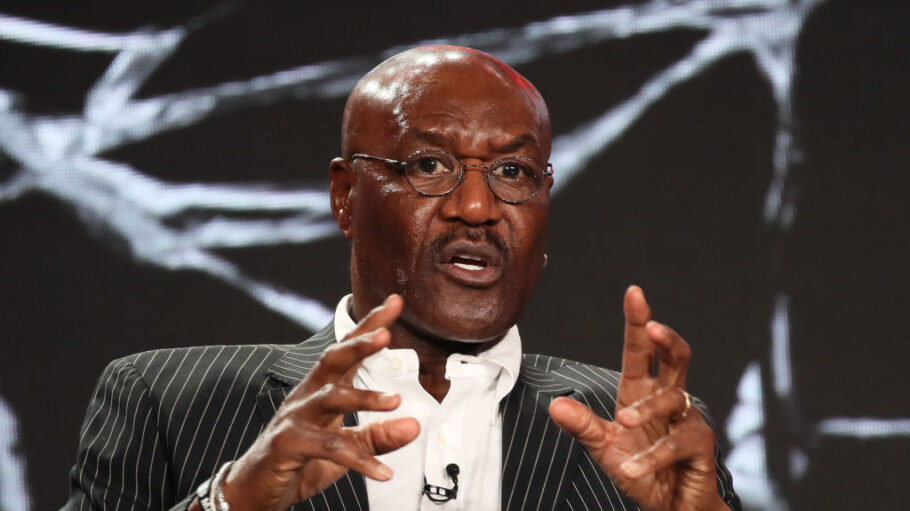
Delroy Lindo doesn’t like ice in his tonic water.
We’re at the London hotel in West Hollywood, settling in to discuss his long-awaited moment of Oscar recognition for his turn in Ryan Coogler’s “Sinners.” Barely a minute into the conversation, he asks how I predict the winners (he knows it’s part of my job): “Is it your personal opinion, or is it the way you think the wind is blowing?”
I reference Rule No. 2 of my 10 rules of Oscar predicting: It’s not about what you want to win. It’s about what will win. The waitress brings me a bottle of still water and sets down his tonic. “Is that the tonic one?” he asks.
“Yes,” she responds.
“Can you please pour the ice out? Actually, give me a spoon.”
“I’ll grab you a fresh one,” she offers.
“No, nothing’s wrong with it. I’ll use the spoon.”
Love Film & TV?
Get your daily dose of everything happening in music, film and TV in Australia and abroad.

She walks away, and Lindo, 73, begins fishing for ice.
As he struggles to capture the cubes — he tries pressing them against the glass for traction, but they slip away — I start rattling off my favorite Oscar rhythms, the patterns that lead to snubs and surprises. The conversation veers into genre bias, how horror films and musicals enter awards season already disadvantaged.
After about two minutes, Lindo’s publicist, sitting nearby, intervenes, offering to fish out the ice for him because it’s “driving [him] crazy.”
We all laugh — a moment, my wife later jokes, that “is documented proof that men can’t do anything.” Perhaps Lindo’s wife of 35 years, Nashormeh Lindo, would agree.
Eventually, we land on “Sinners,” Coogler’s vampire film that shattered expectations by earning 16 Academy Award nominations — the most ever fora single movie — and is tied with 2021’s “Judas and the Black Messiah,” another Coogler-produced project, for the most individual Black nominees. In the film, Lindo plays Delta Slim, a blues musician haunted by ghosts both literal and metaphorical.
“Those paradigms are inherently fallible,” Lindo says, referring to awards projections and acknowledging the unpredictability of it all.
He’s right. Six years ago, Spike Lee’s “Da 5 Bloods” seemed like Lindo’s moment. Critics hailed his performance as Paul, a traumatized Vietnam veteran unraveling in the jungle. Awards poured in from critics’ groups — he received the second most of any actor that year. And then nothing: No SAG. No Golden Globe. No Oscar.
But on a Thursday morning this past January, the door opened again — this time via a phone call from his 24-year-old son, Damiri, who had risen early to watch the televised Oscar nomination announcements while Lindo chose to skip them. For Lindo, the nomination went beyond industry validation; it was personal, familial and complete.
Lindo’s journey spans five decades, three countries and countless performances that should have led here sooner. Born in London to Jamaican parents, raised in Toronto and forged in American theater, Lindo has been one of cinema’s most reliable presences: the FBI agent leading a kidnapping case in Ron Howard’s “Ransom,” the moral center of Spike Lee’s “Malcolm X,” the wounded vet of “Da 5 Bloods.” Yet this is his first Oscar nomination.
While filming “Ransom” in 1996, Howard told him, after watching his work in Lee’s “Clockers,” “Make sure the studio sends the tapes out. You’ll get nominated. ”But it took nearly 30 years for that prediction to come true.“
The work still stands,” Lindo says when asked if this nomination changes how he views past omissions. “The fact that the work was not recognized by the guilds does not in any way undervalue the work itself. They exist in very separate spheres.”
There’s pragmatism in his reflection. “I’m so glad I didn’t read some of these trade papers that had [predictions] lists where I wasn’t included,” he says. “That would have depressed the hell out of me. Because all these actors have really done worthwhile work, but if you don’t make the first cut, you’re just buried.”
Now he’s embracing the moment as a first step, not a culmination.
Fifty years in, Delroy Lindo is just getting started.
This interview has been edited and condensed for clarity.

Tell me about Delta Slim. What did you immediately understand about him when you read the script for the first time?
It was less about him when I first read the script and more about the narrative as a whole — what I perceived Ryan was going for as a storyteller and how Delta Slim fit into that overall narrative. I thought of “Sinners” as a very contemporary film, even though it’s set in 1932. All these contemporary themes are present in the film.
The movie grapples with systems of exploitation and shows cultural resilience as an act of defiance. I remember saying to Ryan, “I think I know what you’re getting at here.” And he said, “Yeah, you got it.” And I said, “Well, man, given that that’s true, can we talk about Delta for a second? You give him such a dynamic introduction, and then he falls away in the second act.” And he said, “We’ll work on that.” And we did.
Delta drinks a lot — he’s clearly self-medicating. What is he medicating against?
There was a scene — which didn’t make it into the final cut — where I talk about women. One of the things I gleaned from reading the first two books Ryan sent me — “Blues People” by Amiri Baraka and “Deep Blues” by Robert Palmer — is that, in the lives of blues musicians, women were ever-present. I’m not going to reinvent history, but what’s very clear is that women were constant. So, I want to believe that whatever my relationship with women is, that’s also part of my pain.
Was that something you were actively thinking about as you built the character?
It lived in the back of my mind. It may have been operating unconsciously, because one of the things various colleagues of yours have said to me — which is really affirming — is some version of, “When I’m first introduced to Delta Slim, I see a man who has lived life. I see a life that’s been lived.” And in my interpretation of Delta Slim, women were central to that.
Ryan Coogler is 39 years old and has already had an extraordinary run. What is it like working with him on set?
What’s beautiful about it is that he’s like an open vessel. The communicative lines can flow back and forth because this one’s open and that one’s open. And those exchanges are centered on something of real substance — whether it be “Fruitvale Station,” “Black Panther” or “Creed.”
And I hope I don’t get in trouble for saying this, but have you ever seen Sylvester Stallone be any better? Wonderful, understated, nuanced, painful, tragic — all of it. [Ryan] creates these environments, seemingly effortlessly, where people can flourish and do their best work.
Concerning “Sinners,” it’s like being in receipt of a gift. Oftentimes it’s hard to talk about acting without sounding precious or pretentious, because it is a job, but it’s a job of work. There’s work and then there’s work. And this work is special.
I knew it was when I read it. Looking back on the experience, the reason it’s difficult to answer is that when I’m working, I’m fully in the process, with virtually no room to take a half-step back. But there are moments when things feel right. There’s a scene in “The Cider House Rules” where it’s raining, and I’m calling to Tobey Maguire’s character, Homer. Something about the groundedness and rightness of that moment let me know something was happening.
On “Sinners,” sitting around with my castmates, there were moments when we were talking among ourselves that felt special. And the scene right before Mike [B. Jordan] put the stake through [the lead vampire] Remmick; when Ryan was setting it up, he played a piece of music on a loop that really set the tone. I never stepped outside and said, “This is special,” but I was experiencing the specialness.
The night you wrapped filming — can you describe that?
On my last day of filming, as I was about to leave the set, Ryan and some of the actors spoke about what my work had meant to them and what the process of working together had meant to them. I said a few words through my blubbering tears because I was so moved. That was special, and it felt special in the moment — a deep, deep-seated feeling of appreciation.
This movie produced the most individual Black nominees from any film in history, tied with “Judas and the Black Messiah.” What does that mean to you?
It’s profoundly meaningful. When people ask, “How does it feel?” There’s gratitude, of course, that I’m still working at all, but also the gratitude that I get to work on the kind of material I’m working on. Being in receipt of a gift like “Sinners,” that’s special.
You trained at the American Conservatory Theater and came up through the ranks of Shakespeare and August Wilson. How did theater teach you discipline in a way films never could?
Being challenged by the work I did in theater — Lorraine Hansberry, August Wilson, Shakespeare — helped me develop a very particular work ethic. Not just mentally, but physically: vocal exercises, physical exercises that I adapted for film and still use today. I got that from starting my career in the theater.
Do you think people really know you? The real you.
I don’t think people know me, mainly because I don’t live in Los Angeles — I live in Oakland. Because I’m not here, people may form opinions based on work they’ve seen or on what someone else says. That can be a handicap, because the industry is very small: “Everybody talks to everybody,” quote unquote.
If something uncomplimentary is said and you’re not in the room, it can spread quickly. And if people haven’t seen you in three dimensions, you’re not there to dispel it. One thing my colleagues on “Sinners” keep reminding me of is that it’s valuable for audiences to see you as you are, separate from a character. Just sitting, talking, shooting the shit, chopping it up, maybe even being funny. Humor isn’t necessarily something people associate with me, so showing that side can be unexpected.
And to answer your question directly, no — I don’t think people know me.
You were born in London to Jamaican parents, then lived in Canada and the U.S. How has that layered identity shaped the stories you’re drawn to?
I want to believe that having lived in those various countries has given me a broader perspective on life — when I’m smart enough to draw on it — and that I can infuse that perspective into my work.
You’ve long talked about your directorial debut and your desire to bring production jobs to Jamaica. Why is that mission so personal to you?
What we’re missing are authentic depictions of Jamaica. The last thing I saw that was purportedly Jamaican had few, if any, Jamaican actors.
Let me be clear: that took away from its authenticity for me. Is it required that Jamaicans be in every Jamaican story? Not if actors are convincing and authenticity isn’t compromised. But I haven’t seen enough work that reflects elements of Jamaica that resonate with me — particularly the spirituality, resilience and brilliance of its people. Too often it’s reduced to the sea, the sun and the sand. But I’m talking about culture, the soul.

DAVID LEE/NETFLIX
Do you credit Ryan Coogler for this moment in your career?
Spike Lee and Ryan Coogler both are. Had “Da 5 Bloods” not happened, I wouldn’t be on this trajectory. Ryan has spoken about seeing me in “Malcolm X,” when I became part of his consciousness as an actor. And if you look at the past five years — “Da 5 Bloods,” “The Harder They Fall,” “Unprisoned” and “Sinners” — that trajectory speaks for itself. I must include Spike in that.
Even though you’re 50 years into your career, this moment feels like a beginning, not a culmination. What do you think about that?
I absolutely concur. And I’m claiming — and I hope this doesn’t come back to bite me — yes, please God, I’m claiming that this is the beginning of whatever the next phase will be.
What do you still want to learn as an artist?
I want to continue learning how to remain open — open to work that reflects the human condition in some way, shape or form.
If an actor sees your journey and wonders if it’s ever too late to make it in this business, what would you tell them?
Never too late, period. Never too late. You must be prepared to put the work in, but it’s never too late.
When the dust settles on this Oscar season, how do you want this chapter of your life to be remembered?
As an outpouring of joy from people who are genuinely happy for me in this moment of my life and career.
Is there anything else that you want to say that I didn’t ask? And I always say, if you didn’t mention your wife enough, you can say it one more time, just so we get how much she means to you.
Let me pause; I got to pee. [Laughs] Hold that question. I’m coming back with a good answer. Hold it!
I’m holding. [Lindo leaves the room and then returns five minutes later.]
OK, can you please repeat the question?
Do you want to say anything else about your wife?
When I think about this moment, especially receiving an Oscar nomination, my partner is fundamental to having arrived here. Being with someone for as long as we’ve been together means experiencing all the ups and downs right alongside me. To a slightly lesser extent, I include my son as well. Family sees everything from the inside out, and they’re every bit part of this journey, along with the scores of people who’ve wished me well. My wife told me she knew it was going to happen. She said, “I didn’t want to say anything,” but she knew. She’s right all the time.
Actors have to find ways to ride the storms, to ride the waves. It isn’t easy. What I do know is this: The work still stands. And right now, I’m choosing to embrace the joy of this moment and the people who are sharing it with me.