


























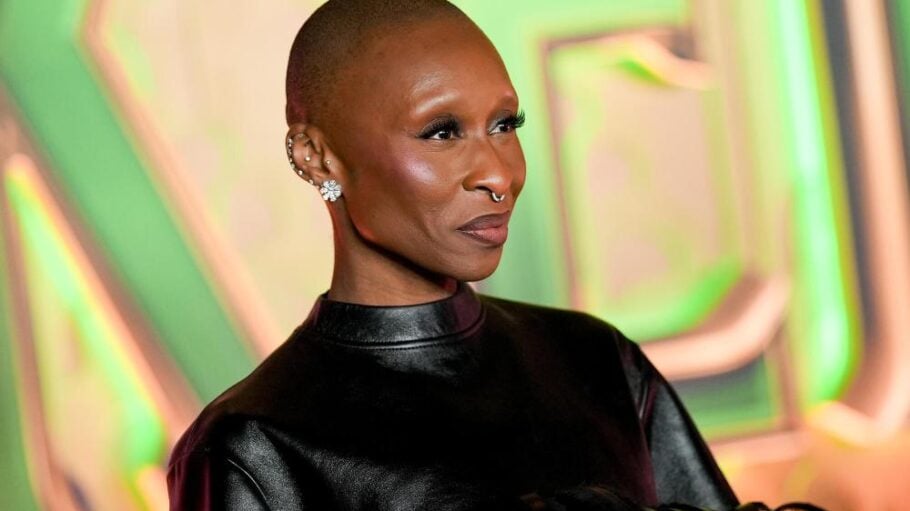
Thirty-six minutes after the American Film Institute announced its Top 10 films of the year, Cynthia Erivo sat down with Variety‘s Awards Circuit Podcast to discuss “Wicked: For Good,” the conclusion to Jon M. Chu’s ambitious two-part adaptation that has become more a box office phenomenon and a cultural movement.
“I feel relieved that we can finally share it all and talk about it openly,” Erivo says, reflecting on the journey that began years ago and culminated in what she calls “one of the hardest things I’ve ever had to shoot.” The actress, who earned Oscar and Grammy nominations in the same year she became the magical Elphaba speaks with the authority of someone who has lived inside this character’s green skin for years, understanding her pain, power and ultimate sacrifice.
The film’s most devastating moment, “No Good Deed,” required Erivo to perform while suspended diagonally in wires, her feet in the air, her head coming toward the Grimmerie. “The reason I love this song is I think it’s her greatest moment of vulnerability,” she explains. “I think it’s her surrender. I think it is the explosion of grief and pain and hurt.”
The sequence took multiple days to shoot, with Erivo pulling against opposing forces — wires holding her up, wind machines blowing at her face — all while delivering the emotional devastation of a character who has lost everything.
When asked about the widely debated ending — does Glinda know Elphaba survived? — Erivo is definitive. “I don’t think she knows. I don’t think she knows at all. In fact, I would put my money on it that Glinda does not know that Elphaba is alive.”
She interprets the Grimmerie opening for Glinda as a sign of worthiness rather than revelation, a magical inheritance that Elphaba explicitly prepared her for.
The personal parallels between Erivo and her character run deep. When discussing how others perceive her versus reality, she draws from her own experiences: “I’ve had my ‘No Good Deed’ moments, and I have learned that you cannot please everyone. Everyone is not going to understand who you are, and everyone won’t get that, and some people won’t want to understand who you are. And that’s okay.”
Love Film & TV?
Get your daily dose of everything happening in music, film and TV in Australia and abroad.

But perhaps her most surprising revelation comes when discussing her Tony Awards hosting gig, a performance that showcased her versatility and meticulous creative vision. “I knew I wanted to do it a couple of years ago, and it wasn’t the right time,” she reveals. Erivo fought for complete creative control, handpicking her writers, choreographers, and musical collaborators. She demanded a beginning, middle, and end — something she believes award shows had lacked.
“I was like, we keep ending on someone wandering off stage and actually it doesn’t end, and that’s a weak ending.” Her vision included recording all the voiceovers herself, ensuring her presence was felt even when off-stage, creating what she describes as a “Pippin”-style ringmaster experience.
The physical toll of bringing Elphaba to life cannot be overstated. From 14-hour days in harnesses to shooting in relentless movie rain for “Bad Times at the El Royale” (an underrated incredible performance of hers), Erivo refuses the warming padding that might make her comfortable, preferring authentic discomfort to restricted movement. “I’m a glutton for punishment,” she admits with a laugh.
Looking ahead, Erivo has an ambitious slate including David Oyelowo’s “Othello” adaptation, the samurai thriller “Karoshi” (where she learned Japanese and kendo), and voicework for “Bad Fairies.”
But it’s an “Aida” film adaptation she wants to see make it to the big screen, though she acknowledges, “You would have to literally recreate Egypt, which is a lot.”
As she prepares to return to London’s West End for “Dracula,” and potentially make Oscar history as the most-nominated Black woman in the best actress category, Erivo remains grounded with gratitude. “I’m grateful to have been the vessel through which this character could be brought to life,” she says. “She’s definitely going to have a big chunk of my heart.”
Also on this episode, writer-director Craig Brewer discusses crafting a true American love story with Hugh Jackman and Kate Hudson in “Song Sung Blue,” while paying homage to his late mentor John Singleton. And the Roundtable dissects the news that the Oscars will move to YouTube in 2029, and pays tribute to the late Rob Reiner. Listen below!
Read excerpts from her interview below, which has been edited and condensed for clarity.

Giles Keyte/Universal Pictures
Does Glinda know Elphaba is alive at the end of the film?
I don’t think she knows. I don’t think she knows at all. In fact, I would put my money on it that Glinda does not know that Elphaba is alive. I think that she needs her to believe that she’s not alive. Even with the book opening, I think the book opening for her at the end is more a sign that she’s worthy of the magic that that book has, which is what Elphaba told her: you have it, you have to learn how to use it now. You have to be the good that changes things. It has to mean something, and you have to figure out how to work with this piece of magic. You haven’t had magic until now. Now you have the opportunity to find a way to use it, to find a way to have it.
How would you describe Elphaba’s relationship with the Grimmerie?
Elphaba doesn’t need the book anymore. Elphaba is already in possession of her magic — it hasn’t gone anywhere. She’s in possession of magic that is already, as we know, unlimited. It’s a part of her. And so the book and her, I think, share a connection. I love that moment towards the end where she just sort of takes a moment with the book before she gives it to Glinda, which for me always felt like a silent goodbye. Most people would see this book as an inanimate object, but I don’t think that is what it is to Elphaba. I think that book is living. It listens, it hears, it feels, and they have a connection to it. And she has to say goodbye to this thing that lives, that feels and has a connection to her, to give it away. It’s that moment where she gives the book permission to choose when she’s ready. You work with her.
The picnic scene with Ariana Grande feels intimate and nostalgic. How was it filmed?
We filmed a lot of stuff during that day, some of which is in both the movies and some of which we didn’t use in the end. That was all filmed over that walk, that one day. We just went to Richmond Park and we shot over the day, just these friends. It wasn’t even a pickup shot. We shot that day with the intention of shooting scenes. We had no idea what we were using it for. He just was like, I want a full day of them just being friends, of them connecting with each other. And we knew we wanted that shot. I had no idea where we were going to use that shot. We had no idea.
Glinda whispers something to Elphaba in the final moments of the film. Can you share what it was?
I do, but I’m never telling anyone. It is movie related, I suppose, what she said to me, but it’s also us related as well.
“No Good Deed” is a showstopper. How do you interpret that moment for Elphaba?
The reason I love this song is actually I think it’s her greatest moment of vulnerability. I think it’s her surrender. I think it is the explosion of grief and pain and hurt. But I think it is that proclamation at the end that she makes: ‘Alright, enough. So be it. Let all of Oz be agreed: I’m wicked through and through. And since I cannot succeed Fiyero in saving you, I promise no good deed will I attempt to do again. Ever again.’ It is her deciding at that moment that there’s nothing left. I don’t have anything else to give. Everything has gone. Everything has been taken. I’ve attempted over and over again to change things, to do good, and it’s not working. Actually, what’s actively happening is it’s making things worse. So I can’t do — I don’t have the will to do any more other than to let go. I’ll be the thing that you want me to be, because I can’t change your minds. And if I can’t change your minds, I’ll be the thing that you all think I am. I don’t even think she believes that of herself, but there’s nothing left. I think it’s the saddest moment because I think she finally accepts that that’s how people see her, because before then, I think she’s been giving people the chance to see her differently.
What were the physical and emotional demands of filming that sequence?
The first half of that section is done at a diagonal with my feet in the air and my head coming towards the book. I’m on the wires when I fly in, and I stay in the air for that first section. I had to get my body ready to be in the wires like that whilst trying to get that amount of force out of my body and the pain and the anger and the hurt — still being able to deliver the emotion but still being able to hold the balance in my body, which is such a weird feeling.
“We filmed that version, and then we filmed another version where I was on the ground, but the wires are on me. My feet are barely touching the ground, so I’m pulling against the wires, but there’s wind blowing at me. So there’s two opposing forces happening with me in the middle. That was kind of how it felt to shoot it — loads of opposing forces happening whilst trying to work through the frustration, the pain and all of those things.
Was filming that moment isolating?
It was the craziest couple of days I’ve ever had to shoot, and also really lonely. There was nobody there. It was just me. I couldn’t even see Jon. An empty room with the plinths and whatnot. The set is built, but the blue screen was around us. So really it was just all imagination and feeling to do it.
How do you personally connect to Elphaba’s experience of being misunderstood?
I think I’ve learned to sort of let that be what it is. I can’t change people’s minds. I’ve had my ‘No Good Deed’ moments. I have learned that you cannot please everyone. Everyone is not going to understand who you are, and some people won’t want to. That’s okay. I can’t change every single person’s mind in the world, but my job is to keep growing as a human being and being what I perceive to be a good person. That’s all I can do.
What moments from the past two years have stayed with you most?
At the London premiere, I hadn’t seen Karis Musongole, who plays little Elphaba, for a long time. She jumped into my arms and we had the biggest hug ever. I thought to myself, what a wonderful thing to be a part of in this way. She’s such a sweetheart and unbelievably talented. It was a really beautiful moment.
Has Elphaba’s impact extended beyond the film itself for you?
I saw a talk show with this young girl who had just come out of cancer. She said seeing me with no hair made her feel like she could be OK too. Those are the moments that really shift things for me — knowing people are meeting themselves again through this character. That, for me, is really special.
What are your parting words to Elphaba?
I would love to thank her for ushering me into another chapter in my life that I could never have imagined. This isn’t just a popular film — it’s a cultural movement. I’m really grateful to have been the vessel through which this character could be brought to life. She’ll always be a part of me. She definitely has a big chunk of my heart.
Variety’s “Awards Circuit” podcast, hosted by Clayton Davis, Jazz Tangcay, Emily Longeretta, Jenelle Riley and Michael Schneider, who also produces, is your one-stop source for lively conversations about the best in film and television. Each episode, “Awards Circuit” features interviews with top film and TV talent and creatives, discussions and debates about awards races and industry headlines, and much more. Subscribe via Apple Podcasts, Stitcher, Spotify or anywhere you download podcasts.
From Variety US