




























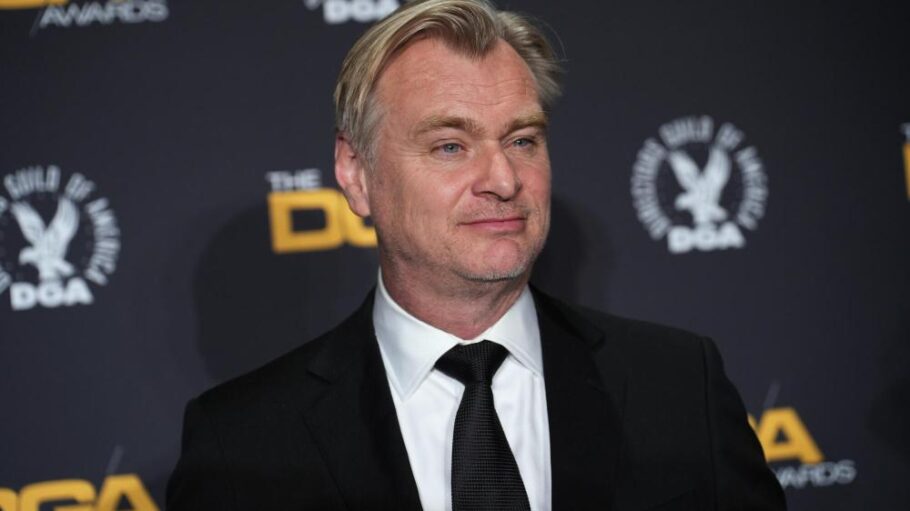
Christopher Nolan is a busy man.
When he’s not working on “The Odyssey,” his sprawling adaptation of Homer’s epic, he is tackling all the other challenges facing Hollywood as the new president of the Directors Guild of America.
The union’s 20,000 members are dealing with a sharp decline in jobs, the rise of artificial intelligence, and the absorption of Warner Bros. into either Netflix or Paramount — which portends consolidation in streaming and a threat to the future of moviegoing.
“We have very, very significant concerns about how this is all going to happen,” Nolan said in his first interview as DGA leader since being elected in September. “I think it’s a very worrying time for the industry. The loss of a major studio is a huge blow.”
The DGA is headed into bargaining with the major studios this spring. Its contract expires on June 30, which happens to be two weeks before “The Odyssey” comes out.
Speaking to three reporters around a conference table at DGA headquarters, Nolan displayed a smooth command of the guild’s negotiating priorities — jobs, AI and health care — while dropping the occasional “frankly” into a sentence to signal a point of conflict.
“We need to look at how the new models have created this disconnect between — frankly — the level of production and overall spending from the consumer,” he said, warning that changes in technology should not be an excuse to shortchange workers. “That’s completely unacceptable.”
Love Film & TV?
Get your daily dose of everything happening in music, film and TV in Australia and abroad.

A citizen of both the U.K. and the U.S., and at home in both cultures, he was also diplomatic when needed. Though he shot “The Odyssey” in locations around the Mediterranean, he passed up an opportunity to slam President Trump’s proposed 100% tax on movies made overseas.
“I don’t know how a tariff system would work,” he said, judiciously. “I will say that since President Trump has started bandying these ideas around, there’s a much more serious conversation from the studios about how to improve the situation in the United States — to be perfectly frank about it.”
The DGA has had high-profile presidents from the start. Frank Capra shot “Mr. Smith Goes to Washington” while serving in the role; ditto Joseph Mankiewicz and “All About Eve.” Nolan follows a succession of in-demand TV directors — Paris Barclay, Thomas Schlamme, and Lesli Linka Glatter — who held the post while juggling their day jobs.
Asked how he was managing it all, Nolan said he has strong support from the staff, the board and prior DGA presidents.
“I see the value of having active, working members run the guild,” he said. “I’m prepared to knuckle down and figure it out.”
Nolan is of course famous for being one of the great champions of the theatrical experience. But as president of the DGA, he represents a constituency that largely works in television and that has struggled mightily since the end of Peak TV.
Netflix’s proposed acquisition of Warner Bros., which still must clear regulatory hurdles, raises concerns across the board. Filmmakers fear the loss of a major distributor, while those in TV face the potential consolidation of HBO Max into the largest streaming platform.
The DGA has not taken a position on the deal, but has had discussions with both Netflix and Paramount, which is pursuing a hostile bid for the studio.
“We’re interested to hear more about the specifics of how they’re going to run these things,” said Nolan, nine of whose films are in the Warner Bros. library.
Addressing fears about the future of theaters, Netflix Co-CEO Ted Sarandos has pledged to maintain a 45-day window. (The DGA has pushed for 60 days.) Meanwhile, David Ellison, CEO of Paramount Skydance, has offered to maintain “healthy, traditional” windows while expanding the combined studio’s theatrical output to 30 films a year.
“There are encouraging noises, but that’s not the same as commitments,” Nolan said, making clear that windows are not the primary issue. “The theatrical window becomes a sort of easily graspable symbol of whether Warner Bros. will be run as a theatrical distributor or whether it be folded in as a streamer. But the reality is, the issues on the television side and the streaming side are far more important to our membership.”
The DGA represents not only directors, but also their crews — assistant directors, unit production managers, stage managers — who have already been hammered by a decline in domestic production.
The dropoff has been so bad that it attracted Trump’s notice. Nobody in Hollywood wants a 100% tariff, but the hope is that Trump’s attention can be redirected toward a federal production incentive on par with the generous rebates offered by other countries.
“The way we see it, you want a stackable, 25% federal rebate that you can combine with your state rebates and be competitive with other places in the world that are siphoning production from the United States because of the excellent incentives that they have,” Nolan said.
Nolan was quick to acknowledge that the decline in jobs is not primarily about overseas competition. Rather, he sees it as a function of business models that are changing, often to the detriment of DGA members.
“If you look at the overall spending from the consumer on media, on entertainment, on our work, it’s extremely stable,” he said. “But we’re looking at a 35% to 40% decline in employment for our members. How do you reconcile those things? What’s happening to the investment? Why aren’t we reinvesting in the consumer? Because the consumer is invested in our work and values our work tremendously.
“There are always going to be ebbs and flows in the level of production,” he said. “That’s understood. That’s a reality to deal with. But I believe we’re seeing too big a disconnect between the level of investment the consumer is making and how that’s being filtered down to our members in terms of employment opportunities.”
The Hollywood unions have all grappled in their own way with the threat of further job loss from AI. Disney’s recent deal with OpenAI — which allows Sora users to play around with its iconic characters — has underscored that threat.
“I see that as a positive in terms of establishing the principle of licensing,” Nolan said. “But until we see how that’s going to be paid through to the union members of all three unions — which, at the moment, we don’t know what that’s going to be — but that’s when these companies will have the support of the guilds, is when they’ve shown how creators are going to benefit from those kinds of licensing opportunities.”
For the DGA, AI also raises fears about the integrity of the director’s vision. In the 1980s, the union fought against colorization of black and white films. Such “creative rights” battles are central to the union’s mission and self-image.
“You have to have a voice in how this tool is being used,” Nolan said. “There are myriad issues to do with control of our work and how it might be manipulated through AI.”
That discussion is not limited to AI, he said. As a consumer of movies, Nolan said he has noted a shift in the home theater experience. Instead of watching films uninterrupted on DVD or streaming, viewers are increasingly watching them on ad-supported platforms.
“The first time it goes to the home, it’s interrupted with commercial breaks,” he said. “That hasn’t happened, frankly, since the 1970s… In a strange way, with this brand-new technology, we’re sort of looping back into those kind of scenarios.”
Many of these things will be on the table when the DGA sits down with the Alliance of Motion Picture and Television Producers in May. In a break with custom, the DGA will go last this year, behind SAG-AFTRA and the Writers Guild of America. Unlike the other two, the DGA did not go on strike three years ago — it never does — but it did secure most of the same terms.
All three face difficult conversations about bread-and-butter labor issues, especially funding for their health plans. As is customary for a DGA president, Nolan is not on the negotiating committee and won’t be in the day-to-day talks, though he will, no doubt, be involved.
“We have a responsibility to our members to look to the future, to look at what innovation is and what’s going to change, but also to keep a clear head,” he said. “We don’t want innovation to just be an excuse to pay our members less.”
From Variety US