




























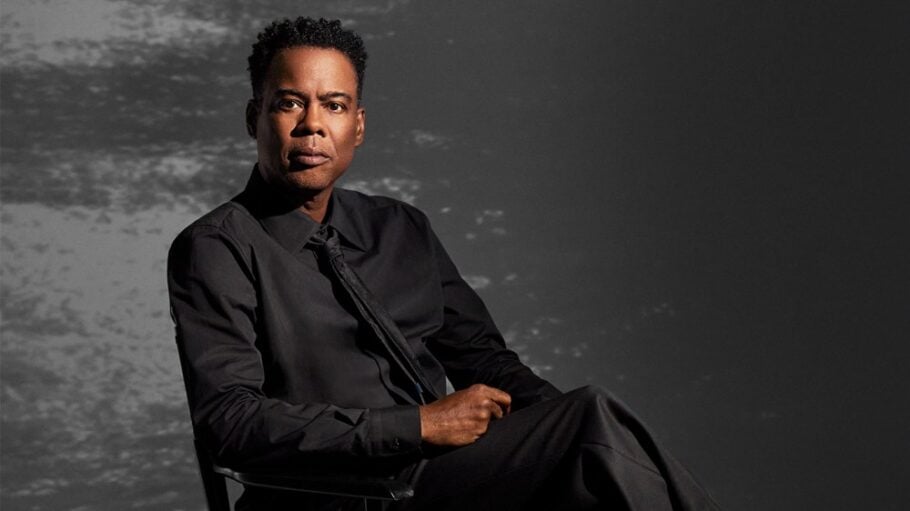
Chris Rock isn’t exactly who you remember him to be.
He likes to take his time. “What am I trying to say?” he asks himself repeatedly in conversation, pausing to truly consider that question before continuing to speak. And he doesn’t speak at all on an empty stomach. “I don’t want to say something mean and get cancelled,” Rock says more than once while reaching for a bite of a pastrami sandwich. Sure, it’s just a joke. But he’s also a celebrity whose friends over the years have included Dave Chappelle and Kanye West. He’s seen firsthand what can happen when you don’t eat your pastrami.

That isn’t to say he’s shed the opinionated, incendiary persona that caught Eddie Murphy’s eye at a New York comedy club one night when Rock was just 19, leading to his being cast in Murphy’s “Beverly Hills Cop II” (1987) and later “Saturday Night Live” (1990-93). Rock was one of the few celebrities to publicly predict Donald Trump would win the 2016 election, and speaking about the president today, Rock says, “I’m not a fan. But it’s weird when somebody gets one thing right, and the one thing almost clears them of all their other sins. The news is fake. He got that right.”
Still, Rock has formed a habit of making concessions to his least generous interpreters before anyone has even criticised him. “People have their reasons, and nobody’s wrong,” he says after remarking that it’s difficult to find actresses interested in roles that involve nudity. Referencing some Black actors’ grievances about the prevalence of Brits and nepo babies in Hollywood — a position he disagrees with and satirises in his upcoming film “Misty Green” — he says, “They’re valid. I’m not going to dismiss anyone.”
On one hand, that caution feels surprising coming from the man behind “Bring the Pain,” the outrageous 1996 HBO stand-up special that transformed him overnight from an “SNL” has-been who couldn’t get an agent into a global superstar being offered blank checks. Rock went on a lengthy tirade during that hour-long set about a cultural tension he famously referred to as “Black people versus n—-s,” which stoked significant controversy, but not before it brought the house down. And if you thought the recorded version was uncouth, you should have seen him workshop it on tour. “In Oakland one night, I remember dying a death. People wanted to fight, because I didn’t have it right yet,” he recalls. “You gotta go over the line to find the line. That’s what people don’t understand. When a comedian gets in trouble for saying something at a club, it’s like, ‘Dude, that’s what the club’s for.’”
On the other hand, Rock is 61. He doesn’t spend much time at the club anymore. “We’re all different people at different points in our lives, and I think I got everything I could out of the last guy — whoever I was then,” he says. “Now I’m this director guy.”
Love Film & TV?
Get your daily dose of everything happening in music, film and TV in Australia and abroad.

Rock is gearing up for the Toronto International Film Festival premiere of “Misty Green,” his first directorial effort in 12 years, which will hit theatres via A24 in October. Rosalind Eleazar of “Slow Horses” gives a breathtaking performance as the title character, a once-famous actress with a nearly empty bank account who can no longer maintain the ocean views and Equinox membership she’s accustomed to after her sugar daddy dies. The film follows a week of Misty’s life as she vents to her only friend (Anna Kendrick) and rubs elbows with former colleagues (Rock and Adam Driver) while desperately hunting for a gig that will pay enough to cover both her cushy Santa Monica lifestyle and the care of her mentally ill brother, Jordan, played by Daniel Kaluuya in a heartrending return to the big screen.
But as her agent (Topher Grace) reminds her, it’s not particularly desirable to work with Misty Green. “The last time I cast you, you punched this bitch in the face,” Rock’s character says to Misty. (There’s a stunning real-world resonance in this moment that Rock, in his first sit-down interview since Will Smith slapped him at the Oscars in 2022, claims he never noticed. More on that later.)
Rock began his directing career with 2003’s “Head of State” and 2007’s “I Think I Love My Wife.” Both were negatively reviewed; neither succeeded at the box office. By the 2014 release of his thoughtful rom-dramedy “Top Five,” though, Rock had matured as an artist, casting himself as a comedian and recovering addict who spends a day verbally sparring with a reporter and fellow AA attendee (Rosario Dawson). Critics loved it, and the film was moderately profitable.
“Misty Green” is what Rock calls a “tiny” movie — the budget came out to roughly $5 million, he says, less than any of his previous films. But it’s also the most important moment of his career since “Bring the Pain.”

That’s in large part because, aside from “Selective Outrage,” the 2023 Netflix special that marked his first time addressing the Smith incident in detail, “Misty Green” is Rock’s first major project since being diagnosed in 2020 with nonverbal learning disorder. “It’s a kind of ADHD-ish, Asperger-y thing,” he says.
Thanks to extensive therapy, “I have a level of concentration and empathy that I just did not have back then,” he says. “I was so good at telling jokes that I didn’t have to face a lot of things. My comedic gifts put me in a position where I didn’t have to grow up. So I’m better equipped to make this kind of movie now.”
Rock returns to his mantra: “I’m a different guy. I’m trying to be, anyway.”
But don’t worry. He’s still making jokes. “We’ll see what happens,” Rock continues. “I’m saying I’m a writer-director guy, then I’ll get an offer for some show on CBS where I’m Mandy Patinkin’s neighbour — ‘Hey, I brought back your wrench!’ — making 80 grand a week.”
What inspired you to write “Misty Green”?
Have you ever read “Breakfast at Tiffany’s”? The drug use. She uses the N-word several times. Like, she’s racist. They should have made that movie. And I like “Frances Ha.” I love “Vicky Cristina Barcelona.” You’re not allowed to say Woody [Allen], so I’m trying to get around it — who makes those types of movies anymore?
I stole from a bunch of movies. The biggest was “Legally Blonde.” Reese Witherspoon is as funny in “Legally Blonde” as Jim Carrey is in “Dumb and Dumber.” The key is that she’s smart. If you only watched the trailer, you would think we’re gonna follow some ditzy girl, but when they make her smart, it elevates it to this whole other thing. So I knew Misty had to be great. You can’t just be a fuck-up. And I didn’t have the money to do it, but I was really going for a “Magnolia” thing. The movie is about Misty Green, but a lot of it’s about L.A. L.A. has got very wonky priorities. There’s a real estate office on the same street as The Ivy on Robertson, and in the window, there are houses for $30-$40 million. In the window. But there’s a homeless guy sleeping right outside. The movie is about that crazy dichotomy.
Tell me about your relationship to L.A.
It’s weird. I just bought a place there [assumes a snobbish affect] so I winter in L.A. I love parts of it. I always say: The average movie studio, like Paramount, what’s in Paramount? There’s cameras, sound equipment. But what are you gonna do with that? Can you really steal that stuff? There’s more value at the average Home Depot than at Paramount, but Paramount’s got armed guards. Why? Because they have dreams in there. And people will do anything to get to their dreams.
L.A. is a complicated place, man. Fame’s a complicated thing. I’ve seen the switch in my lifetime. It used to be that everybody wanted to be great — a great singer, great actor, great comedian. Now it’s just fame, and the greatness is almost assumed. I mean, you’re always gonna be outed at some point if you don’t have the goods. But L.A. is the mecca of that. It can be beautiful. It’s got the best weather in the world. But it also attracts an underbelly that people want to pretend doesn’t exist.

Since Misty was relatively popular before her fall from grace, the obvious choice would have been to cast a more famous actress. How did you become aware of Rosalind Eleazar?
Oh, we had other people that I will never name in a million years. It’s a hard part to cast. Some of it was money. Some of it was because we shot in the summer, and people have vacations and shit. Also, there’s a little bit of nudity in the movie, but there was definitely more in the script. Mikey Madison won the Oscar for “Anora,” and you would still have a hard time casting that role today. People have their reasons, and nobody’s wrong.
We just auditioned Rosalind. We were gonna do a Zoom, but she didn’t want to — she flew herself in from London, knowing good and well it would only be 40 minutes. She blew us away. She wasn’t famous, so we kept trying to figure out reasons to not cast her. Different actresses — a singer or two — were attached at different times. But she was just the best one, by a lot.
And as a director, when you’re talking with a celebrity, they’re talking about themselves: “How am I gonna look?” But with Rosalind, it was all character, all the time. I basically didn’t meet Rosalind until we were done with the movie. I was dealing with Misty the whole time.
How did the rest of your cast come together?
Adam really liked “Top Five,” so he would call me periodically. I was like, “Dude, I did ‘Top Five’ 10 years ago.” But every six to eight months, I get a call from Adam Driver. “What are you working on?” I’m sure he’s got a long list of directors that he’s checking with, so when he gets down to the R’s, he calls me. And this time I happened to be working on something.
Similar with Anna Kendrick. It was “Top Five” love, and I loved her movie [“Woman of the Hour”]. She’s a great director. And there’s something about her [dating] Black men [onscreen] that’s kinda like, “Hmm! OK …”
Daniel was kind of retired. We hung out when I was on tour with Chappelle. I had to beg him. He was the only one I had to beg. Everybody else was like, “I can’t wait to do this movie!” Daniel, I had to go to his hotel. I definitely tap-danced. It was worth it.
Why was he hesitant?
Well, we had no money. People want to get paid! This is a good time — all these streaming services and diversity and whatever. Everybody’s getting paid on some level. But this movie was like …
You were paying scale?
Kind of. And people don’t say yes to scale right away. Like, “OK, I guess I’ll go home with you.” But he knew Rosalind because they’re both Brits. He had seen her do theatre. He was the only person that really knew how good Rosalind was. That’s what got him excited, more than anything.
There’s a joke in the movie about Brits “taking” roles from Black American actors. Did you write that before or after casting two Brits as American siblings?
Before. I’ve been in those rooms where people complain about nepo babies and Brits, and it’s been the same complaints for the last 30 years. “We need our own distribution.” Whatever. They’re valid. I’m not going to dismiss anyone. But these movies play all over the world. They’re not just ours. And I don’t know a lot of better actors than Daniel Kaluuya.

What was your thought process for the role you play?
I got to a point where — I sound like Olivia Wilde — I decided at the last minute to act in the movie. I was really thinking about doing a movie that I just directed. It was a self-imposed “Fuck being on camera.” I was actually imagining Donald Glover. He’s really hard to get. But I love him. We’re talking about another thing.
You mentioned that you “got everything” you could out of who you were earlier in your career, and that you’re now a “director guy.” Who’s that? What’s he about?
I like directing and writing a lot. I like the discipline, how contained it is. When you’re acting, if that’s your main hustle, it’s a lot of campaigning. You’re on the campaign trail [looking for work]. When you’re a writer-director, your script does all the work. So as I get older and less vain, I’m like, “Do I really feel like colouring my hair? Do I really feel like not having carbs for six months?” Spike [Lee] used to be in all the movies, and then one day he wasn’t. Clint Eastwood used to be in all the movies, and then one day he wasn’t. [Ben] Stiller too. Stiller is really the guy I look at, like, “How do I gracefully become this other thing?”
I always say: If only smart people get your jokes, they’re not that smart. All your idols were pop stars. Everybody we think is a genius was a pop star. Miles Davis was a pop star. They played “Kind of Blue” on FM radio in the middle of the afternoon after Kool & the Gang — that’s how pop Miles Davis was. Bob Marley’s a pop artist. Louis Armstrong was as pop as Harry Styles.
And you’re looking to become a pop star?
Not in the sense that I want to make a Marvel movie or something, but you can make a great piece of art that everybody gets. Chris Nolan’s last two movies are the most popular art movies ever made. “Oppenheimer,” in the hands of somebody else, would have been a little movie. But in his hands, it’s fucking … “The Odyssey” is like, what the fuck? And the last “Joker” — not “Joker 2” but “Joker 1” — is a freaking art movie. That’s what I’m aspiring to do.
Several characters in “Misty Green” also aspire to make great art that’s broadly popular, but they all compromise. Industry pressures, family problems and finances force them to accept careers and lifestyles they did not want. Where did that theme come from?
It’s part of being a grown-up. We live in this world of no settling, but it’s like, “Dude, everybody settles.” Not only do we settle — we learn to fall in love with settling. One of my favourite song lyrics is by Garth Brooks: “Thank God for unanswered prayers.” We all hit an age where you’re like, “Oh shit, I gotta stop. This bullshit has to stop.” I did a joke 100 years ago where I said, “I want to find God before God finds me.” That’s what everybody in the movie is trying to do. “Let me find God, because when God knocks on my door, it’s not going to be good news.”
What has that process looked like in your life?
I’ve been lucky. I’ve made some money. I’m not swimming in it. I’m not on jets all the time. I don’t own a boat. But I always tell people: Your monthly nut — that’s your religion. You think you’re Catholic? How much are your monthly bills? Because if you can keep your monthly low enough, you can say no to things. I don’t own a car. Yeah, I have a place in New York and L.A., but I don’t even have a doorman. I live on a normal block in both places. You can ring my bell. It doesn’t say “Rock” on the bell, but you can ring my bell. And I do this purposely, so I don’t have to do things I don’t want to do. There’s meetings I don’t have to take because I keep my expenses down. Holly Robinson’s mom, the great Dolores Robinson, was a talent manager, and she used to say, “You have to spend income, not if-come.” That’s the problem with most people in Hollywood. They’re spending if-come. If-come will ruin your life.
It’s been 12 years since you last directed a movie.
I can’t believe they let me direct a movie. I kept expecting to see Donald Glover on the set, like, “Hey, what are you doing here?”
Were you truly worried you wouldn’t be able to make “Misty Green”?
Unless you’re a Leo DiCaprio, box-office-guaranteed guy, every movie is a miracle. A movie is a loan you don’t have to pay back. That’s a weird gamble, because with most gambles, they get your house. I’ve been lucky enough to be in the right place at the right time. Some of it is my work speaking for me. Some of it is just being a nice guy. Being a decent hang will get you more work than you would imagine.
Did it feel that miraculous to you when you directed “Head of State” 23 years ago?
Me and Chappelle always joke that that was back when I was Drake. Back when I was Harry Styles. Man, I was so hot. Like, what the fuck, dude? I got money to do “Good Hair.” I did “Pootie Tang.” I was literally doing whatever I wanted. So in retrospect, “Head of State” is not even remotely ambitious enough for the juice I had at the time. If I knew what I know now, I wouldn’t have starred in “Head of State.” I would have written it for Denzel [Washington]. I didn’t have a real sense of my own power at the time.
At what point did that change?
You have your career, and you have your life. And they intertwine from time to time. Not everybody makes it. Some people are just dead, who you loved. And there’s people who didn’t make smart decisions, who now don’t get to express themselves, which is really not cool. Everybody doesn’t get to make the movie they wrote. So I don’t take it for granted. And I always say: The worst thing that can happen to an artist is not that you’re washed up. The worst thing that can happen is that you’re not washed up, and no one wants to hear you. That you’re actually still good, and you’ve fucking worn out your welcome. I’ve seen it happen to other people where — I’m not gonna say who — but things just got so complicated.

“Bring the Pain” is when you truly became a celebrity. What has changed about your experience of fame from then to now?
It used to just be about getting free stuff. And how you’re basically on the third date with anybody you date. They’re like, “I know you!” You’re at least on the second date. You skip a date just by being famous.
Part of this is just getting diagnosed [with NVLD], but when people come up to me, it used to scare me. Now, I realise that you’re making somebody’s day. I try to ask them at least one question. “Where are you from?” As simple as that. And they’re like, “Oh, shit! I had a conversation with him!” I’ve learned to accept this is who I am. It’s like basketball. If you’re seven feet tall, you can’t get mad at people asking if you play.
I try not to think about fame, but it could be a lot worse — you could be infamous. So I accept it. It helps me get work.
Your first two movies struggled at the box office. “Top Five” did better, but we live in a different world now. Is there more pressure on you this time around?
I would love to have a box office hit. I would love for the people that helped me make this movie to get their money back. I’m dropping names today — Warren Beatty told me a long time ago, “The only measure of success is: Does it get you another job?” So I hope this movie does very well, because I hope people continue to show faith in me. I hope Adam Driver calls me six months from now, like, “What are you working on, dude?” I hope Michael B. Jordan calls me up. Part of it is about making something that does well, but it’s also got to be really good. Because all these movies end up in the exact same place, and you don’t know which ones made money. At some point, when you’re going through your Apple TV looking for a movie, the hits and the misses are right next to each other. Isn’t that weird?
So you’re playing the long game.
I always play the long game. I’m not looking for Michael B. Jordan numbers here. I’m realistic. But hopefully, it makes enough money that somebody at A24 calls me up and goes, “What do you want to do next?” That’s all I care about.
It seems like “Misty Green” will become part of the awards conversation.
You’re not gonna hear me say that. No one’s ever talked about anything I’ve made like that before. You’re the first person. You. Right now.
Rosalind Eleazar is already in Variety’s predictions.
I’ll say this: 100 years ago, when we were doing “New Jack City,” we rehearsed for a week before Wesley [Snipes] got there. It’s me, Ice-T, Al Payne, Vanessa Williams, Bill Nunn. We’re rehearsing, and we’re fine. Then Wesley comes. None of us knew Wesley. At the table read, Wesley sits at the head of the table and puts on the Nino Brown hat. He starts reading, and — I’m not lying to you — within 10 pages, we realise we’re in a motherfucking classic. We were looking at him like we weren’t in the fucking movie. Like, “Oh my God.”
And I say that to say: By the end of the first week of filming, I’m looking at Rosalind like, “Oh, shit, she is throwing the fuck down.” To the point that I had to elevate my own work. Like, “Shit! I got scenes with her next week!” The only other time I’ve had that feeling was with Wesley. Like, “Oh, a star is born.”
What was it like to direct her?
The thing about her — about all the great actresses, because I went through this with Rosario too, and she should have gotten nominated — all great actors are just really smart. Her script notes were impeccable. So anything false: “Get rid of that.” We would argue back and forth, and 90% of the time, she was right.
So it’s not about directing her. It’s about protecting her. It’s about keeping things truthful around her. You ever have a friend, and they lie, and even though you don’t know what they’re lying about, you just know there’s a lie being told? Because when you know somebody, they speak in a rhythm. And lies are spoken at a different rhythm than the truth. Scenes are like that — what’s the rhythm? So directing her was just beautiful music. She was always on key.
Directing is 80% casting. It really is. I can say the same things for Daniel and Adam and Anna. And Topher Grace is great. Topher actually read two parts at a table read I had three years ago. This guy’s got “Spider-Man” money. He don’t need to be at my fucking table read. But he smelled a decent script, and he got in early.
You made “Head of State” and “I Think I Love My Wife” at the height of your stand-up fame. Back then, did you see yourself wanting to make something like “Misty Green”?
I didn’t go to college. I got a GED. I wasn’t that sophisticated. Like, I played Pookie in “New Jack City.” I had just done this dramatic role, and I remember my agent telling me about [Julian] Schnabel’s “Basquiat,” but I didn’t know who Basquiat was. I wasn’t sophisticated enough to do “Misty Green” back when I did “Head of State.” I just wasn’t. Getting treatment [for NVLD] has changed my life. I’ve gone from reading three books a year to 23.
But hey, we’re all working on ourselves. I don’t want to be one of those people bragging about their therapy. I crawled in there like everybody else. Nobody struts into therapy. You crawl in there on your knees, soaked from crying.
But there was a turning point in your work before you started therapy. “Top Five” was a big jump in 2014, and you did a Broadway play in 2011. When did you start to see yourself as an artist and filmmaker instead of just a comedian?
Hey, being a comedian is the hardest one of those. It’s the only one they don’t have a school for. But you’re right. I did the play — boy, there’s nothing like doing a play. I wish I could do another play. Plays are fucking magical. It’s some of the best writing in the world.
I’m really into what I’m not already seeing. Before there was Spike Lee, there was not a Black guy like Spike Lee. It just didn’t exist. And before Denzel — I mean, Sidney Poitier did some great work, but he was never the bad guy. Denzel has done a fucking roller-coaster ride of parts. And what would Richard [Pryor] have done if he was sober? Richard did a lot of great work — my favourite is actually “Blue Collar” — but there was more there. He got sick, and there was the drugs and the fire, but there was a lot more there. So I don’t know. I’m trying to be a guy I haven’t seen, or at least that I haven’t seen as a Black guy.
You’ve explored substance abuse a lot in your work. Your question about what a sober Pryor could have achieved feels present in both “Top Five” and “Misty Green.”
I mean, my brother drank himself to death. I’ve lost a lot of friends to substance abuse. Here’s the crazy thing: In most instances, the ones who died are better than the ones who haven’t quite reached their potential because of their substance abuse. There’s something sadder about a person coming in fourth place than a person dying, actually. Because you know they could have come in first if it wasn’t for substances.
It’s been a part of my life since I was in my late teens. The crack epidemic in America, especially in Bed-Stuy, was insane, so that really implanted into my brain. There was nothing like my neighbourhood when crack was big, man. The things I’ve seen, I wish I could have not seen them. Users aren’t the only abusers, as Jay-Z famously said.
So substance abuse has been really, really, really big in my life. But I’ve been very fortunate. I like drugs, but they soothe me; they don’t move me. Like, “We’re gonna do some coke? I’ll do some coke.” But I wouldn’t cross the street to do some coke. I’m not like, “Oh, my friend is uptown, he’s got stuff, we’re gonna get in a cab for half an hour” — no, no, no. I’m going to bed. Now, even with drinking, you get a certain age, and these hangovers are bad, dude. Like, I love the morning. I love being up at 7 a.m. and walking and listening to a podcast or whatever the hell, attacking the day.
What’s your next goal after this movie?
I’m trying to write a book. A series of essays, like all the [James] Baldwin books. The title is “When the Homeless Know Your Name.” Because when they ask you for money, it’s one thing. When they ask me for money, they know I have it — it’s a whole ‘nother thing. AIso, I came to this realisation that being an author is the highest form of art. Half the world’s at war over stuff in books. No one’s getting killed over a freaking miniseries. Nobody’s getting killed over “Love Island.” But you put some shit in a book 1,000 years ago, and people would get their heads chopped off. Books are powerful.
I’ve been reading. I read the Baldwin biography, that big 700-page thing. I read the Elon [Musk] one recently. They had nothing in common, but they both knew they had a place in history while they were doing it, not after the fact. That’s something. That’s something.
You were in the Lorne Michaels documentary earlier this year. What sticks with you about your time at “Saturday Night Live”?
It’s the best doc ever where you don’t learn one thing about the guy. The most interesting people in the world — who do not tell you about him. But I met Lorne Michaels and haven’t been broke a day since. That is my guy.
Chris Farley and me and Adam [Sandler] and David Spade shared an office. We would go, “Oh, let’s make a McDonald’s run.” “Carolyn Bessette’s here tonight! You gonna talk to her?” “No, you talk to her.” Then she came in with JFK. “Oh, that’s what she’s going for.” It was a magical time. All you remember are the friendships. I didn’t go to college, but those would have been the years I was in college.
You mentioned that you think your hosting career is over. Have you been asked to host the Oscars again?
When people answer those questions, they’re being disrespectful to the people that got the gig. They have great hosts. Conan O’Brien is amazing. Nikki Glaser is amazing on the Golden Globes. I’m not going to say never, but my time might have passed, honestly.
How has it felt to think about returning to the Oscars for the first time since 2022?
I’m not getting nominated. The only way I’ll go back is if I’m nominated, and I’m not getting nominated. And that’s OK. We’ll deal with that if it happens. Like, let’s manage expectations.
But you know that all eyes are on you when it comes to the Oscars. And you made a movie about a woman who smacks her colleague, where you play a character that has to decide whether to forgive her.
Oh. Yeah. You know, I never even thought about it like that.
No?
No. This is literally the first time I — that she got connected to — yeah.
It’s been four years since Will Smith slapped you. How do you feel about it all now?
Hey, man. You know, to answer your question a little bit, I wish nothing would have happened. And also, I don’t want to say anything that takes any attention away from Rosalind and how good she is in this movie. It’s a crazy world. We walk by homeless people. There’s all sorts of shit going on right now. Me having a bad day is not the biggest — it’s not that important.
Is that what you’re saying with all of the juxtaposition in “Misty Green”? That hard things have happened to you in this business, but they don’t matter in the end?
A long time ago, I went to a comedy club on a freaking whim. I got onstage and did about five minutes, and the owner of the club said, “You should come back.” If he didn’t say that, I probably wouldn’t have come again. That one night changed the whole trajectory of not just me, but my whole family.
So, you know. What am I trying to say? Showbiz has been very, very good to me. In a world where we have trillionaires, I don’t have that much money. But my dad got sick when I was poor, and my mother got sick when I had some money. Dad’s dead. My mom’s doing great. You know what I mean? It’s literally that simple. So I’m good. I’m really good.
Styling: Chloe Hartstein/The Wall Group; Grooming: Lisa Deveaux; Look 1 (all black): Full Look: Louis Vuitton ; Shoes: Paul Smith ; Socks: Falke; Look 2 (red sweater): Jacket & Pants: Gabriela Hearst; Sweater: Rag & Bone; Shoes: Paul Smith; Socks: Falke; Look 3 (white): Full Look: Brioni, Shoes: Paul Smith, Socks: Falke
From Variety US