





























When Daley Pearson set out to make his new Netflix feature “Allen,” he knew he wanted to tell a story that felt distinctly Australian.
The filmmaker and Ludo Studio co-founder found inspiration in the place he knows best: Coolum, a coastal town on Queensland’s Sunshine Coast, complete with local characters, familiar childhood references and a distinctly Australian sense of humour.
While such a local story might seem a gamble for international audiences, Pearson says the global success of productions like “Bluey” and “Talk to Me” gave him greater confidence to embrace that specificity, rather than dilute it for a global audience.
“These really Australian things out there, I think it… gave us the confidence to make more stuff like that, that was quite, you know, authentic,” he tells Variety Australia. “And it also probably gave maybe our partners a bit of confidence as well, which might be new.”
Pearson had seen the potential of that approach in other productions, particularly those that brought a fresh perspective to familiar genres through their local settings.
“I had hoped in a lot of the stuff I loved out of Wellington that, you know, like ‘What We Do in the Shadows’ was kind of ‘Lost Boys’ or whatever it was, but setting it in Wellington, everything old was new again, just by setting it somewhere fresh,” he explains.
“And, you know, having characters that were from there, they behave differently. So you could tell a familiar story in a new way.”
Love Film & TV?
Get your daily dose of everything happening in music, film and TV in Australia and abroad.

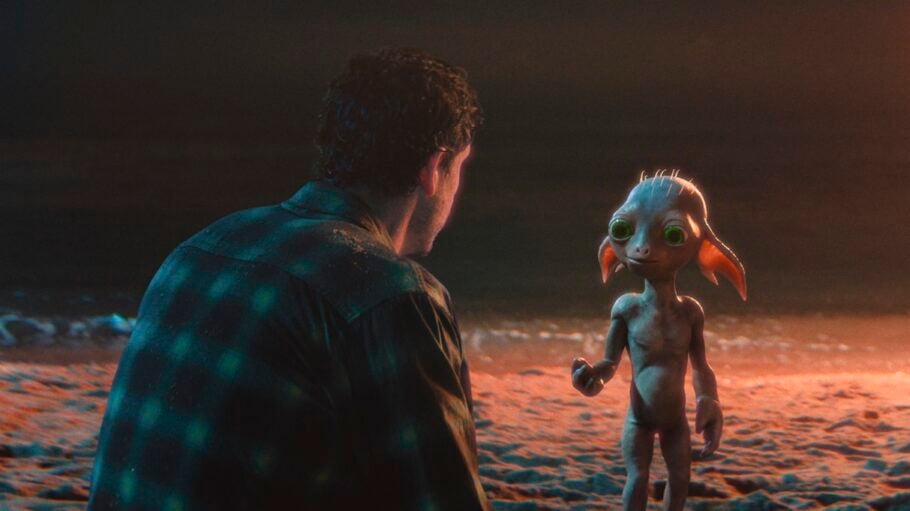
“Allen” marks the first locally produced live-action feature from Ludo Studio, the Emmy and BAFTA-winning Brisbane production company. Created by Pearson, co-directed with Jeffrey Walker and co-written with Sophie Miller, the film follows Petey (played by TJ Power), a man whose childhood best friend was an alien named Allen, who mysteriously disappeared without saying goodbye.
Twenty years later, Allen unexpectedly returns, bringing with him a secret that could change the world. But their reunion also forces Petey to confront a past he’s spent much of his adult life trying to recapture.
The film stars Power alongside Charlotte Nicdao, Josh Helman, Emily Barclay and Benedict Hardie, and was produced with support from Screen Queensland.
Pearson tells Variety Australia that bringing such a local story to Netflix was an opportunity he doesn’t take lightly. “It really feels like they’ve given us this incredible, so rare opportunity to go literally to the homes of people around the world,” he says.
But reaching a global audience hasn’t meant leaving the film’s Australian identity behind.
“Allen” is filled with references to Australian childhoods in the ’90s, from Goosebumps books and Ninja Turtles toys to Cheezels and Bubble O’ Bill ice creams. While some of those references will be immediately familiar to local audiences, Pearson says conversations with international interviewers have already highlighted a few cultural differences.
“I’ve had a chat to a few overseas guys about it. And I don’t think they’ve had Cheezels or anything,” he laughs. “There’s a few things that they’re like, ‘What are those?'”
But rather than seeing that as a problem, he believes audiences are capable of connecting with the meaning behind those details, even without having experienced them firsthand: “There was a lot of trust that the audience was smart. And even if they didn’t have Cheezels where they’re from, they would get the meaning behind it or whatever.”
Pearson’s approach reflects a broader conversation taking place across Australia’s screen industry about the value of telling distinctly local stories for international audiences.
In a recent interview with Variety Australia, Netflix ANZ content director Amanda Duthie spoke about the streamer’s efforts to champion original Australian voices through its “The Next Brilliant Career” initiative, which gives emerging screenwriters the opportunity to pitch directly to Netflix.
“I’m excited by how emboldened Australian production is becoming,” she told us. “We’re seeing familiar territory being explored, but the surprises, the twists and the turns, the genre jamming, the global ideas but made locally, that is increasing.”
Pearson shares that optimism, with the success of “Bluey” and “Talk to Me” reinforcing his belief in the international potential of distinctly Australian stories.
“I think what it did is it made us a little bit bolder to keep telling stories where we were with what we have. Like, I don’t think we could tell any other stories. It’s like being left-handed a little bit. We can’t help but tell those stories because that’s what we live. And we like to tell those sort of stories.”
Still, he acknowledges that the success of previous productions offers no guarantee the next will find the same audience: “You also never know. Like, just because Hollywood makes a bunch of stuff and not all of them work, but they had a formula that works… you never know.
“But the same things we love about those, we hope the audience loves in this one too.”
Allen is now streaming on Netflix.