



























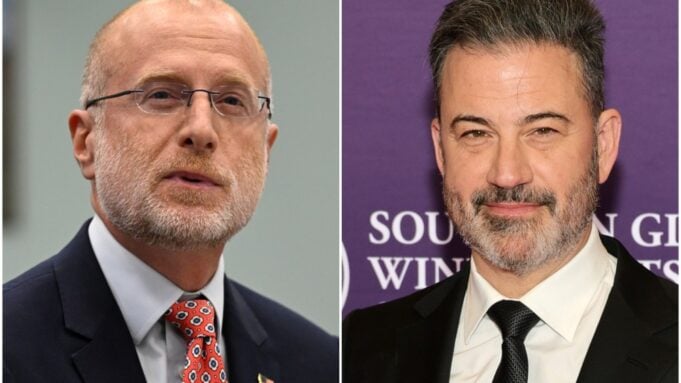
Brendan Carr, the Trump-appointed chairman of the FCC, has been accused of improperly exerting pressure on ABC and local broadcasters to cancel Jimmy Kimmel over the late-night host’s comments about Charlie Kirk’s murder — and that Carr’s threats were tantamount to a First Amendment violation.
On Wednesday, Carr, amid pointed questioning from lawmakers at a Senate hearing, suggested that he was simply holding broadcasters to a legally required “public interest standard” when he was asked about his Sept. 17 remarks on a conservative podcast in which he threatened ABC and its affiliates if they did not “take action” on Kimmel. Carr had called Kimmel’s comments on “Jimmy Kimmel Live!” about MAGA trying to exploit the Kirk assassination to score political points “some of the sickest conduct possible.”
“We can do this the easy way or the hard way. These companies can find ways to change conduct and take action, frankly, on Kimmel or there’s going to be additional work for the FCC ahead,” Carr said in September, suggesting the FCC would pursue “news distortion” allegations against local ABC broadcasters unless they dropped Kimmel.
Sen. Ted Cruz (R-Texas) was among Carr’s critics. The senator in recent comments had likened the FCC chair to a “mafioso” over his saber-rattling to broadcasters, and warned that it is “unbelievably dangerous” to try to shut down speech the government doesn’t like. At the Senate Commerce, Science and Transportation Committee’s FCC oversight hearing Wednesday, Cruz said that — while he agreed with Carr “that Jimmy Kimmel is angry, overtly partisan and profoundly unfunny” — “what the government cannot do is force private entities to take actions that the government cannot take directly. Government officials threatening adverse consequences for disfavored content is an unconstitutional coercion that chills protected speech.”
Cruz posed the question to Carr: “So long as there is a public interest standard, shouldn’t it be understood to encompass robust First Amendment protections to ensure that the FCC cannot use it to chill speech?” Carr said he agreed — then launched into examples of the FCC’s supposed “weaponization” of the agency’s regulatory enforcement during the Biden administration. Cruz asked Carr whether he had any responsibility for Kimmel’s suspension, to which the FCC chief said, “They made these business decisions on their own. The record is clear on this.”
At another point in the hearing, Sen. Amy Klobuchar (D-Minnesota), asked Carr, “Do you think it is appropriate to use your position to threaten companies that broadcast political satire?”
Carr, as was the case at other points during the hearing, gave an indirect answer, responding, “I think any licensee that operates on the public airwaves has a responsibility to comply with the public interest standard, and that’s been the case for decades.” Carr said local TV affiliates are “obligated” to ensure they do not broadcast news and entertainment programming that “does not serve the public interest.”
Love Film & TV?
Get your daily dose of everything happening in music, film and TV in Australia and abroad.

Other senators were not buying Carr’s line of argument. “You are not reinvigorating the public interest standard — you are weaponizing the public interest standard,” Sen. Ed Markey (D-Massachusetts), said to the agency chief. “He is turning the Federal Communications Commission into the Federal Censorship Commission. It is a betrayal of the FCC’s mission. You should resign, Mr. Chairman.”
In September, after Carr’s comments about Kimmel and saying “We can do this the easy way or the hard way,” Nexstar Media Group and Sinclair announced they were preempting “Jimmy Kimmel Live!” Shortly thereafter, ABC suspended Kimmel, before bringing his show back on Sept. 22. Carr has claimed that Nextar and Sinclair independently decided Kimmel’s show was not in the “public interest.” At the Senate hearing, Carr insisted, “There was no threat to revoke a license.”
Meanwhile, there was another jarring moment during the Senate hearing: Carr said the FCC “is not an independent agency” — something that has been part of the agency’s mission statement for decades.
When Sen. Ben Ray Lujan (D-New Mexico) asked Carr for a yes-or-no answer to “Is the FCC an independent agency?” Carr eventually replied, “formally speaking, the FCC isn’t independent.” Lujan pointed out the FCC’s own website said the agency was independent and the senator asked if the FCC’s website was “lying.” Carr answered, “Possibly.”
Within minutes after that exchange, the FCC had deleted “independent” from its description. Previously, the FCC website mission statement said this: “An independent U.S. government agency overseen by Congress, the Commission is the federal agency responsible for implementing and enforcing America’s communications law and regulations.” Following the edit, the word “independent” was deleted: “A U.S. government agency overseen by Congress, the Commission is the federal agency responsible for implementing and enforcing America’s communications law and regulations.”
In a statement about the website edit, an FCC spokesperson said: “With the change in Administration earlier this year, the FCC’s website and materials required updating. That work continues to ensure that they reflect the positions of the agency’s new leadership.”
From Variety US