




























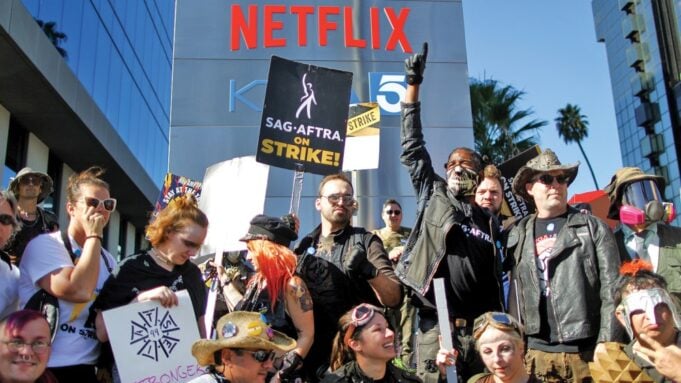
As Netflix and Paramount began their fight for control of Warner Bros. this week, each sought to reassure the creative community that the outcome will mean more content and more jobs.
But Hollywood union leaders have seen that movie before, and have every reason to be skeptical.
“We’ve seen in the past how these mergers have impacted workers,” says Lindsay Dougherty, secretary-treasurer of Teamsters Local 399. “It’s never been good. It’s never created jobs. We have never seen the benefit for working people.”
Netflix’s deal to buy Warner Bros. follows a brutal five-year stretch for the entertainment business, which has been buffeted by the pandemic, two strikes and an unshakable slump in global production. So when the deal was announced on Dec. 5, few were disposed to be optimistic.
“This has created so much concern because we’re at the tipping point,” says Susan Sprung, CEO of the Producers Guild of America. “It’s suddenly hit people that there are going to be almost no places to sell.”
The standard antitrust analysis of the deal would focus on its impact on consumers. But regulators are also expected to consider how a merger will affect producers, writers, directors, actors and crew members.
Netflix is either the largest streaming service or, if YouTube is counted, the second largest. Much of the initial discussion about the merger has focused on whether putting HBO Max under the same tent would give Netflix de facto monopoly power to raise prices.
Love Film & TV?
Get your daily dose of everything happening in music, film and TV in Australia and abroad.

But under the Biden administration, the Department of Justice and the Federal Trade Commission added labor market impacts to the list of criteria for evaluating mergers. That means the Trump administration could choose to go after Netflix as an unlawful monopsony — that is, a dominant buyer with the power to dictate terms to the creators of movies and TV shows.
“I think there’s definitely a possibility,” says David Berger, a Duke University professor who has studied monopsonies in labor markets. “There has to be some small non-transitory change that permanently harms some class of workers in some market. It doesn’t need to be a huge class of workers. If it’s elite producers, that could be enough to form a viable worker claim.”
Unions are already warning that any sale — whether to Paramount or Netflix — will drive down wages and result in less content, not more. The Writers Guild of America has blasted both suitors, saying they would be bad for writers. The Directors Guild of America and SAG-AFTRA have struck a more measured tone, saying they have questions and concerns without taking a firm position.
The Justice Department and the FTC — one of which will take the lead in evaluating the deal — each declined to comment. The transaction will also have to pass muster with European Union regulators and other agencies around the globe. It could also be reviewed by state attorneys general.
The California attorney general’s office declined to comment on whether it will investigate, but said that “further consolidation in markets that are central to American economic life — whether in the financial, airline, grocery, or broadcasting and entertainment markets — does not serve the American economy, consumers, or competition well.”
The AG’s office continued: “We are committed to protecting consumers and California’s economy from consolidation we find unlawful.”
Netflix points out that it accounts for just 8% of all TV viewership, according to Nielsen data. HBO Max would add another 1.3% — hardly making the combined entity a dominant player. But that argument depends on a large denominator. If the market is limited to paid streaming TV, the combined entity
would account for nearly a third of viewership — enough to potentially trigger regulatory concern.
Theater owners have also raised alarms about the impact on their business. Netflix could shorten theatrical windows for Warner Bros. releases, favoring its direct-to-consumer platforms. That sort of vertical integration could also be the basis for antitrust scrutiny.
“The antitrust agencies have been more interested in vertical aspects,” says Jennifer Dixton, a former DOJ assistant chief who teaches at UCLA School of Law. “They would look at how this would affect theater owners and cinemas.”
Regulators might have the most luck bringing a monopsony case — technically, an oligopsony case — similar to the one that blocked the merger of Penguin Random House and Simon & Schuster. In that instance, the government argued that consolidation would reduce the number of buyers for book authors who make advances of at least $250,000.
The WGA has been warning for years that a comparable dynamic was unfolding in the TV and film business. It opposed the merger of Disney and Fox in 2017, saying that the combined company would become a “dominant” firm, controlling 28% of the market for writers’ work.
Some have speculated that Paramount might have an easier time winning approval from the Justice Department, as it is a smaller player in streaming. But from the WGA’s perspective, both deals are bad. The union’s hope is for Warner Bros. to remain a stand-alone company.
“The problem is the acquisition and pending consolidation of two media giants, not who the buyer is,” the WGA said in a statement Dec. 8. “These companies should be focused on investing in their own businesses rather than wasting tens of billions to buy up the competition.”
From Variety US