





























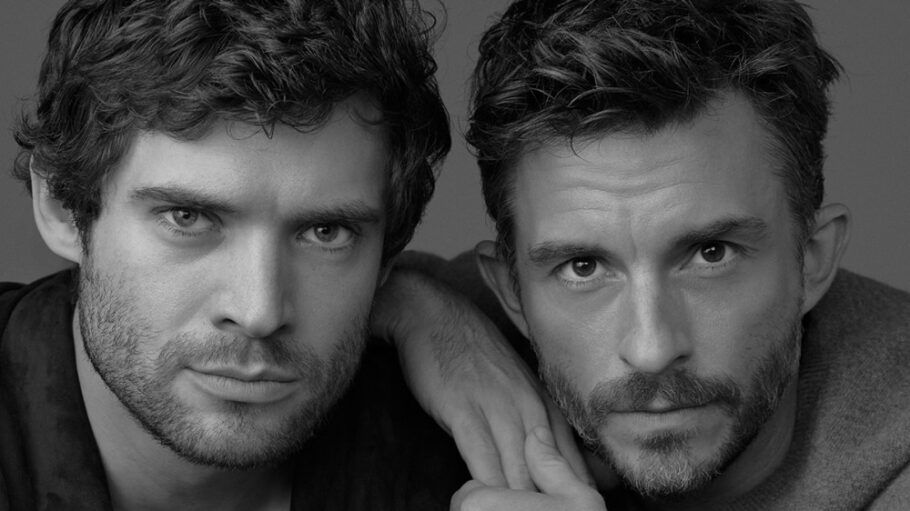
“I’ve been plugged into some sort of matrix,” Jonathan Bailey says to David Corenswet. “I feel like I’ve been slowly working on the hardware over the years, but the software has just been accidentally upgraded exponentially.”
The “Wicked: For Good” star is enjoying his newfound fame, but he’s struggling to make sense of it. He shares that feeling with Corenswet, who ushered in a new era of superhero movies earlier this year with “Superman,” the summer blockbuster directed by DC Studios co-chief James Gunn. Bailey, 37, and Corenswet, 32, both began acting as children of the theater and expected to have humble careers. Instead, they’ve become heartthrobs — with Corenswet’s dark hair and strong jaw earning him Clark Kent comparisons years before he booked the role and Bailey recently being crowned as People’s first openly gay Sexiest Man Alive — at the center of box office smashes. But as they marvel at their own successes and each other’s, their most profound similarity isn’t their career trajectories. It’s their earnestness.
David Corenswet: I said to James Gunn, “If you wanted somebody cool, you should have hired somebody else.” And he was like, “Oh, believe me. I know.”
Jonathan Bailey: That’s a really good place to start. What is cool these days?
Corenswet: Not caring. “It doesn’t matter what happens, because I’m cool.” That’s what cool is, and that’s why I reject it outright.
Bailey: But I think you’re cool. Because you care. “Superman” felt like a very honest version of integrity, and therefore values, and therefore cool. The hero was fallible and sees the world in a different way. The thought processes were very scientific.
Corenswet: Scientific curiosity does take a willingness to look a little foolish by trying really hard. James is that way in life, and especially with his movies.
Love Film & TV?
Get your daily dose of everything happening in music, film and TV in Australia and abroad.

Bailey: When you get the call for “Superman” — presumably no one’s ever mentioned that to you before in your life, because that was a wild casting against type — must’ve been crazy.
Corenswet: Well, when I got the audition, I was standing on a ladder changing a light fixture. My agent said, “We think you know what this is about.” I said, “Is it ‘Top Gun 3’? What am I waiting for?” I really was not expecting it, although I think other people thought that I should be expecting it. Just statistically speaking, it feels completely impossible.
Bailey: We’ve got things in common, haven’t we?
Corenswet: Theater is one of them.
Bailey: And from a young age. How old were you when you started?
Corenswet: I was 9 when I did my first professional play in Philadelphia. I played Bert in “All My Sons.” I had two scenes in the first act, and then I fuck off before intermission to go home to bed so I can wake up for school the next morning. One of the adult actresses, when the gunshot goes off at the end of the play, she would squeeze my shoulders. And I always thought, “I’m not sad.” I was so happy to be there. At some point my dad explained to me, “She’s not trying to comfort you. I think she’s trying to comfort herself.” I remember, as the lights came up, seeing the faces of the audience light up with relief at seeing this 9-year-old boy running out all carefree after this sad ending. That was when it struck me.
Bailey: The crackle of energy, and how it can change.
Corenswet: That in-person, immediate impact was quite intoxicating for a 9-year-old kid. I liked school, but I didn’t understand why it all felt like “Because next year, and because next year, and then you want to get into a good school” — and it all sort of fades off in the distance. With the theater, you need to go to rehearsals, because in three weeks there’s going to be a paying audience, and if you don’t know your lines, you can imagine how that’s going to feel. It wasn’t for some other reason. It wasn’t to get the next part.
Bailey: No. It was to be there and maximize the experience with the people around you. With that in mind about theater, the performances in “Superman” are so brilliant. The long scenes with you and Rachel [Brosnahan], they play out like theater scenes.
Corenswet: And we rehearsed them like theater. That was when I realized that I had not done a deal with the devil in taking this big role. I was actually sort of returning home. Let’s talk about “Wicked: For Good,” because I think there’s some interesting parallels here too.
Bailey: Jon M. Chu and James Gunn must’ve been in a room together. Jon was someone who, probably like James, could see it all in his head and would know how to invite the right people.

Corenswet: You would think those are antithetical. James storyboards every shot of the movie, and with a musical like that, you’ve got to have a very clear vision. But then to invite people in, not to fit your vision, but to contribute in a real way — that’s much harder. You also shot two films back to back.
Bailey: At the same time. On a Monday, you’d be shooting Dr. Dillamond’s classroom in the first film, and then on Wednesday, it would be “For Good,” the duet at the end of the second film. It’s testament to the two extraordinary women playing those two roles [Cynthia Erivo and Ariana Grande], because they were so locked in with Jon. It’s great when you’re playing a supporting role where you know your job is making your contribution, but mostly you don’t want to fuck up the process that’s already going on.
Corenswet: What was your singing prep?
Bailey: Being in a film like this, you get these extraordinary experts who are there to gift you technique and time. We’ve actually trained with the same physical trainer, Paolo.
Corenswet: I forgot we have Paolo in common. Love you, Paolo!
Bailey: If you think about your — forgive me. I assume your body wasn’t — I mean, maybe you were born Superman?
Corenswet: No, no, no. I was what one of my high school crushes very unaffectionately described as a string bean.
Bailey: Some people are Popeye, and some people are Olive Oyl.
Corenswet: And I was Olive Oyl. So yeah, I put on 40 pounds with Paolo.
Bailey: That’s incredible. But also, the process there, if you apply that to vocal training, you get the same [result]. For me, it’s about confidence. Those eight days of doing “Dancing Through Life” were some of the most extraordinary and toughest days I’ve had on a film set. Jon Chu had a baby, so we did one day without a director. You have to train that hard. There will be variables on the day. You might not sleep. You might have a cold. The director might have a baby. It’s so satisfying to really commit fully.
Corenswet: And to have a good reason to put so much into it. I had always wanted to put on weight, and I would love to take singing lessons for six months, but when you’re not Cynthia Erivo or Ariana Grande, you feel like you might have a long way to go. The first couple months, maybe you don’t sound so good, or you’re not putting on so much weight.
Bailey: Trust the process. Something similar [between] “Superman” and “Wicked”: Like you said about Cynthia and Ari, it’s so easy with superhero films to go, “They’re just so talented. It’s a God-given gift.” Absolutely, yes, of course — but there’s years of honing craft.
Corenswet: And they still have to warm up in the morning.
Bailey: Totally. Ari changed her whole tone and her voice, and Cynthia was training so that she could deliver that every single take. If it looks like it’s something that you were born to do, then you’ve done the work so well.
Corenswet: Part of it is making it look easy.

Bailey: There’s something about the values of Superman, and this version of Superman, that felt so alive and connected to the audience. Did you feel that?
Corenswet: Yeah. It’s interesting, because there’s so many different measures of that. How do the cast and crew feel about the film? How does the director feel? The publicists, the agents and managers who get to watch it ahead of the release. The press. The screenings you do for diehard fans, people who really want to love it or have extremely high expectations and are easy to disappoint. And the people who are writing about it and who want to talk about the zeitgeist and how it fits in. And then you have the box office, which is just a measure of how many people buy tickets. You can tell a bunch of different stories depending on what you focus on.
Bailey: It’s a lot of noise, isn’t it? Because there’s only so much you have control over: the process and the making of it.
Corenswet: When I leave set, I have done my work. To a certain extent, promoting the film is part of your work as well. But people can love the press tour and not love the film. My contribution happened a year ago when I was on set. It’s that thing of running out for my curtain call and seeing the audience’s face light up. That’s the feedback that tells you whether you’re on track or not. If my scene partner gets what they need from me, or if my director says “That was good. We’ve got it,” and even more importantly, if the crew is happy to see me — I like to put my energy there.
Bailey: It comes through on screen.
Corenswet: Well, good. I don’t pretend to know how that happens, because so much happens between your performance and it showing up on screen. The edit. Color correction and sound design.
Bailey: I feel like you’ll probably, one day, write and direct.
Corenswet: Probably. Do you have any interest in writing and directing?
Bailey: I’m in reverence to every person on set and every moment of the process, and actors come on set for 15% of the whole process. So it would be a great honor working with something all the way through.
Corenswet: Is this your humble way of saying yes?
Bailey: I’m, like, wriggling nervously.
Corenswet: I also think, as an actor, there is just a desire to be more involved. You are the last person to find anything out. And there’s a culture of protecting actors from too much information, which I think can hamstring us. I often get frustrated feeling like I want to contribute in this moment when we’re shooting the scene, but I don’t know why we’re shooting it in this room.
Bailey: There’s amazing footage of you and James having an extraordinary conversation. Obviously, this is coming with such privilege to be able to say this, but certain career paths are very restrictive. It feels entirely right to be curious all the time. And the conversation you had with James was so brilliant because — godGod, this is such a nerd thing to say, but — I always think there should be tension, but not friction. And that was such a good example. It was actually kind of vulnerable. You have to be able to make those mistakes.
Corenswet: I love that. Tension without friction. Because friction creates unnecessary heat.
Bailey: And it’s not economic. You hemorrhage energy, whereas tension holds energy.
Corenswet: I feel so lucky that that is on film, and it was interesting hearing from people what they thought of it — everything from, “Well, that’s what always happens,” all the way to, “What a terrible working environment.” For me, it does happen all the time. It was amazing how indefatigable James was. He very rarely got fed up with me, because I think he knew that the reason I’m having those conversations with him is, at my boldest, because I think I might see something that he doesn’t see and he might value. I never want any director to say, “Fine. If you need that, go do it.” I’m not doing it just for me. I might see something here that you actually like, and then you’ll feel like it’s yours.
But on the other end, I don’t know how to do a good job otherwise. I got this criticism in theater school quite a lot, and that was a good lesson to learn. As an actor you do need to let go. As a young actor, you’re sort of waiting to feel ready to make the action. There’s a practice of just, “Walk before you’re ready to walk. Just say the line before you’re ready to say the line.”
Bailey: That’s what we do as humans, isn’t it?
Corenswet: I think we do it at our most interesting. And as actors, you don’t want to just be human. You want to be humans at their most interesting, dynamic, dramatic moments. Drama is life with all the boring bits cut out.
Let me ask you this. Sexiest Man Alive. Where do you go from here?
Bailey: No. Okay. [Laughing nervously, he turns to the director and gestures to cut.] It was so lovely to chat. OK.
Corenswet: “Wicked: For Good” is fucking fantastic. You fly in this movie.
Bailey: We both kiss levitating!
Corenswet: Yes. But you have the bigger challenge. As the man, and as Sexy Man — and that’s not me saying that — which magazine does Sexiest Man Alive?
Bailey: All of them. Horse & Hound.
Corenswet: Anyway, Sexiest Man Alive, you are carried by Cynthia. She’s levitating you. Every man out there would think there’s no way you can look masculine and powerful and in control when you’re being levitated by a woman. And you, in that moment when she’s lifting you by your fucking massive arms, maintained your masculinity. Well done, mate. Because it’s a lot easier when you’re carrying the girl.
Bailey: I mean, listen, I’d be carried by both Cynthia and Ari for the rest of my life if I could be. I was like, “Oh, shit” when I saw your kiss at the end [of “Superman”]. My favorite moment of chemistry is the chuckle.
Corenswet: James, when I was doing that chuckle when she says, “I love you too,” he came up to me and said, “It’s not working. It needs to be solemn.” I was like, “No! The whole point is, ‘I fucking know that you love me.’” Credit to James. He was right on 90% of everything, but on that one, he saw that chuckle was a very truthful thing.
Bailey: That is what makes a leading man smash it out of the park.
Corenswet: So how do you top Sexiest Man Alive?
Bailey: Ugliest.
[They stand up to say goodbye.]
Corenswet: Should we kiss or something?
This is a conversation from Variety and CNN’s Actors on Actors. To watch the full video, go to CNN’s streaming platform now. Or check out Variety’s YouTube page at 3 p.m. ET today.
Production: Emily Ullrich; Agency: Nevermind Agency
From Variety US