





























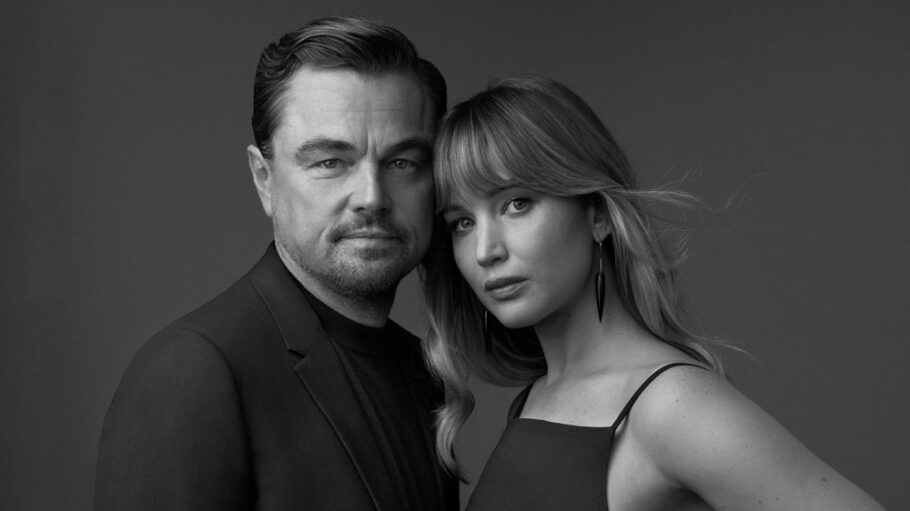
This is it. The grand finale to our most compelling Actors on Actors lineup ever. Jennifer Lawrence and Leonardo DiCaprio are arguably the biggest stars in the world, both Oscar winners whose creative choices are watched as closely as their red-carpet looks. DiCaprio comes to the table as the head of a stacked ensemble cast in “One Battle After Another,” Paul Thomas Anderson’s action opus for thinkers. Lawrence delivers one of her most visceral and unforgettable leading performances as a new mother whose reality dissolves under the weight of postpartum depression in Lynne Ramsay’s “Die My Love.” Here, the former co-stars discuss life as kids on sitcoms, on-set etiquette and their upcoming gig with Martin Scorsese.

Leonardo DiCaprio: Where did we meet?
Jennifer Lawrence: I don’t remember meeting you. Somewhere in the Valley.
DiCaprio: Not the Valley.
Lawrence: The Hills. “One Battle After Another” is my favorite movie I’ve ever seen in my life.
DiCaprio: Oh, stop.
Love Film & TV?
Get your daily dose of everything happening in music, film and TV in Australia and abroad.

Popular on Variety
Lawrence: You’re a really great actor and this was the greatest performance I’ve ever seen. What struck me, because I know you, is that this character Bob was the rawest I’ve ever seen you – but also really warm. It reminded me of your parents and their values. I know they were very counterculture. Was Bob built from you or did PTA just hand you a warm, amazing guy?
DiCaprio: This was personal for Paul. He’d been writing it for 15-20 years. It’s very pertinent to today. It was based on “Vineland,” but he made his own rendition. The idea of a guy who was a revolutionary trying to assimilate himself in the modern world, with a daughter that he didn’t connect to, giving up on life was something that had been permeating in his mind for a long time. As far as the counterculture stuff, yeah. My parents are different though. My dad hung around with Abbie Hoffman a bit back in the day. They were definitely hippies, but [my film] has much more hardcore revolutionaries that did much crazier stuff.
Lawrence: I think your dad was also a bomb maker. Were you aware of the comedy? I think the funniest people are an Alec Baldwin type who does it as serious as a heart attack. I can’t do that. When I was doing “No Hard Feelings,” I was too aware of the jokes and I was like, “Yay! A joke’s coming up!” Were you aware that you were being funny?
DiCaprio: It was the circumstances. I mean, the fact that you think I’m going to be able to utilize all the skills from my past as a revolutionary, but Bob is too stoned to get off the couch. Each time we got to these moments where maybe my character was going to do something heroic, we throw it out the window. Up to the final moment in the movie, where we still thought I was going to do something heroic, but, nah. He doesn’t do it.
Lawrence: Benicio del Toro’s character also never really got his moment after all his work, like where he rides off into the sunset. Your chemistry [with Benicio] is amazing. Have you ever kissed?
DiCaprio: [Laughs]. He was actually doing “The Phoenician Scheme,” and we waited for him. Shut down production for three months, and then he was like, “I’m not prepared for this.” But he came in and knew exactly who his character was, and we changed the whole movie when he arrived. All the stuff we did on the road together was because Benicio was like, “This is who Sensei is.”
Lawrence: Do you watch playback?
DiCaprio: Depends on the movie.
Lawrence: Did you watch playback on “One Battle”?
DiCaprio: No. Tell me about “Die My Love.” It reminded me of the French New Wave. I thought immediately of “A Woman Under the Influence,” which is one of my favorite performances and one of my favorite movies. You were fantastic in it. Why did you want this part?

Lawrence: Thanks. Martin Scorsese had read the book in his book club and he was like, “You should make this into a movie and star in it.” And then when I was reading it, I really couldn’t understand how it would be a movie. I felt like the author, Ariana Harwicz, was able to describe the indescribable grave depression of an identity crisis, but really poetically being lost in a forest and these visuals and metaphors. I couldn’t crack how to make it a movie, and I didn’t want to go back to Marty and be like, “I don’t get it, try someone else.” I think I realized that it’s poetry, it’s not a literal story. Then it clicked that Lynne Ramsey would be the only [director for this]. I think she’s a poet.
DiCaprio: What stuff was in the book versus the movie?
Lawrence: Lynne changed a lot. She made the lead couple be new to town, which they’re not in the book. That adds a huge element to my character’s depression. She’s pacing like a tiger in a cage, and that added a lot more of the isolation that I think a lot of new parents have. Like, what is my life now?
DiCaprio: A lot of the tension for me was wondering what’s going to happen to your character’s baby.
Lawrence: I know!
DiCaprio: Your character is unraveled and capable of anything, it got me on edge.
Lawrence: I really loved seeing you be a dad in “One Battle After Another.” The child in our movie is not well taken care of, and Rob and I are both parents in real life. Rob had a newborn, and we just could not play characters like that. It changed. Societal understanding of postpartum is very simplistic, it’s “You don’t connect with your child.” But that’s one version of it. Another is that your marriage can erode because your dynamic is completely different.
DiCaprio: We dealt with a lot of that with Teyana Taylor’s character in our movie. It was hinted at in the script, this idea of me loving our baby more than her. Her being jealous of the baby. We both started out in this business very young. How old were you when you started auditioning?
Lawrence: About 14, in New York.
DiCaprio: I was 12. And you did a lot of commercials before “Winter’s Bone”?
Lawrence: Yes. And we were both on sitcoms.
DiCaprio: What was your sitcom, again?
Lawrence: Well, yours was “Growing Pains,” which I watched every day after school. Mine was “The Bill Engvall Show,” which I don’t think anybody has ever seen except me and my parents.
DiCaprio: How long were you in it?
Lawrence: Two years. After I wrapped “Winter’s Bone,” the show got cancelled. It worked perfectly.
DiCaprio: I did one year on “Growing Pains,” then I got the movie “This Boy’s Life,” which was my first starring role. They were so incredibly awesome to me because I think that we were going to do another year on “Growing Pains,” and the late great Alan Thicke and everyone got together and said, “Let the kid go do this.” It was a really an amazing moment.
Lawrence: They’re not normally nice like that.
DiCaprio: What was your first commercial?
Lawrence: I did an MTV promo for my “Super Sweet 16.” I’m being carried on a chaise lounge and then they drop me.
DiCaprio: But you were in the show?
Lawrence: No, I didn’t have the money. It was a promo for the show, playing a fictional rich girl having an over-the-top birthday party.

DiCaprio: I think a lot of my propulsion to want to act as a kid was to get out of my neighborhood. My stepbrother did a lot of commercials. He was like, “Wait a minute, you can get paid to do that? I got to get out of this place.” I was [our] stage mom, pushing my parents to take me on auditions. I told them, “This is going to be my college fund to get me money to try to have some sort of career in something.” I didn’t book anything for a while. I got a Matchbox car commercial where I played a gangster with slicked back hair. I had a briefcase and I opened it up.
Lawrence: Did you go to the audition looking like a gangster?
DiCaprio: Yes. I slicked back my hair and I put a little leather jacket on. I booked “Mickey’s Safety Club,” too. An after-school special thing where you teach kids the dangers of drugs My first television show was “The Outsiders.” There’s my whole filmography.
Lawrence: That brings me to one of my questions. PTA was your white whale for a while after [you didn’t do] “Boogie Nights.” Who is your white whale now?
DiCaprio: There’s a lot of great directors out there. Damien Chazelle is very talented. Michael Mann’s amazing, I’ve always wanted to work with him. I don’t have one specifically, Paul was always somebody generationally that I really looked up to. We almost did “Boogie Nights” together, and then I got to watch his entire career progress over the last 25 years and see this incredible visionary.
Lawrence: Did you pass on “Boogie Nights”?
DiCaprio: It was a hybrid of that. “Titanic” and “Boogie Nights” kind of overlapped in production. Maybe it could have worked out.
Lawrence: Have you rewatched “Titanic”?
DiCaprio: No. I haven’t seen it before.
Lawrence: Oh, you should. I bet you could watch it now, it’s so good.
DiCaprio: I don’t really watch my films, do you?
Lawrence: No. I’ve never made something like “Titanic,” if I did I would watch it. Once I was really drunk, I put on “American Hustle.” I was like, “I wonder if I’m good at acting?” I put it on, and I don’t remember what the answer is.
DiCaprio: I wanted to ask about David O. Russell. You’ve worked on so many films, like “Silver Linings Playbook.” What do you feel he brought out in you?
Lawrence: He taught me how to act, really. I want to be sensitive to the other actors who’ve worked with him. I know he’s tough. He can be really, really hard on people. For me, I don’t know if it was because I grew up doing sports, and so I felt like he was just a stern coach. “Do it loud,” “Do it quieter,” “That was bullshit,” “That was bad,” “Do it better.” He was very straightforward with me. I was 21 when I did “Silver Linings” and it felt alive. I never felt like he was yelling at me. I really don’t like being tiptoed around, like I’m an emotional landmine. I hate that.
DiCaprio: Did you have that dynamic [with Lynne], too?
Lawrence: She was hands-off by the time we started shooting. She builds the world and then steps back and watches and is very observational. Have you ever done nudity?
DiCaprio: Yes, maybe I have. I did a film which you never would’ve seen, called “Total Eclipse.” It was about Arthur Rimbaud, a French poet, when I was 17 or 18. I was nude in that. And I think I was partially nude in “The Aviator.”
Lawrence: I want to ask – I find that my creative part of my brain and the political part of my brain are intrinsically linked. Like that’s how I’m digesting the world. Are you like that?
DiCaprio: No. But this was an interesting one because PTA wrote this 15 years ago, though it feels very topical. You and I did “Don’t Look Up” together. It’s very difficult to say something about the world we live in. And, it has to have an element of irony or comedy to it otherwise people don’t feel allowed in. There’s all those political films of the seventies: “The Parallax View,” “Three Days of the Condor,” “All the President’s Men,” they were taken very seriously. Nowadays, it feels like there’s such polarity and extremism that if you pick a side, you’re alienating half [of the audience].
Lawrence: What are your good and bad habits as an actor? And can I answer for you?
DiCaprio: That’d be much better. I think I shoot out a lot of ideas that are sometimes unnecessary. Like a shotgun spray of anything that comes to mind.
Lawrence: A broken clock is right twice a day.
DiCaprio: Well, there you go. I’ll throw that question back on you.
Lawrence: My bad habit is I’m so good at letting go at the end of the day, that I don’t think about the next day. And then it’s a mad scramble in the hair and makeup trailer.
DiCaprio: So, your ability to shut off in between scenes?
Lawrence: It’s great for my life. It makes me not go crazy, but the next morning is hell. With “Silver Linings,” I had a scene where I’m just yelling nothing but sports stats to Bob De Niro and it’s obviously hard to memorize. It’s just numbers and sports, which I don’t care about. I didn’t know that I had to do that until the day of, and it’s Robert De Niro and I’m like, “I’m not going to fucking waste Robert de Niro’s time.” So that’s an example of a really bad thing to do.
DiCaprio: But it turned out great.
Lawrence: I nailed it on the first take and then fucked up every single other take until we finally moved on. It’s like going to school in just your underwear. It’s a horrible feeling. You and I are both obsessive about sleep when we’re working, like counting the hours. When I did “Red Sparrow,” I took an Adderall instead of a sleeping pill, and then I didn’t sleep all night. I was taking hot showers in a panic. I am not somebody who can function without sleep. And then I had to say the phrase “Senate Armed Services Committee” in a Russian accent. That sucked. I also once took an Ambien in the morning, thinking it was something else.
DiCaprio: Those are key screwups.
Lawrence: It was a dance scene with Philip Seymour Hoffman on the second “Hunger Games” movie. I was hallucinating. Elizabeth Banks got really annoyed with me. Maybe she didn’t know that I was on an Ambien. Well, you and I are about to work with each other again. Is there anything I should absolutely know about Martin Scorsese before we start?
DiCaprio: It’s a great thing, and he’s going to give you a lot of film references.
Lawrence: Oh. Do I have to watch all of them?
DiCaprio: They usually come in the form of a DVD. And if you don’t have a DVD player, get one.
Lawrence: Oh my God. I’m going to kill myself.
DiCaprio: But he’ll have screenings sometimes for just one sequence in a movie. If there’s something that he wants you to capture from an old film or the pacing of something, you might have a screening of a whole film just for a specific scene that he wants to see We might see some Japanese ghost films for reference, just to get the tone of it. You’re going to have an amazing time.
Lawrence: Are you really excited to work with me again?
DiCaprio: Who isn’t?
This is a conversation from Variety and CNN’s Actors on Actors. To watch the full video, go to CNN’s streaming platform now. Or check out Variety’s YouTube page at 3 p.m. ET today.
Production: Emily Ullrich; Agency: Nevermind Agency
From Variety US