





























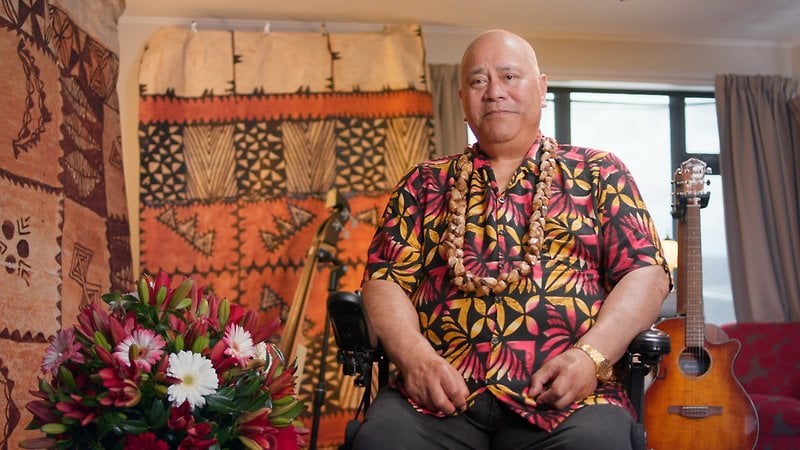
If you’re a Kiwi of a certain vintage, you definitely know “Sweet Lovers”, one of the biggest songs of the ’80s.
The chart-topping hit came from the Holidaymakers, whose cover of Bill Withers’ “We Could Be Sweet Lovers” connected in a big way with New Zealand listeners. Proving this point, the group won an impressive seven gongs at the 1988 New Zealand Music Awards.
The Holidaymakers broke up soon after, the group members going different ways. Amongst them was Fonotī Pati Umaga, who went on to run a contemporary music programme in Whitireia.
Pati’s life changed dramatically in 2005, however, when an accident at home left him paralysed from the neck down. A period of depression inevitably followed, but Pati soon found renewed purpose.
He’s spent the past two decades being a vocal disability advocate, which is expertly captured in My Humble Friend, a revealing new documentary.
Mark Papalii’s film follows Pati’s incredible life story, featuring interviews with the musician and advocate himself alongside chats with family and close friends.
Papalii told me all about My Humble Friend, how great Pati is as a musician and as a person, his thoughts on Aotearoa’s film industry, and more.
Read the full conversation below, and catch My Humble Friend at New Zealand International Film Festival 2026 this weekend (August 1st).
Find out more about My Humble Friend here.
Rolling Stone AU/NZ: Firstly, for younger readers, how big of a star was Pati at his peak?
Mark Papalii: Pati was one of the biggest names in New Zealand music during the late 1980s and early 1990s. As the bass player for the Holidaymakers, he was part of a band that was everywhere. Their version of “Sweet Lovers” became an iconic Kiwi anthem, topping the charts and cementing their place in New Zealand music history.
If you turned on the radio back then, chances are you would have heard Pati’s music. I’m quite sure that “Sweet Lovers” was the first New Zealand single to be certified platinum, which is pretty awesome.
Was Pati’s music always playing in your house growing up?
Absolutely. “Sweet Lovers” was a staple in our house growing up. I think anyone who grew up in New Zealand during the ’80s and ’90s would recognise it instantly. It wasn’t just a hit song — it became part of the soundtrack of so many Kiwi families’ lives.
What’s your favourite song of his?
It’s hard to go past “Sweet Lovers” because of what it represents, but I’d also say “Le Taua o le Pepeve’a”. It speaks to another side of Pati and his connection to his culture, and it’s a song that has stayed with me.
Was it easy to gain interview access to those closest to Pati?
Telling someone’s life story comes with a huge responsibility, especially when it’s someone people love. Trust had to be earned. It really started with Pati believing that I wanted to tell his story honestly and respectfully. Once he opened that door, others slowly followed because they knew the film was coming from the right place.
View this post on Instagram
How important was disability advocacy to Pati?
It’s central to who he is. After his accident, Pati could have withdrawn from the world, but instead he chose to use his experiences to advocate for others living with disabilities. He’s spent years encouraging people, challenging perceptions and proving that disability doesn’t define your value or your ability to contribute.
What’s one thing you hope viewers get out of your film?
I hope people leave believing that no matter what life throws at you, you never stop having purpose. Pati’s story reminds us that setbacks don’t have to define the rest of your life. I hope audiences walk away feeling inspired to keep going, even when the odds seem impossible.
Who is your biggest filmmaking inspiration?
Martin Scorsese and Steven Spielberg have always been huge inspirations. They’re both incredible storytellers who know how to connect [with] audiences emotionally, regardless of the genre. That’s something I’ve always aspired to in my own work.
Is there another Kiwi filmmaker coming through that you’re excited about?
Vea Mafile’o. She’s an incredibly talented Tongan filmmaker whose work continues to raise the bar for Pacific storytelling. I’m really excited to see Lomu screening at this year’s New Zealand International Film Festival, and I think she’s someone audiences should be watching.
Tell me about being a working filmmaker in Aotearoa today. How do you find it?
It’s incredibly rewarding, but it’s also one of the toughest industries to build a career in. The last year has been especially challenging, with a slowdown across the sector meaning many filmmakers, including myself, have had to take on other work while waiting for productions to start again. There are a lot of talented people competing for a small number of opportunities, so your reputation, relationships, and resilience become just as important as your creative ability.
View this post on Instagram
Are funding opportunities easy or difficult to come by?
Funding is one of the biggest challenges facing independent filmmakers in New Zealand. There are opportunities available, but they’re highly competitive, and many great projects miss out. I’ve applied for funding several times without success, which is why My Humble Friend was self-funded.
What one thing would you change about the Aotearoa film industry?
I’d love to see more investment in New Zealand storytellers. We have no shortage of talented filmmakers, writers, and creatives, we just need more opportunities for those stories to be made. Supporting local filmmakers ultimately means telling more uniquely New Zealand stories, and I think audiences here and overseas are hungry for that.
What other films have you worked on in recent years?
I’ve directed several short films, including Emily and Mako, both of which screened at the New Zealand International Film Festival. I’ve also had the opportunity to work across a range of productions in different crew roles, and every project has helped shape the way I approach storytelling.
Do you have any future projects lined up?
Always. I’ve got a few stories I’m developing at the moment, and hopefully the next one won’t require quite as much self-funding! Independent filmmaking takes patience, but there are definitely more projects on the horizon. Watch this space.
From Rolling Stone AU/NZ