




























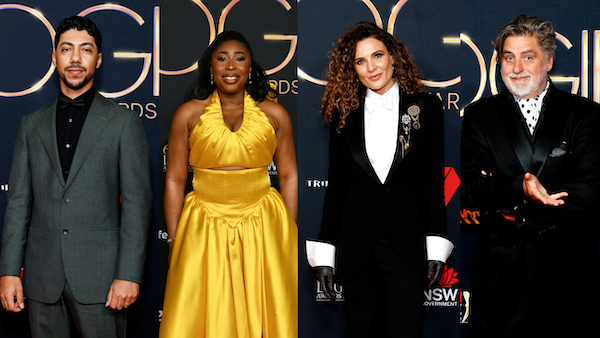
On a night dedicated to celebrating the best of Australian television, some of the industry’s biggest names were also thinking about what it could be doing better.
Variety Australia asked stars on the red carpet at the 66th Annual TV Week Logie Awards on Sunday night (August 16th) a simple question: what is the conversation the Australian screen industry needs to be having that it isn’t?
The answers varied, but a common theme quickly emerged. Australian television needs to become more comfortable taking risks – whether that means backing new talent, putting different faces on screen or giving emerging creatives the freedom to make something that doesn’t feel like what has come before.
“I think the screen industry should keep taking risks,” TV and radio presenter Craig Reucassel, known for “The Chaser,” “War on Waste” and “The Checkout,” told Variety Australia. “That’s how you’re going to keep getting people coming back.”
To him, that means finding and investing in the next generation rather than continually returning to established names. “I’m not saying bring back ‘The Chaser,’ we’re too old,” he joked. “But, you know, who are the new Chasers? Who are the young new Chasers?”
Reucassel said that younger creatives need to be given the opportunity “to make mistakes, to do things wrong” – something several others suggested is becoming increasingly difficult in a risk-averse industry.
Hunter Page-Lochard, who was nominated on the night for his role in “Reckless,” pointed to the kinds of shows being commissioned, arguing there is room for Australian television to embrace a younger and more contemporary sensibility.
“My conversation that I want to have is trying to showcase just more of a cooler, more urban, younger take on Australian TV,” he said. “You know, we don’t have an ‘Atlanta.’ We don’t have a ‘Barry.’ We don’t have some of these cool shows, and we really can. We’ve got the talent for it.”
He continued: “I really think in the next couple of years, this new generation can really try and bring some urban flavour into our TV sector.”
Representation – both in front of and behind the camera – was another recurring concern. Philippa Northeast, the star of Netflix’s new series “My Brilliant Career,” highlighted the importance of ensuring women can see clear pathways into senior creative roles, particularly at the heads-of-department level.
“I think it’s really important to create those educational pathways for females in the industry,” she said. “You can’t really be what you can’t see. So if our heads of department aren’t equally or the majority female, then it’s really hard for young females coming up in the creative industry to see a path forward.”
For “The Twelve” actor Danielle Cormack, representation also needs to extend to the kinds of characters Australian writers are putting on screen. “Representation should always be at the forefront of any conversation in the industry,” she told Variety Australia. “I think it’s been getting better. There’s still room for improvement.”
She also called for greater investment in writing and script development as Australian productions compete in an increasingly crowded global market. “Putting more time into scripts. You know, it’s a very competitive market out there now,” she continued, before adding on a personal note: “Being a female in my 50s, you know, writing for characters around that age, there could be a little bit more of that.”
Others argued the industry should look beyond its established pool of performers altogether.
“Australia could definitely afford to take more risks with the work and to put different faces in works too,” Chika Ikogwe, known for her roles in “Heartbreak High” and “Mix Tape,” said. “It’s incredible that we do have this culture of loyalty and we see similar faces. But there are so many untapped people and undiscovered talent.
“So let’s find the new people, the new diverse people, give them a chance and open the gates a little bit more.”
That willingness to experiment, she argued, should extend beyond casting and into the work itself. “Just taking risks and being bold enough to do something new,” she said. “I think Australia has a great opportunity to be the changemakers and the leaders of that. We don’t always have to copy the US and the UK, which can be great. But we can make our own stuff and we can innovate.”
The push for generational change wasn’t limited to scripted television. One veteran personality – Matt Preston – argued Australian TV also needs to do a better job of developing young presenters rather than relying on the same established names.
“We really don’t nurture enough young on-air talent,” Preston said. “It would be great to see more young on-air talent going there.
“There are, but not enough and not many. And there’s kind of a desire to play it safe and to go with the same names,” he added, acknowledging with a laugh: “I benefit from that, so I’m happy with that.”
His solution? “I think the word is share the mic.”
With social media making it easier than ever for emerging creatives to build audiences outside traditional television, he argued the next step is for Australia’s major broadcasters and production companies to pay attention. “That’s starting to happen,” they said, “but it needs to be taken up by the mainstream, by the legacy as well.”