





























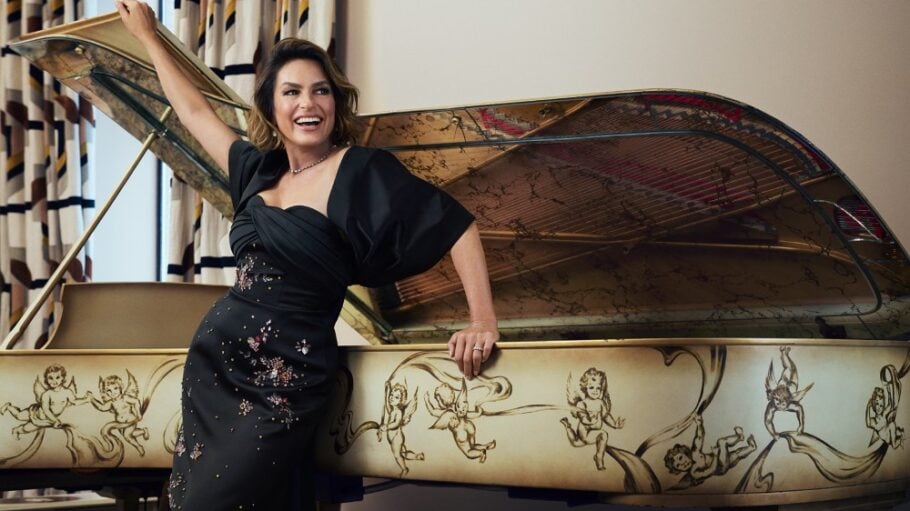
Mariska Hargitay can’t help teasing one thing she might get to do on Emmys night.
“We’ve had five amazing ideas just for the opening,” she says, riffling through script pages she’s left atop a powder-pink binder on the coffee table. She’s welcomed me into her Manhattan home, and we’ve wended through various anterooms — an Emmy statuette hanging out on a shelf here, a needlepoint pillow a fan gave her at a Broadway stage door there, until we’ve gotten to the living room, where her shepherd mix Kaia sits perched on a settee. There are a few concepts Hargitay, slated to be the Sept. 14 telecast’s host, isn’t ready to share, but she’s been brainstorming with a group of writers during lunch breaks on the set of “Law & Order: Special Victims Unit” — Hargitay’s currently shooting Season 28.
She stipulates that it’s all subject to change, but can’t hold in her favourite possibility. “I’ve always wanted to do ‘SVU: The Musical.’”
Mariska Hargitay, song-and-dance woman? It seems hard to fathom, given the role that’s placed her in the modern pantheon of TV stars. On NBC’s “SVU,” all about the pursuit and prosecution of sex criminals, Hargitay’s Olivia Benson has risen through the ranks of the NYPD to captain, doing so with a stern approach to the perps she arrests and a heaping measure of empathy for their victims.
But more than ever before, Hargitay’s trying new things. Her “SVU” job is all-consuming for 10 months a year, so hosting the Emmys is a welcome break from routine. “Chelsea Piers on a soundstage — that’s my life,” she says. “When I go to the Emmys, I get to see everyone — and shows that I get starstruck by.” She wants to meet the actors from “The Pitt” — “I couldn’t turn it off,” she says. “It was so money. I want to hang out with them.”
We already knew that Hargitay could do the specific job of network-TV star as well as anyone alive. But, at 62, she’s experiencing a burst of adventuresome curiosity that many stars half her age can’t match — and operating at the peak of powers she never had to access on “SVU.” This year, she made her Broadway debut in the one-woman show “Every Brilliant Thing.” And at the Emmys, she isn’t just the host, but a nominee for directing and producing “My Mom Jayne,” the HBO documentary about the complicated legacy of Hargitay’s late mother, the actress Jayne Mansfield. Hargitay began shooting her film in 2023 while “SVU” was in production. “I don’t even know how I did it,” she says. “I just fucking started!”
So in one year, she’s become a stage performer, a documentarian, a live emcee —
Love Film & TV?
Get your daily dose of everything happening in music, film and TV in Australia and abroad.

“And I’m a Knick!” she shouts with glee.
Yes, as the New York basketball fans for whom Hargitay became an on-screen avatar would say: Let’s fucking go. Hargitay has long supported the Knicks, and considers point guard Jalen Brunson a friend; when she mentions his name, Kaia bolts upright happily. (As if paying her back for her many evenings spent courtside, he attended a performance of “Every Brilliant Thing” and the New York premiere of “My Mom Jayne.”) “Mariska is my favourite New York Knicks fan,” Brunson says. “I’m so grateful for the relationship we have been able to build over the last few years. As a lifelong fan of ‘SVU,’ her support means the world to me. I’m truly grateful to have her in my corner.“
But her Madison Square Garden appearances at the NBA Finals — during the historic Game 4 comeback, sitting, awestruck, next to Taylor Swift and, postgame, staggering across the court in a state of ecstatic shock — made clear that she’s now the fans’ MVP, and a star whose fame transcends “SVU.” The coverage of the Knicks as a uniting phenomenon featured Hargitay front and centre, which only emphasised the position she’s come to occupy in our culture. She’s a national best friend, unabashedly and perhaps unfashionably earnest, inviting us all to join her in the cheering section.
The Knicks clinched the championship in Game 5, which fell on a Saturday, and Hargitay’s evening performance kept her from watching live. She’d jokingly-but-not asked the theatre if Daniel Radcliffe, who’d originated the role, could fill in for her that night, and the stage manager was unamused. Hargitay watched the second half of the game from home: “My heart was in two places — I’m not going to lie,” she says.
But she’d at least experienced the ecstasy of Game 4, when her team rallied from a 29-point deficit in the third quarter. Hargitay takes a moment to acknowledge what a wild night that was for her: She’d run from the theatre, after slightly shortening her performance, because if she didn’t make it for tip-off, the Knicks organisation would put her in a skybox rather than on the floor. “I’m not interested in sitting in a box!” she says. “I need to be there. I need this for them!” Then she takes herself out of the story. “You’re standing in a miracle,” she says. “The world was changed. New York was changed. The bar of what’s possible has changed. You can be down 29 points and still win — this is what’s in the consciousness of young athletes now.”
Hargitay can relate. After the loss of her mother — who died in a car wreck at 34, with a 3-year-old Mariska in the back seat — Hargitay was raised by Mickey Hargitay, a competitive bodybuilder, who lovingly pushed her to win in whatever she tried. That mentality means that the Emmys won’t just be a coming-out party for Hargitay as a sketch comic. The telecast will also be the latest test for an actor increasingly committed to showing the world all the different ways that she can strive for greatness.
“My dad was an athlete,” she says. “I grew up with ‘Mariska, it takes that much more. That’s what being a champion is.’ I have that every day: ‘How can I be better?’”
Right now, the 29-point deficit Hargitay faces as Emmys host is that very few people in recent memory have converted the gig into a career win. Just last year, Nate Bargatze entered Emmys night as a peak-of-fame comedian, and ended the evening as the object of mass audience disgruntlement after a running joke about winners’ lengthy speeches taking money away from children in need fell flat. The best jobs that recent hosts have done have been unmemorable ones.
Hargitay hadn’t sought out, or even considered, hosting the Emmys before Pearlena Igbokwe, NBCUniversal’s TV chair, called her one afternoon, moments before Hargitay was about to take the stage for a matinee, and offered it to her over the phone. Hargitay was put off. “At first I thought, ‘This is ridiculously thankless — a difficult job that everyone gets ripped apart for. Why? Why would I do that?’” She called friends who had hosted awards shows, and they told her the same thing. Don’t do it.
NBC’s most recent Emmy ceremonies — the show rotates among the broadcast networks annually — have been fronted by performers with more traditional hosting backgrounds (Kenan Thompson, Michael Che and Colin Jost, Seth Meyers). Hargitay may not practice comedy like they do, but Igbokwe says she brings a different strength: “My team was trying to figure out who embodies television, engenders goodwill, and everyone will want to come watch them. And when we got to Mariska, we all looked at each other: Yeah, absolutely.” Igbokwe also believes Hargitay was a less left-field pick than Hargitay thought: “She is funny. She’s got a wicked sense of humour. And, by the way, we’re in the Mariska renaissance. It’s been the year of Mariska!”
Hargitay was craving a break, but she decided — what the hell? — to go for it. “It was just the biggest wrench in the works,” she says. “And then I thought about why I love television. Television, in my opinion, is extraordinarily healing.”
This understanding of TV as healer stems from “SVU”’s subject matter — and the way fans respond to it. “Our show made people talk about sexual assault. Our show changed the culture,” Hargitay says. “And that is the power of television — it creates community, which creates healing. Which is what I’ve wanted to do my whole life.” Hargitay notes, as seems bound to happen in any conversation about a big-tent broadcast, that the nation is politically divided. “I don’t want to talk about that. I love inspiring people. I love bringing people together. I love television.”
Hargitay, a 2006 Emmy winner for “SVU,” is the type of TV star that was thick on the ground when the show started in 1999 but has almost entirely vanished now: a performer with real gravitas who nevertheless shows up to grind it out, 20-plus episodes per season. And while television unites us in the first place, Benson brings us together in a special way. The character isn’t merely beloved because she’s tough and she’s kind. She has a special place in the public imagination because she helps those who’ve been through a startlingly common kind of trauma.
But the intensity of fans’ bond with Benson can get complicated. In 2004, the actor founded the Joyful Heart Foundation, a nonprofit that provides support for victims of sexual assault. Once the show became a hit, Hargitay realised that she was not equipped to carry the weight of her fans’ stories alone. One time, while seated at a play with her husband, Hargitay was approached by a fan who said that “SVU” had saved her life. “I started crying, and I remember, I started shaking,” Hargitay says. “It just started spilling over. I could only hold so much. I had to do a lot of therapy to shore myself up from that.”
“She brings the ability to listen like nobody else, and she can hear you,” Peter Jankowski, president and chief operating officer of “Law & Order” production company Wolf Entertainment, says. “Her character is a broken character who’s compelled to heal other broken people. She does it better than anybody, because in real life, that’s who she is.”
The darkness of the crimes depicted on “SVU,” and the way that viewers identify with and project onto Olivia Benson, may account for Hargitay’s commitment to the franchise even now. Shooting the most recent season finale, Hargitay recalls that director Brenna Malloy asked the cast to take on a night shoot in artificial rain, to lend a cinematic flair to Benson’s pursuit of a killer of children. Hargitay might have pushed back. Instead, “I was like, ‘Bring it! Finish strong.’ I felt so happy, satisfied, sated, proud. That’s how you finish strong.”
As an EP on “SVU” and a director of nine episodes so far, Hargitay evinces a sunny player-coach mentality. It can be hard to believe that she never intended to be a dramatic actress, let alone one who’s nearly 30 years into booking sex offenders. Around Season 25, Hargitay recalls, she was having a conversation with Julianna Margulies, who’d attempted to redefine her career by leaving “ER” in 2000, when it was still a smash hit. “I said, ‘I’ve got to leave the show too. I don’t want people to think I’m a one-trick pony.’ And she goes, ‘Sweetheart, that ship’s sailed.’”
Before her “SVU” audition, Hargitay appeared on “Seinfeld” and “Ellen” and trained with the Groundlings. She appeared in a key role in Season 4 of “ER,” but tended to prefer humour — even developing a dramedy in the vein of “Ally McBeal.” But “SVU,” a spinoff of creator Dick Wolf’s “Law & Order,” a cops-and-lawyers procedural, was going to rely on chemistry: It didn’t just shift its focus to sexual assault but also zoomed in more closely on the NYPD, rather than giving attorneys half the screen time. So the bond between the two lead detectives anchoring the show, written as an empathetic woman and a short-fused, emotionally labile man, would be crucial.
Hargitay and Christopher Meloni — who played Detective Elliot Stabler — felt a connection “from the moment that we set eyes on each other,” Meloni says. “The key of it was humour. If you can communicate through humour, then you have a very tight bond. You experiment with how far you can go. Sometimes it can be very cutting. Sometimes it can be very close to the bone of truth. And if each person can withstand the shots — we may play rough with each other, but if we can communicate comfortably, we can figure out the other stuff.”
Meloni left the show in 2011 after 12 seasons, which was a massive turning point for Hargitay. Reporting at the time indicated that, before negotiations between Meloni and Wolf fell apart and the actor decided to leave, Hargitay’s new contract scaled back her own commitment: She’d been planning to appear in only half the show’s episodes. Suddenly, though, she was single-handedly responsible for carrying “SVU.”
“Chris was No. 1; Mariska was No. 2,” says Ice-T, who’s appeared on the series since its second season. “Chris had notes on every scene, and he was kind of in charge. When you have somebody like that on the set, everybody else is comfortable. ‘I’ll let you do it. Less work for me!’ When Chris left, Mariska took that spot.” For Hargitay, it was a precarious moment. “I wasn’t as vocal,” she recalls. “It was a question for everybody: Can she hold the show? Can she lead the show? Nobody knew.” The performer Mickey Hargitay had trained needed to prove herself. “It was one of those moments,” she says, “of stepping up. And sometimes you don’t step up until there’s a space.”
Hargitay and Meloni remain close, and when I ask him whether he was surprised by his friend’s un-Benson-like work onstage, he says: “We each know what the other is capable of, so there’s never a surprise. But I was so happy to see how much the audience connected with her — it was everything you want.”
Meloni returned to the Wolf universe in 2021 as the lead of the now-concluded “Law & Order: Organized Crime,” on which Hargitay appeared in 14 episodes. It was a mending period after what was, for Hargitay, a painful break. Back in 2011, she says, “I did not want him to leave. I tried so hard to broker that, because it didn’t end great with them.” When I speak with Jankowski, he tells me that Meloni is at that moment visiting the “SVU” base camp at Chelsea Piers for a meeting with showrunner Michele Fazekas. (For his part, Meloni says that the end of “Organized Crime” represents a closing of the door on Stabler, for now: “It’s like when I left the last time. You’ve got to keep moving.”)
Fazekas is the first woman to run “SVU,” returning to the series last season after being in the writers’ room from Seasons 3 through 7. Her arrival was welcome, as Hargitay says she was “getting impatient” for the show to be led by a woman. But even before that shift, “SVU” gave Hargitay moments of surprising empowerment. She recalls the 2023 episode “King of the Moon,” which she directed. It ends with Benson reading a story to an exonerated suspect, a man with dementia (Bradley Whitford). As Benson reads, Whitford’s character envisions himself on a sweetly rendered moonscape, surrounded by stars drawn by a child’s hand. It was an unusual step into sentimentality and fantasy for the show, and Hargitay says it represented her vision brought to life.
“‘SVU,’ we don’t shoot on the moon,” she says. “We shoot in New York City. We had to do this green screen, and it was the most exciting thing, seeing somebody manifest what was in my head.” It was a moment that might never have happened had Hargitay not uncomfortably been forced to step up. And it was yet another pivot point in her long attempt to figure out what kind of work she might do beyond playing Olivia Benson. “It made me feel confident in — what if?” she muses. “What if I wasn’t afraid? What do I want to do?”
Directing an “SVU” episode, even one that ends with a character in imagined outer space, is one thing. Plumbing one’s own story to put it on film is quite another. “My Mom Jayne” pulls at two threads that have defined Hargitay’s life: her ambivalent relationship over time to her mother’s bombshell image and the fact of her true parentage. Viewers were stunned to learn that Hargitay had long known that Mickey is not her biological parent — Las Vegas entertainer Nelson Sardelli is. Hargitay came to this realisation in her 20s, well before “SVU” began, when a Mansfield superfan asked her about the long-standing rumour.
Hargitay considers Mickey her father. “He is the reason I’m standing here today. I’m so proud to be your daughter, Dad,” she said at the conclusion of her 2006 Emmy speech, two and a half weeks before Mickey died of multiple myeloma. But knowing this secret helped Hargitay arrive at a greater understanding of herself, and sharing it helped shake something loose. “It’s no accident that the play came after the movie,” she says. To be onstage eight times a week, with that Olivia Benson jaw at last unclenched and allowing herself to be free and fun — that only happened when she was more open about herself, and what she’d been running from. Walking through her apartment, she shows me a gift from a fan: Two Playbill covers in a frame, side by side. They’re for Mansfield’s 1955 Broadway debut, “Will Success Spoil Rock Hunter?,” and Hargitay’s own, “Every Brilliant Thing” — a show that is, in the end, about struggling to know, and losing, one’s mother.
Mansfield, “My Mom Jayne” makes clear, was a woman of many talents, a multilingual stage actress and instrumentalist who was prized for her figure rather than her mind. Hargitay, unable to speak to or know her mother, spent much of her life pained by the compromises Mansfield had made. “I didn’t like the sex symbol aspect of her personality. She was so much more. I really struggled with the whole … the measurements of it all.” (Mansfield was known for her small waist and large bust.) “I couldn’t understand how the studio system was back then. It’s just too much for a little girl — you don’t even know how to process.”
Hargitay believes that Mansfield’s story subconsciously shifted her own priorities. “I know that she was a victim of domestic violence. It’s no accident that I play somebody who fights for abused women.” Speaking about a film that cuts so deeply to things she long struggled to discuss, Hargitay grows expansive. “I wanted a normal mom, and I kept seeing these images of her running around in a bikini and heels, and that was very stressful for me, because —”
She breaks off. Her oldest child, 20-year-old son August, has entered the living room. He’s home on summer break from college. (Hargitay and her husband, Peter Hermann, an actor she met on “SVU,” have three kids.)
“You can come say hi!” August, strikingly tall and in sweatpants bearing his university’s logo, introduces himself. He’s a philosophy major.
“We’re just talking about the movie, and talking …” Hargitay pauses, trying to figure out how to describe her mother. “About J.M.”
Then Hargitay praises August for supporting her through the challenging emotional work of making the film. “Hell, yeah,” he says. “It was awesome.”
“Leaning into the sharp edges!” Hargitay says as August arranges himself, supine, on a nearby couch. “That’s what that movie was.”
It’s an odd moment of poetry — Hargitay is talking about the complicated family in which she was raised while living in a moment of peace with the family she has built. Lying under a handmade banner, hanging on the wall, that reads “Family Game Night,” August doesn’t leave the room for the next hour, until the interview is over and he gets his mom back.
“My Mom Jayne” introduced Hargitay to a new community: documentarians, who tend not to hold projects about celebrities in high esteem. “The documentary world is a specific group, I’ll just say,” Hargitay tells me. Those who’ve seen the film, she goes on, have been gratifyingly engaged with the work, and not because it’s the story of an “SVU” star. “It’s so much more. They had projected on it and thought it was a celebrity doc. Yeah, it’s not.”
Broadway, with its relentless pace and throw-you-into-the-deep-end approach to rehearsal, provided a similar challenge. Was Hargitay simply a celebrity, or was there more in her tool kit? “Every Brilliant Thing,” co-written by Duncan Macmillan and Jonny Donahoe, requires a great deal of charisma and quick-wittedness. The star, playing an unnamed Narrator, recruits audience members to help act out a story about grief, as her character recounts her mother’s depression and suicide attempts. There’s uplift, but it’s hard-won: The “brilliant things” Hargitay’s Narrator names are reasons to keep on living. Balancing sorrow with ebullient humour and riffing improvisationally with the crowd, Hargitay was working in a very different way than she does on “SVU,” but the comfort Benson provides viewers needed to shine through.
She was at times annoyed by fan behaviour. In one of her shows, as she announced the final brilliant thing that brings joy, an audience member shouted their own: “Seeing Mariska Hargitay on Broadway!” But she was pleased to have found a new gear. “I haven’t had that kind of terror for a long time,” she says. “Learning the lines was — insane. It was such a gift to be a blank canvas.”
The memory has stayed close. “We were on set the other day, and everything was a reference to Broadway,” Ice-T says, imitating her. “‘On Broadway, we do this.’ She’s fucking with us.” (As if to pay the experience forward, Hargitay’s Mighty Entertainment is producing comedian Winnie Stack’s one-woman show at this year’s Edinburgh Fringe — the same festival where “Every Brilliant Thing” broke out in 2014.)
The wealth of new work, though, prompts the question: How much longer will Hargitay want to play Olivia Benson? Asked by email whether the show could survive without Hargitay, Wolf says, “I hope we never have to answer that question.”
Back when Hargitay first told Julianna Margulies she was considering moving on, “I wasn’t ready to leave, because I loved it. And then I got to do all this other stuff, and that’s why I don’t think about leaving right now.” Hargitay says Wolf has lately targeted a 30-season run as his goal. That’d be three more years, during which time Hargitay could do what she’s already proven she can: take on the world, in the hours when she’s not being Benson.
In the past, when she felt the tug to hang up “SVU,” it was because she was worried she wasn’t serving her other interests. “The comedy thing was painful to me,” she says, “because I felt like I was only exercising one part of myself. People would say, ‘You need to get off that show and do comedy. You need to get off that show and have a talk show.’”
But it turns out that she didn’t need to walk away from a show that gives her purpose in order to keep finding ways to make art feel new — that is, as long as she’s willing to work for it. “Do I want to quit now? No. Why? I made a movie while shooting; I did a play for six weeks on hiatus. I’m hosting the Emmys.” Her pace is increasing, her voice growing louder, as she runs through the projects. “Next summer, if I don’t make another movie, I’ll probably do another play. And I love it!” There’s an almost defiant tone now, as if daring me to tell her to quit. “After I made my film,” she concludes, “it was unleashed. Something got unleashed, or broken open, or freed.”
Styling: Erin Walsh/A-Frame Agency; Makeup: Georgi Sandev/Forward Artists/Laura Gellar Beauty; Hair: Orlando Pita/Home Agency; Manicure: Pattie Yankee/Opus Beauty/Essie; Look 1 (cover): Vintage coat: Albright Fashion Library; Shoes: Stuart Weitzman; Tights: Wolford; Look 2 (red look): Dress: Frederick Anderson; Shoes Roger Vivier; Look 3 (blue feather): Dress: Rowen Rose; Look 4 (silver dress): Dress: Michael Kors; Look 5 (nude gown): Gown: Albright Fashion Library/Richard Quinn; Shoes: Prada; Look 6 (black beaded look): Gown: Albright Fashion Library/Erdem; Jewelry throughout: Jessica McCormack, Pomellato
From Variety US