





























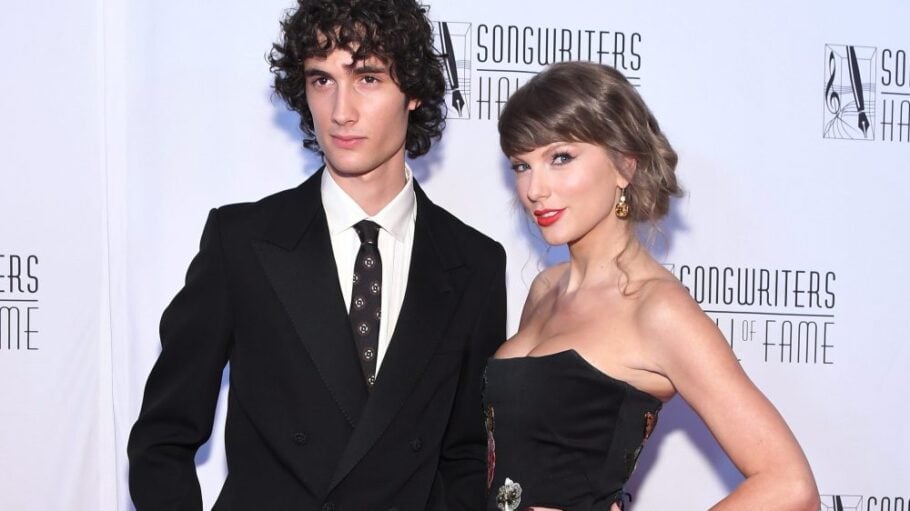
As we say every year, the annual Songwriters Hall of Fame ceremony is a combination of an awards show and a family reunion — an annual gathering of superstars virtually everyone recognises, iconic behind-the-scenes songwriters that a few people recognise, and top executives from the music industry who hardly any normal person recognises. And every non-pandemic year for the last half-century-plus, the ceremony has inducted several legendary, contemporary and up-and-coming talents — and often as not, the inductees say the honour means more to them than any other, because it’s recognition from their peers, many of whom are in the room.
However, when one of the inductees is the most popular musician in the entire world, much of that intimacy inevitably vanishes, and on this night, along with Paul Stanley and Gene Simmons of Kiss, John Fogerty, Alanis Morissette, Raye, Kenny Loggins, and non-performing songwriters Walter Afanasieff, Terry Britten & Graham Lyle and Christopher “Tricky” Stewart, one of those inductees was Taylor Swift. Thus, security was tight and the event did not allow for the usual socializing and table-hopping — and the press, as social media shows, was banished to the balconies.
As she usually is at such events, Swift was in the room for the entire ceremony, seated beside fiancé Travis Kelce and flanked by her mother, early songwriting collaborator Liz Rose, and Steven Spielberg (with wife Kate Capshaw), who would later give her induction speech after Sombr performed “Cardigan” and “Dear John” to her delighted reaction and effusive praise during her speech.
“I have to say thank you to Sombr for that perfect performance,” she said. “His writing is so exceptional that it makes me actually envious, and I love that feeling — he’s gonna be the top of my Spotify Wrapped this year guaranteed, it’s locked, it’s in the bag. A lot of my late night debates with my friends about the state of the music industry involve me saying very loudly, ‘Sombr is the future and he does it all on his own and he doesn’t need AI. The kids are fine.’ And so obviously, Shane is a very well-adjusted person and artist, and doesn’t need any of my advice at all.”
Throughout the night she whooped and rocked out in familiar fashion — so much that, as she took the stage at midnight, as the always-long ceremony entered its fifth hour (and combined with her highly publicised enthusiasm during the Knicks victory the night before), her voice was raspy. (Read her 21-minute speech here in full.)
Sombr sings “Dear John” to honor #TaylorSwift at the 2026 Songwriters Hall of Fame pic.twitter.com/ngW3Y4gId4
— Variety (@Variety) June 12, 2026
Love Film & TV?
Get your daily dose of everything happening in music, film and TV in Australia and abroad.

Spielberg’s introduction was dynamic as well. “As a director, I am acutely aware of the power that music can have on audiences. And as much as I believe that the stories we tell as filmmakers have the potential to entertain and engage, there is something undeniable about how songs enrich our souls,” he said. “Music will always be the guiding force, whether it’s sung in our cars at the top of our lungs, or in houses of worship, or at football games, or on the streets of Minnesota.”
He went on to say that Swift, the youngest female ever to be inducted into the Songwriters Hall of Fame, “has no fear when it comes to shattering records as a writer, singer, and storyteller, a singular artist, and a genuine phenomenon whose place in our culture rivals that of the composers of the American Songbook, Lennon McCartney of the ’60s and the singer-songwriters of the 1970s like Carole King and Stevie ‘Let’s Go Knicks,’” punning the Fleetwood Mac singer-songwriter with the hometown NBA heroes — “and your namesake, James Taylor.”
Noting her long efforts to own her music, he said her “fearless determination to stand up for all artists’ rights is a reflection of her deep understanding of how best to use the meteoric fame that she has been navigating since she was just a teenager.”

Getty Images for Songwriters Hall Of Fame
After initially feeling honoured by the invitation to induct her, Spielberg said, “About five minutes after I hung up, my elation faded slightly because, I mean, what could I possibly say about Taylor that has not already been said? Just thinking about how much true, false, and plain crazy stuff has been written about you boggles the mind. So just out of curiosity, I asked AI if you could tell me how many words have been written about Taylor Swift,” he said to laughter. “And you know what? It couldn’t tell me. Then I asked it, how many words have been written by Taylor Swift? And it couldn’t tell me that either. And I just thought, wow, she is such a force that the depth of her achievements defies AI!,” adding to cheers, “I should have known that something that starts with ‘artificial’ wouldn’t have a clue.”
He concluded, “Through her songs, she has taken billions of people by the hand and by the heart, and lights them with a message that is rooted in community and infused with hope and relatability. Through her songs, she makes us believe that we are in this together and together we can grow up, live, love, make mistakes, succeed, fail, and yet continue to believe in our own self-worth. Somehow, Taylor knows us all too well.
“I love making movies,” he cracked “but I don’t think I will ever fill stadiums of multi-generational fans who want to recite the dialogue from ‘Indiana Jones.’ So thank you, Taylor, for the gift of your stories and for insisting on being an authentic voice in a world where the line between real and fake is increasingly blurred. You are our mirror ball.”
The show began with R&B singer Tamar Braxton honouring Tricky Stewart with a lively performance of “Single Ladies.” During a brief induction speech, Stewart’s longtime friend and fellow Atlanta hitmaker Dallas Austin said, “He is a kind-hearted person, and to me, music is a reflection of the person who created it.” Another performance followed — this time Republic Recording artist Kylie Cantrall singing the Rihanna smash “Umbrella” — before Stewart’s long acceptance speech, in which he reeled off his long history of publishing deals and finished by announcing his newest, with BMG.
Next up was Britten and Lyle, honoured with a jazzy cover of “What’s Love Got to Do With It?,” made famous by Tina Turner in 1984, and a more conventional one from Taylor Dayne on another Turner hit, “Hero.” Jane Seymour gave a warm induction speech, and the pair followed with brief comments of their own, noting that others who’d covered “What’s Love Got to Do With It” before Turner “didn’t have the legs” she did.
Accepting a second award from the Hall was John Fogerty, who was already an inductee but on this night was receiving the Johnny Mercer Awards, recognizing “a writer or writers already inducted into the Songwriters Hall of Fame and judged by the Nominating Committee as having established a history of outstanding creative works.” Veteran rocker Steve Miller gave the induction speech, saying that “John Fogerty is Americana at its finest” and referencing his “unwavering fight for artists’ rights and his decades-long battle to regain the rights to his work,” referencing Fogerty’s long, and ultimately successful, battle with Fantasy Records and subsequent owners.
Fogerty charmed the crowd by taking the stage with an effusive “Hello all you wonderful songwriters!” although his speech went on for nearly half an hour, beginning with him as a three-year-old receiving a record as a gift from his mother (“Oh Susannah!” on one side and “Camptown Races” on the flip) and proceeding seemingly in real time throughout the rest of his 81 years. However, a high point came when he said that he’d finally gained control of his catalogue because he’d “outlived all those sons of bitches!”
He then was joined onstage by two guitarists for not one but four songs: a brief “Oh Susannah” followed by his own hits “Proud Mary,” “Have You Ever Seen Rain?” and finally “The Old Man Down the Road,” which concluded with a long and fiery guitar duel. By the time he left the stage, Fogerty’s segment alone had lasted for more than 45 minutes and deflated the mood. However, eyebrows raised when, next up, Mariah Carey hitmaker Walter Afanaesieff was inducted by his friend, actor Jeremy Renner, praising him for creating “the soundtrack of our lives,” and a lovely version of “One Sweet Day” from Sheléa.
A jolt of energy hit the room as Smashing Pumpkins frontman Billy Corgan entered the stage wearing dark eye makeup and clad in one of his now-characteristic long tunics — an incongruously serious getup in which to be singing Kiss’ classic “Rock and Roll All Night.” He was then joined by Goo Goo Dolls singer Johnny Rzaznik, and as the pair took the podium, Corgan said “We just lived a childhood dream!”
The pair paid tribute to the “demonic dynamic duo” of Stanley and Simmons and their half-century long partnership, before ceding the stage to Stanley, who said how humbled he was to be on the stage before explaining that his “partner of 57 years” had an unspecified family emergency and was currently at a hospital. He continued by saying that amid the “bombs and the bombast and all the things the band is known for, it’s nothing without a song,” and recalled his days as a young musician trying to hawk his songs at the legendary Brill Building in Manhattan and hoping one day to emulate his songwriting heroes there like Carole King, Doc Pomus, how she longed to hear Ellie Greenwich and others. Stanley, 74, added, “At this point in my life, I say I f you love me let me know — don’t save it for my obituary!”
The evening took an unusual turn as a violinist and cellist — SistaStrings — took the stage and were followed by Brandi Carlile bearing an acoustic guitar. The musicians then proceeded to peel off a fiery cover of Alanis Morissette’s “Uninvited” that was the most musically innovative performance of the night.
During the induction speech, Carlile spoke of being a young gay woman in the Pacific Northwest, growing up amid the sound of “angry young white men” singing the grunge music that emanated from the region and how she “longed to hear a woman’s voice singing rock and roll — and it came from Ottawa, Canada.” She spoke effusively of Morissette’s “unusual cadence and unhinged precision,” and how her music is a “masterclass on knowing oneself, and challenge what it means to be a woman.”

Getty Images for for Songwriters Hall Of Fame
Morissette, clad in a glittering gold dress, took the podium and said that “writing has always been a survival strategy, an imperative. It helps me locate and find myself from outside-in, as opposed to inside-out.
“I love humans, but don’t get me wrong” — she laughed — “I hate us sometimes too.” Accompanied by two guitarists, she then played “Merry Go Round” and the 1995 hit that put her on the map, “You Oughta Know.”
Next up was Raye, who received the Hal David Starlight Award for rising young talent, but likely just as much for her fierce advocacy for songwriters, who, as everyone in the room knows all too well, are unfairly at the bottom of the streaming economy. She was inducted by none other than Chic cofounder and legendary producer, songwriter and guitarist Nile Rodgers, who has been chairman of the Songwriters Hall of Fame for some eight years. He said he would keep the introduction short — adding “Yo, John,” with a laugh to Fogerty — before ceding the stage to Raye.
She too said that although she is naturally verbose and “I’m sometimes irritating and annoying to some people” and would keep it short, but “we have an obligation to protect [songwriters] — it can’t just be rich people writing songs!” and then spoke briefly but emphatically of the need for songwriters to receive “points on the master” — meaning a percentage of the profit, which artists, labels, publishers and producers receive but songwriters inexplicably do not.
The pre-Taylor show concluded with Gavin DeGraw paying tribute to Kenny Loggins with a slow, soulful version of his 1972 hit “Danny’s Song,” an arrangement so imaginative that Loggins joked at the beginning of his speech “What song was that?” He too spoke at length about how music came into his childhood via his brother’s record collection, which he was forbidden to play but did anyway.
In a telling moment for the rebellious spirit of rock and roll and a tip for parents everywhere, he said, “If you want your kids to love music — forbid it!”
From Variety US