





























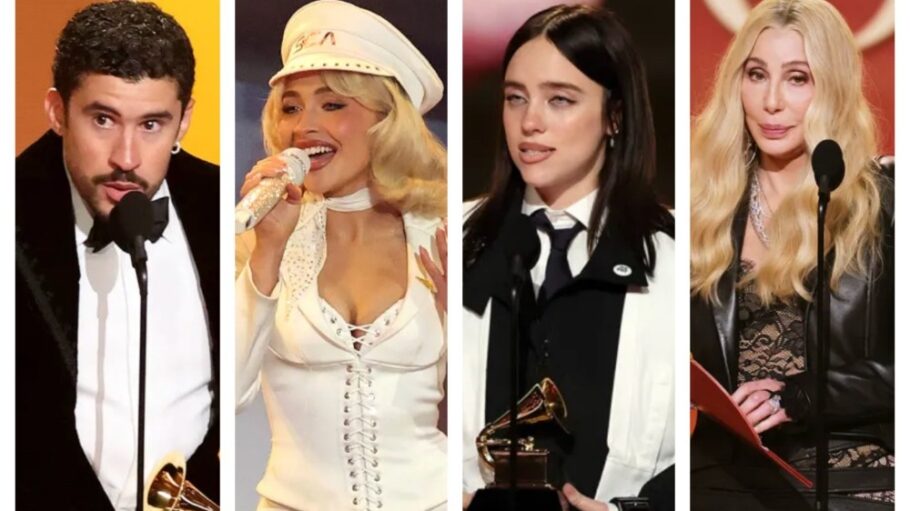
What was your favorite part of the 2026 Grammys, if you watched? Was it seeing the succession of artists who spoke up to address the deportation raids that are roiling the nation, with either blunt-force language about federal agents or thoughtful appreciation of immigrants? Maybe it was seeing Bad Bunny getting the climactic win, for album of the year, and using that platform to say “ICE out” and to make a moving declaration on behalf of anyone who has been “other”-ed in this country: “We’re not savage, we’re not animals, we are not aliens, we are humans, and we are Americans.”
Or… was your favorite part when Cher forgot to give out an award, and then, when she did, gave it to Luther Vandross?
We’re among friends here; we can be honest. The tension between the show’s somber and silly moments felt a little difficult to navigate, but that’s a reflection of how a lot of us are torn between the lure of celebratory entertainment-as-usual and a righteous anger, or sadness, over the chaos being wreaked by the federal government in local communities. So, if you’re like me, maybe you wanted to stand and cheer when artists like Billie Eilish, Olivia Dean, Kehlani, SZA and Shaboozey were bold enough to make statements against the current oppression, or in support of the value of immigrants. And perhaps, also, like me, you wanted to cheer when a Sabrina Carpenter or a Tyler, the Creator turned in a big, satisfying, old-fashioned production number.
We may all need more time in this fractured state we’ve been thrust into before we determine whether we’re Team Billie “Fuck ICE” Eilish or Team Bruno “What Good Is Beauty if Your Booty Can’t Find the Beat?” Mars, or a bit of both. These are strange times we’re in, and the bifurcation made for a strange Grammys, with some utterly opposite-feeling highlights.
If this is destined to be remembered as a “political” show, from all the headlines that were generated by the night’s anti-ICE statements, the Grammys very much backed into that, and not necessarily willingly. It’s unlikely CBS was eager to have the show seen that way, even if this was the last year the Grammys would be on the network before moving on to ABC in 2027. There was some wishful thinking going around out there that the show might prove its relevance by booking Bruce Springsteen to sing his new song, “Streets of Minneapolis.” If you’ve followed CBS and its ownership and practices at all lately, you knew the odds of seeing Bruce opening the night with a protest song were about as likely as Bari Weiss tossing her Free Press recuits of her newsroom in favor of poaching the entire MS NOW masthead.
But the artists were determined to make it happen anyway, or at least some were, first with the buttons on the red carpet — as omnipresent as red ribbons, once upon another troubled time — and then with statements, in the 220-minute pre-telecast “premiere ceremony” and the equally long prime-time broadcast. CBS probably didn’t have that much to lose by this happening, aside from a Truth Social or two from Donald J. Trump (he obliged quickly, there) and a couple days’ worth of wokeness accusations on X. They could privately blame it on the incorrigible talent, making the case that they only intended to throw a house party and couldn’t be responsible for the kids trashing the place.
But for the music community at large, the stakes felt much higher. Like: Could music even hold the pretense of relevance, going forward, if everyone in its elite class held their tongues, right now, for three and a half hours? If you’re a music fan, you ought not to be telling your heroes exactly what they should be saying, but it’s right to expect that their consciences would compel them to say something. Sunday night, enough did.
Love Film & TV?
Get your daily dose of everything happening in music, film and TV in Australia and abroad.

At the start of the prime-time telecast, it was show business-as-usual. Mars opened with the first of two giddy performances, offering a sneak preview of how he may even further dominate the 2027 Grammys telecast, singing “APT” with Rosé as if it were a rock ‘n’ roll song. (Lady Gaga later did something similar with her “rock version” of “Abracadabra.”)
Then Trevor Noah did his sixth and final monologue as Grammys host, and it’s been five years now since everyone learned that he does these gigs in his apolitical mode, brushing on topical issues at least as lightly as a Jimmy Fallon. It was all about celebrating who was in the room, with no edge to any of the recognitions; he is the anti-Nikki Glazer, in that way. The closest he came to getting a little rough was in making a joke about another Nicki, the currently demonized Nicki Minaj, and her ass size in relation to Trump’s… followed later to a hypothetical reference to Trump’s friendship with Jeffrey Epstein that had the president staying up late on his socials, threatening to sue. Even with that reaction, Noah’s “blows” seemed glancing at most — the president should have been counting his blessings, compared with what a Kimmell would’ve been doing in this spot. And yet, now that we’ve had years to become accustomed to Noah doing the inoffensive opposite of his “Daily Show” persona when he comes to the Grammys, you can see that there’s something sweet about his ultra-avuncular cheerleading for the artists that may be missed, depending on who ABC lands as his successor next year.
It felt like the cheerful side of the show really took flight with Carpenter’s baggage-claim-set performance of “Manchild,” a song that’s been done on television enough times now that we probably didn’t need to have her do it again — unless she is always going to find a way to present it as over-the-top as this, in which case, sure, bring it on a few more times. The elaborate stage set seemed to extend halfway to LAX, with actual carousels delivering men in bulk, instead of suitcases, like a Cecil B. DeMille cast-of-thousands version of the Village People. It was charmingly choreographed and delightful, and if Carpenter did not go on to win any Grammys this year, she won at the Grammys.
Are we still only 20 minutes into a three-hour-40 minute show? There is a lot to unpack, besides Carpenter’s luggage. As with Sabrina, Gaga was compelled to bring out her biggest recent single and nominated song, even if her fan base might prefer a deeper cut at this point. And here as well, it was just fine getting the biggest hit again, as Gaga wore what appeared to be a designer wicker lampshade on her head, forcing a camera crew to find creative ways of capturing views of her face within it. (According to those inside the house at Crypto, it was robot cameras making all those sudden movements.) It was an effective tour tease that can only raise resale prices even higher for the next sold-out U.S. leg of her Mayhem Ball, even if concertgoers won’t get Andrew Watt in his sideman-rocker mode there.
Justin Bieber’s return to public singing after about three and a half years of keeping himself under wraps was much anticipated, and he delivered a cool performance — perhaps cooler than producers might have liked, in terms of delivering something buzzy to talk about around the water cooler the next day. But it did a nice job of reflecting the lo-fi vibe of parts of his “Swag” projects, even if, unlike Gaga, Bieber did not bring any of his celebrity producers along for the ride but came riding in strictly solo, without even a shirt for accompaniment. He did “Yukon” Ed Sheeran-style, creating a loop with his electric guitar to sing over, and we all reckoned with the idea of Bieber as something we wouldn’t have imagined a few years ago, a quasi-indie-rock minimalist. If only we could be sure if he really wanted to be there; he didn’t crack any more of a smile while singing then he did while enduring Noah’s compliments during the monologue, where he looked like the least eager awards show guest since Ben Affleck on this same occasion three years ago. It’s all right: he owes us no sign of his teeth when he’s this generous with his abs.
And then there was Tyler, the Creator, eternally maximalist and playful under these circumstances, here blowing up a house real good and ending by playing dead, appropriate for a medley that includes “Thought I Was Dead.” He got his own memo.
The list of performance segments for the 2026 Grammys looks impossibly short, on paper, for a telecast that stretched past its planned three-and-a-half-hour end point. But that’s because much of the available time for performing was given over to two epic performing slots that each seemed to go on forever… which, in this case, is intended as a compliment. The first was an epic segment devoted to allowing all eight nominees for best new artist to play a few minutes of one of their signature songs. The other was an In Memoriam that went on even longer and more elaborately than the BNA spotlight.
The Grammys: They see dead people. And they also see young people. It must’ve taken a little nerve, letting these two spots take up such huge chunks of the show. But it paid off. Rewarding fresh talent and celebrating the dearly departed — these are twin poles that the show was right to emphasize, to an extreme level. (Going so long with the BNA nominees stood in stark contrast to the 2024 show, after which my review complained that “the show has forgotten how to spotlight new artists.” What a happy difference a couple of years can make.)
The best new artist segment began with a kind of cold open with the Marias doing their lonely-dreamscape thing. It then made the most abrupt possible segue to Addison Rae, doing her sex-bomb thing in the bowels of the arena, in what appeared to curiously be the one pre-taped moment of the night (reminiscent of the pandemic-era Grammys, when that happened more often). Katseye brought things back into the actual auditorium, and lit up a very devoted fandom, with a “Gnarly” that lived up to its sensational name. Leon Thomas’ “Mutt” provided the first quality neo-soul of the evening; there would be a lot more of that to come in the In Memoriam, but it’s good to know it doesn’t require a death in the family to deliver these more traditional R&B pleasures. Alex Warren went Soarin’ Over California with an aloft performance of “Holy” — nearer his God to thee, and all that. Lola Young, who would later score one of the night’s biggest surprise wins, stayed earthbound with a short solo piano performance that went right from 0-to-60 on the emo/belting scale.
Olivia Dean didn’t get nearly enough time to demonstrate all of the easy charm that is making her potentially the biggest superstar breakout of this year’s crop, but even an abridged “Man I Need” offered evidence enough of her chops and charisma. (If there’s a reason it didn’t feel like a crime that she didn’t have a longer performance slot of her own, it’s because she’ll obviously be back at the 2027 Grammys, when her album will be in contention and she may have some frontrunner songs as well.) Finally, in the BNA marathon, there was Sombr, a real rock star with his wobbly-teardrop mic stand and a cocky-yet-vulnerable-yet-cocky attitude.
Could the best new decedent segment outdo the best new artist segment, in length and quality? It could. Without looking it up, it seems possible that the Grammys devoted this much time to memorials before in a single night, but not all linked together in a single segment that felt “Lawrence of Arabia”-sized. There was a hell of a lot of music crammed in, even with the legacy of the late Brian Wilson and Sly Stone being limited to spoken tributes. The trifurcated In Memoriam began with Reba McIntire, Brandy Clark and Lukas Nelson singing “Trailblazer,” a song about lost country music heroes that was extended here to serve as accompaniment for the traditional slide show of the recently fallen. Then Post Malone led an all-star band in tribute to Ozzy Osbourne with “War Pigs,” offering possibly the first and last appearance on the Grammys stage of a Red Solo Cup, because Post Malone. It could’ve benefited from more of a belter, but his heart was in the right plastic beverage container.
Finally, as the stairway to heaven seemed like it might be about ready to roll up, Ms. Lauryn Hill hosted a double-fisted salute to D’Angelo and Roberta Flack that by itself lasted longer than most traditional full In Memoriams. It was sublime, even if it quickly became apparent that most of the stars being trotted out on stage would only get a couple of bars before we moved on to the next neo-soul all-star. Here’s Leon Bridges! No, here’s Lalah Hathaway! No, here’s Chaka Khan! (And Lucky Daye and Raphael Saadiq and Anthony Hamilton and John Legend and… you get the idea.) With the level of talent in this bit alone, the revue should have been booked for its own three-and-a-half-hour time slot.
With a cavalcade-of-stars moment like that bringing down the house, it was almost difficult for politics — or the real-life stuff that gets perceived as politics — to take priority in how the 2026 Grammys were seen, by the media and by many viewers. But it felt right that many of the night’s winners and presenters felt compelled to at least share their ambiguous feelings about partying or making a joyful noise in this time of national crisis. And, at most, to bust out the understandable F-bombs. Some of the artists may feel an acute awareness that, when some of the potential viewers at home feel like their communities are under siege, this is a moment where indulging in pure escapism can feel like complicity. At least these Grammys will be remembered for opening the door a crack to let the real world in, whether or not everyone involved felt driven to participate in that same mission.
But finally… Cher. Should we talk Cher? Bad Bunny talked a lot about love in his speech, and although he was referring to a hope of overcoming the tendency to meet hate with hate, it was also easy to think about love when Cher was on stage. As in, she is the kind of mega-celebrity who somehow only breeds more heartfelt adoration as she goes. Even when she makes multiple sequential flubs, as she did Sunday night, the audience is looking to laugh with her, not at her. (And “Luther” is rooted in Luther Vandross, so this was not a total Adele Dazeem moment.) Speaking of love: “I love live television,” said Noah, simply, after the smile-inducing Cher moments, and this was no year to do anything but agree with that.
From Variety US