




























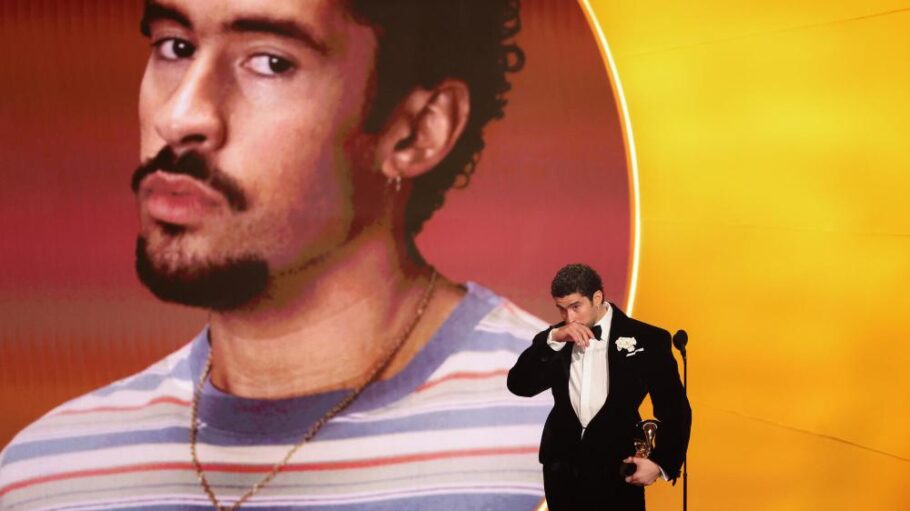
When Puerto Rican-born Benito Antonio Martínez Ocasio — better known as Bad Bunny — walked onto the Grammy stage at the end of the night, tears coming down his face, he was holding more than a historic album of the year statuette.
Bad Bunny held the weight of every abuela who crossed a border with little more than hope and determination. He held every father who was detained on his way to work. He held every child who now fears the sound of a knock at the door. And most of all, it was for everyone who has been disparaged for their language, their music and their culture. Remember the vile “joke” about Puerto Rico heard at Donald Trump’s October 2024 presidential campaign rally?
But not tonight.
Bad Bunny’s smash album “Debí Tirar Más Fotos” (“I Should Have Taken More Photos”) became the first primarily Spanish-language album to win the Grammy for album of the year. After decades of Latin artists shaping the sound of American music, after generations of our stories being told, our rhythms borrowed, our culture consumed, the industry’s highest honor finally went to an album sung in the language our mothers pray in. Sunday night’s Grammys belonged to Bad Bunny. But they also belonged to all of us. Still, the win tastes bittersweet at this time.
Our communities are under siege from the Trump administration’s cruel campaign of terror around immigration enforcement. Yet every movement has a moment when pain transforms into power. We can only imagine that at the moment Bad Bunny’s name was called, ICE agents were tearing families apart across the country. The Trump administration’s assault on Latino communities has created a climate of terror, one designed to erase us and make us feel invisible.

Love Film & TV?
Get your daily dose of everything happening in music, film and TV in Australia and abroad.

Against that backdrop, Bad Bunny’s declaration earlier in the night — “ICE out. We’re not savages. We’re not animals. We’re not aliens” — landed as a rallying cry. He’s about to step on an even bigger stage next Sunday as the star performer in the Super Bowl Halftime show. And still, Benito Antonio Martínez Ocasio needs to tell America: “We’re not savages.”
Personally, the tension of this moment felt unbearably close to home for my family and me.
Earlier on Sunday, my wife and I watched a video from our old neighborhood in Jersey City Heights, mere blocks from our former home and my in-laws. We watched in horror as a woman recorded an encounter with a Spanish-speaking man being handcuffed by an ICE agent. She asked his name and his date of birth. He pulled down his face covering — it was 10 degrees that day — so she could see him clearly, so he could be adequately identified.
Then the man broke free for a moment and ran.
The ICE agent caught him and would return to mock the woman recording, telling her to “get a job.” As the man was being walked back to the agent’s unmarked car with no license plate, he spotted another Latino approaching and yelled, “¡Corre!” — run. He was taken away. As of this writing, we don’t know where he is.
The cruel irony is impossible to ignore: on the same night American music’s most prestigious institution affirmed that our art belongs at the pinnacle of creative achievement, our communities are being told we don’t belong here at all.
But there is one thing they can never take from us: our voice. When Bad Bunny spoke, he did so in Spanish. He was unapologetic and powerful.
He thanked God, the Recording Academy, his mother, and his collaborators. He also gave us the key message we all needed to hear: “Hate gets more powerful with more hate. The only thing more powerful than hate is love.”
In dedicating his award to “all the people who had to leave their homeland and country to follow their dreams,” Bad Bunny articulated the soul of “Debí Tirar Más Fotos.” The album is about nostalgia, Puerto Rico and the ache of what’s lost and the fight to remember. It’s about capturing moments before they slip away, and preserving memory in the face of erasure.
Bad Bunny didn’t just win for himself. He won for fellow Boricua Marc Anthony. For Cubana Celia Cruz. For all the legends who paved roads they never got to walk themselves.
When Bad Bunny said, “We are Americans,” he asserted a truth that shouldn’t need defending. Our American-ness is not up for debate. We are not guests to be tolerated. Our labor built this country, and our culture enriches it.
ICE out. Love in.
From Variety US