





























The “Scream” movies, at their best, are delectable booby-trapped entertainments, and part of that is how cleverly they stay a step ahead of us. But there’s a moment in “Scream 7” that typifies the sensation this new movie gives you: that it’s leading the audience and lagging behind it at the same time.
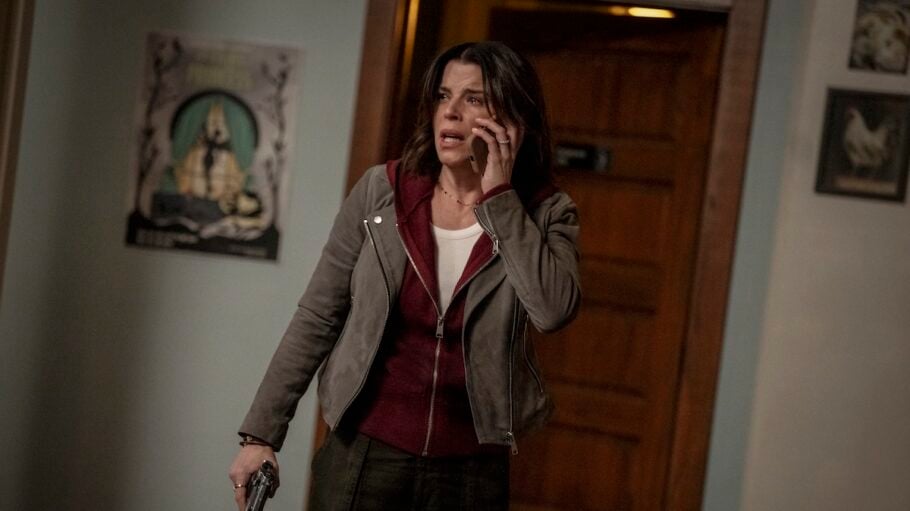
We’re watching a homicidal pursuit through the home of Sidney Prescott (Neve Campbell), who is not only back but once again the central character (let’s call her the Final Girl as Mom). Sidney and her teenage daughter, Tatum (Isabel May), a kind of Final Girl in Training, are attempting to elude the blade of Ghostface. There’s a good bit where they inch along a catwalk behind the living-room wall, with Ghostface stabbing it from the other side. He misses, and they wind up on the street outside, where the killer gets smashed by a car that comes barreling out of nowhere (the driver, in fact, turns out to be an old friend).
The killer’s costume-shop Edvard Munch mask gets pulled off, revealing his identity, and this is followed by some chatter about how Ghostface often turns out to be more than one person. You don’t say! Considering that we’re only 45 minutes into the movie, that’s kind of a super duh. “Scream 7” is inadvertantly revealing its true theme, which is: Does anyone even care anymore who Ghostface is? Once all the obvious suspects have been eliminated, the answer is destined to be as arbitrary as it is forgettable.
The last two “Scream” films were nothing if not busy — nearly antic at times, stuffed to the bloody gills with backstory and mythology and schlock trivia. Yet there’s no denying that that was part of what kept the pulse of the series alive. In the lead-up to “Scream 7,” however, the busy quality seemed to transfer over to the drama offscreen: the firing of Melissa Barrera after comments she made that some judged to be antisemitic; the bowing out of Jenna Ortega; the fight over Neve Campbell’s salary (she sat out “Scream VI”); the fact that the directors who’d taken over the franchise, Matt Bettinelli-Olpin and Tyler Gillett, opted out, and their replacement, Christopher Landon, then quit after he started getting death threats over Barrera’s firing.
As if to calm the waters, the reins were handed back to Kevin Williamson, who 30 years ago wrote and created the original “Scream.” He was the series’ true auteur: the one who devised the whole concept of a meta slasher movie, a trash thriller maze that would be equal parts straight horror and a hack-’em-up version of Trivial Pursuit.
But Williamson returns to the “Scream” franchise, now directing one of the films for the first time, with a weirdly restricted agenda. The whole slaughter-movie scholarship side of the “Scream” films — “Look! We’re deconstructing the prospect of our own deaths like horror-film-class geeks!” — has basically been played out. And the series is all too aware of that. Williamson knows that he can’t just go back to that age-of-VHS ’90s drawing board. So what he’s done instead is to return the series to its “roots” in a straightforward, analog, Jamie Lee Curtis-in-the-rebooted-“Halloween”-franchise sort of way. “Scream 7” has enough shocks and yocks to keep the product churning and the audience, at least for a weekend, turning out. Williamson has gone back to basics, but the result is a “Scream” sequel that, while it nods in the direction of being seductively convoluted, is really just…basic.
The teenage Tatum, named for Sidney’s late lamented bestie (the Rose McGowan character from the original “Scream”), has a boyfriend, Ben (Sam Rechner) who smirks too much, along with a minor circle of friends who could all, theoretically, be suspects. But they get bumped off with a regularity that lets us know the mystery is elsewhere. One of the murders is a grisly piece of showmanship: Hannah (Mckenna Grace), flying around on a harness as she rehearses the high-school play, gets slashed with Ghostface’s knife until her innards fall out. But that scene is the exception to the film’s rule of routine “sensational” killings. Simply put, “Scream 7” isn’t very scary, and it isn’t very inventively gory (which some of the sequels have been).
Love Film & TV?
Get your daily dose of everything happening in music, film and TV in Australia and abroad.

The film opens with a fun variation on the ritual Ghostface phone call: Scott and Madison (Jimmy Tatro and Michelle Randolph) are visiting the former home of Stu Macher, which has been turned into a slasher museum. Among the nostalgic artifacts is a life-size Ghostface model that turns its head via movement sensors. Roger L. Jackson is once again the voice of Ghostface (the aggro psycho as AM radio DJ), and all of this erupts into a satisfyingly incendiary prelude.
But once “Scream 7” settles into its main story, Williamson adopts a tone of mordant sincerity regarding Sidney and the trauma she can’t seem to outrun. Courteney Cox’s Gale Weathers shows up, and she too becomes a major player, though the “media” commentary is strictly pro forma. The film has better luck reviving Matthew Lillard’s Stu, a character we were certain was dead‚ and he may in fact be. But then how is Stu, with mottled skin, calling up Sidney and conducting threatening live video-phone chats with her? Lillard’s raging performance could almost be his answer to Quentin Tarantino’s dis of him. The actor, like the character, is saying, “I’m still here,” and that’s true even if Stu is just a deepfake.
As Mindy, the aspiring TV news reporter who’s working for Gale, Jasmin Savoy Brown gets to deliver the film’s few token snippets of horror-snob geekery, and she’s so good at it that she made me wish Williamson had included more of it. Maybe the reason this stuff got so played out is that the series, creatively speaking, could actually use a more expansive vision of what horror movies are. But that’s not about to happen, because the “Scream” films are so successful they’re now effectively trapped in a genre that can’t risk being too smart about playing dumb.
From Variety US