





























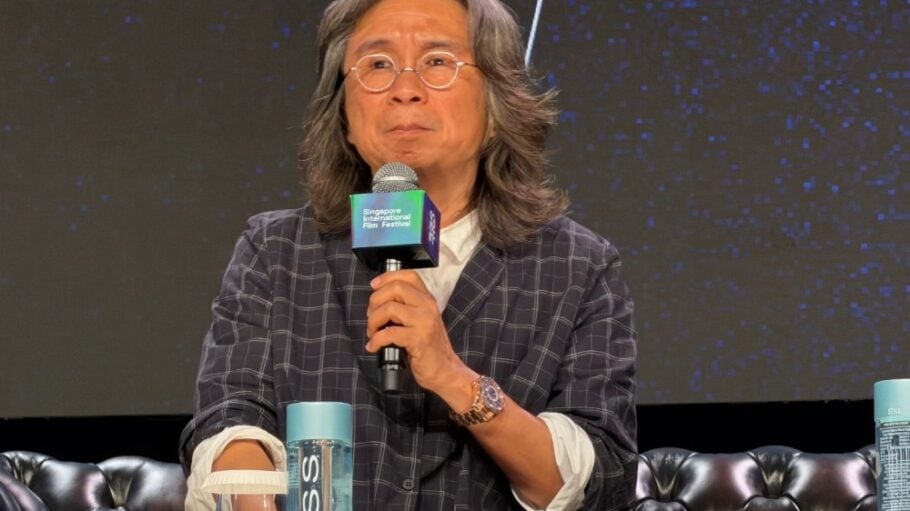
Acclaimed Asian filmmaker Peter Chan Ho-sun, director of “Comrades: Almost a Love Story” and “The Warlords,” said he will probably use AI in his filmmaking but “definitely not AIGC,” or AI-generated content, and that the two-hour feature will hold its ground against short-form and vertical dramas, at least in his lifetime.
Speaking at an In Conversation event at the Singapore International Film Festival, Chan was asked by an audience member whether he had ever doubted his decision to go into the film industry. His advice to aspiring filmmakers: “This is probably the toughest time for film, but do I believe this medium is going to be lost and gone to short-form entertainment? No.”
He said he would probably use AI as a technique, the way the industry already uses CGI and special effects, noting that CGI has relied on AI for years without calling it that. “Anything that helps me make movies, I welcome. But they won’t know art. Movies are still made by people,” Chan said.
Young audiences’ shrinking attention spans have them turning to short and vertical dramas, Chan said, while at the other end, people are listening to podcasts that run for hours, and Christopher Nolan did podcasts around the world to explain his purist approach of making “Oppenheimer” the way movies were made in the ’50s. “So there are two completely opposite ends of the spectrum that are surviving and thriving simultaneously. So I believe that movie will be around for a long, long time,” he told a rapt audience at the Grand Ballroom, Marina Bay Sands.
Chan’s latest film, “The Road Not Taken,” premiered in Toronto. “My new movie is about Alzheimer’s, but it’s really not just about Alzheimer’s. It’s about a broken family that has all sorts of problems a family could have,” he said.
The story centers on a couple in the middle of divorce proceedings when the wife, who has early-onset Alzheimer’s, no longer remembers the divorce and drifts back in her mind to the time they fell in love in their 20s. A harsh grandfather and the couple’s relationship with their Gen Z daughter complete the picture. The daughter in the film is 20, the same age as Chan’s own daughter, who is training to become an actor. Chan’s partner is actor Sandra Ng.
The English title comes from the Robert Frost poem, which Chan called his life motto, while the Chinese title, “Ming Tian Hui Geng Hao,” translates as “Tomorrow Will Be Better.” “There’s really no right path,” he said. “Whether it’s right or wrong, it’s all about how you walk it. You make it right.”
Love Film & TV?
Get your daily dose of everything happening in music, film and TV in Australia and abroad.

While researching the film, Chan visited an Alzheimer’s care institution in Chengdu, in China’s Sichuan province, where he picked up an eight-word Mandarin phrase that he used to sum up his career: go with the flow, and know when to stop. In the ’90s, when he was making romantic comedies at United Filmmakers Organization (UFO), the company he co-founded, gangster pictures and wuxia ruled Hong Kong screens. “We were not exactly going with the flow, but we did make the flow, somehow,” he said.
That same flow later carried him to “The Warlords,” which he described as his biggest film. “Never had I thought that I would ever make a historical epic battle movie with Jet Li. That was never, ever in my agenda for my entire life,” Chan said.
This year marks the 30th anniversary of “Comrades,” which Chan made at 34 as his seventh feature and which captures Hong Kong between 1985 and 1995. He left Hong Kong on Christmas Eve 1996, and only after returning from America around two and a half years later did he grasp how deeply the film had affected filmmakers in mainland China, South Korea and Southeast Asia, even though, he said, it probably only barely recouped its investment.
“That movie gave me a lease of movie life for the next 30 years, until now,” Chan said.
He said 90% of people remember him for that single film, “as if I have not done better afterwards,” calling it a blessing but also a spell he wanted to break.
Chan, who also said the ’90s marked the start of Hong Kong cinema’s decline rather than its golden age, described his DreamWorks film “The Love Letter” as a difficult experience. He was not thrown by working across cultures, he said, having grown up Thai-Chinese and feeling like an outsider even in Hong Kong. What he struggled with was a corporate system where it was unclear who called the shots, and a reliance on test screenings that he likened to today’s algorithms. He said he was probably the first, if not the only, Hong Kong filmmaker to make a non-action film inside the U.S. studio system.
“Had I gone to America or Hollywood with the knowledge that I have of film and marketing and dealing with corporate, I probably would have fared better,” Chan said. “I was too young then, too naive.”
Asked later by an audience member how he navigates censorship in mainland China, Chan said: “Dealing with a corporate is very, very difficult. And if I can survive that, I can survive anything.” He added that limitations of budget, stars, studios or censorship tend to push filmmakers to be more creative.
After Hollywood, Chan set up Applause Pictures, a pan-Asian venture that made 10 films in two and a half years, most of them horror. Its output included “The Eye” franchise and the “Three” horror omnibus films, which brought together directors including Park Chan-wook, Miike Takashi, Kim Jee-woon and Fruit Chan. He also executive produced “One Fine Spring Day” for Korean director Hur Jin-ho – director of SGIFF opener “The Assassin(s)” – whose debut “Christmas in August” he loved. But a planned three-part love story with Hur and Japan’s Iwai Shunji found no investors.
“If we continue this pan-Asian effort, I’m going to be stuck with making horror films my whole life,” Chan said of the decision to move on to mainland China, where his first film was the 2005 musical “Perhaps Love.”
An aspiring screenwriter in the audience asked how he handles a scene that isn’t landing. “I don’t usually fix it for them. I make them fix it over and over and over and over again,” Chan said, adding that after saying “great” to everything at home, he doesn’t do the same with his writers.
He credited nine writers on “The Warlords,” and said screenwriters joke that his films’ writers would not fit in a minibus. “I milk the writer to death, and then I milk another writer,” he said. “So the writers’ community really don’t like me very much. But making movies is not about being well-liked.”
Though he is often seen as a genre-hopper, Chan said the same concerns run through his work, citing the love triangles in his debut “Alan & Eric: Between Hello and Goodbye,” “Comrades,” “Perhaps Love” and even “The Warlords,” which he called a love triangle between three brothers.
“Making every movie is answering some sort of life questions that I have at that stage, in point of my life,” he said. “So in a way, I’ve been making the same movie in my mind in the last 36 years.”
From Variety US