





























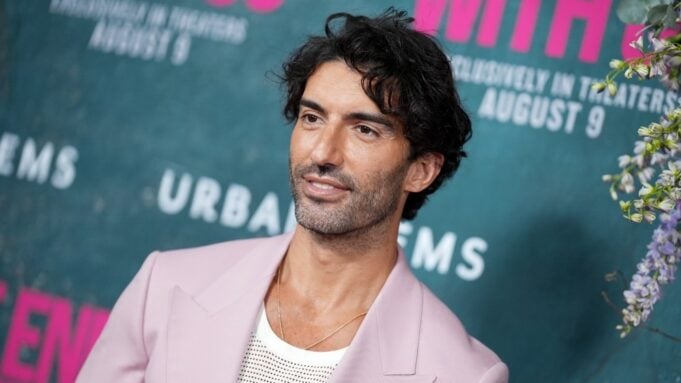
Lawyers for Justin Baldoni appeared in court on Thursday hoping to persuade a judge to dismiss Blake Lively‘s lawsuit against him, in which she alleges sexual harassment and retaliation during and after the making of their 2024 film “It Ends With Us.”
Baldoni’s team argued that the allegations involve improvisation during filming of sexually charged scenes — which does not amount to gender-based harassment.
“I don’t know if the court is familiar with the show ‘Heated Rivalry,’” attorney Jonathan Bach said at one point. Laughter spread throughout the courtroom as U.S. District Judge Lewis Liman indicated that no, he was not familiar.
Bach went on to explain that the series — a gay romance drama that recently concluded its first season on HBO Max — featured several “explicit” scenes. He was rebutting a point made earlier by one of Lively’s lawyers: Esra Hudson argued that Baldoni’s choice to improvise on set was not an excuse for kissing and nuzzling that Lively had not consented to, therefore providing basis for a claim of gender-based discrimination. Bach countered the argument, saying that if male actor on “Heated Rivalry” improvised during an intimate scene with another man, could there be a complaint of gender-based discrimination?
Bach frequently returned to the idea that any touching that occurred between Baldoni and Lively came from the relationship between their characters in the film and had nothing to do with Lively herself being a woman.
He was the first attorney to speak at the podium during the hearing, and opened his argument by saying that Lively signed onto “It Ends With Us” knowing that it would feature “hot and sexy scenes” that would become “steamy and turbulent.”
Liman was quick to push back, indicating that Bach was surely “not suggesting” that the film’s sexual subject matter gave Baldoni license to touch Lively as he pleased. Bach agreed. “So maybe you can actually help me understand where the lines are,” Liman said, leading Bach to emphasize that “context matters.” If anything “awkward” arose, he argued, it was in pursuit of a certain aesthetic. He insisted multiple times that Lively’s complaints were “small potatoes” that did not rise to the level of sexual harassment.
Love Film & TV?
Get your daily dose of everything happening in music, film and TV in Australia and abroad.

Hudson was the first to speak from Lively’s side. She first made clear her team’s position that key facts were in dispute between the two parties, necessitating the input of a jury. As an example, she offered the differing perspectives on a particular interaction between Lively and “It Ends With Us” executive producer Jamey Heath during which he entered a room while she was nude from the waist up. Heath says he heard someone tell him to come in, whereas Lively and her hair and makeup artists recall saying, “Whoa, whoa, whoa, no, no, no.”
Hudson then focused her time on the issue of Lively’s consent. Lively was “kissed, nuzzled and touched” in ways she hadn’t consented to while shooting one scene, Hudson said, regardless of knowing she would be acting in intimate scenes. Liman pressed Hudson about the exact meaning of consent in the context of intimate scenes, asking whether and how improvisation may come into play.
Hudson clarified that she wasn’t saying improvisation should be off-limits or that an actor must give consent for every individual motion in a scene, but that for improvisation to be considered consensual, there should be a conversation about what kind of touching can be expected — hence the advent of nudity riders and intimacy coordinators.
Though Liman continued to question whether every touch-related decision could be for a jury to decide — “That can’t be right,” he said — Hudson maintained that in this scenario, there was a subjective standard they needed to look at: Lively was uncomfortable, surprised and leaned back, indicating that her consent had not been given. Whether or not another generally reasonable person would have reacted similarly, Hudson said, should be up to a jury.
Liman took the arguments under submission and will rule on the motion at a later point. The case is scheduled for trial in May. Liman could opt to narrow the scope of the allegations that a jury will consider.
From Variety US