





























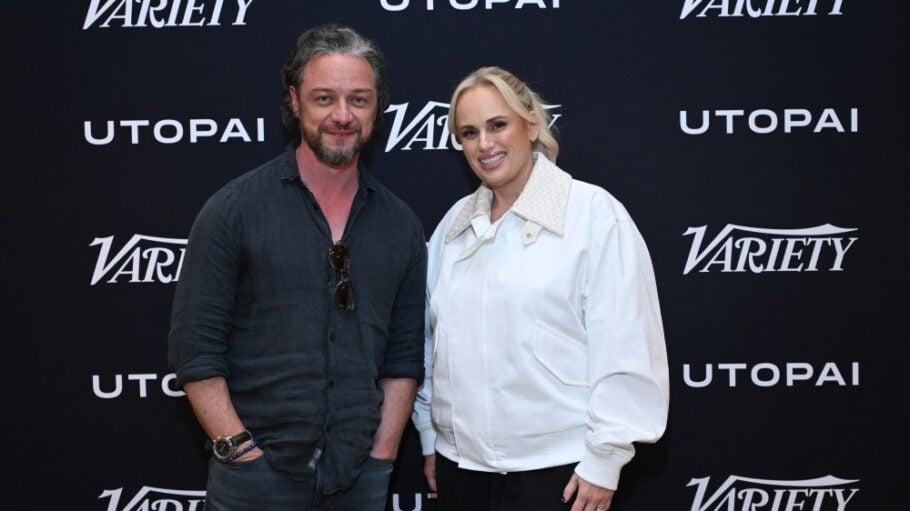
Actors James McAvoy and Rebel Wilson opened up about expanding their artistry behind the camera while filmmakers Rachel Morrison and Liz Garbus got candid about the barriers that still need breaking in the film business during Variety’s Future in Focus panel, presented by Utopai Studios, at this year’s Toronto Film Festival.
Variety’s executive editor of film, Matt Donnelly, and senior entertainment writer, Angelique Jackson, led a series of conversations at the invite-only event, which explored how innovation is shaping the art and craft of filmmaking. With the advent of AI and amid corporate mergers and production woes, cinema is at a tipping point, but this assembly of panellists is optimistic. To them, the future of film looks bright.
Conversation with James McAvoy, Actor, Director and Producer
McAvoy first attended TIFF 20 years ago with his film “The Last King of Scotland,” but his trips to the festival have become a little different now that he’s become a director and producer. Last year, McAvoy travelled to Toronto with his directorial debut “California Schemin’” and this year, he returned in support of “Faith,” a British supernatural drama from director Paul Andrew Williams (“Dragonfly”), where he stars opposite Erin Doherty (“Adolescence”).
In the conversation, McAvoy got candid about what he has learned from the transition behind the camera, joking that he has become the “monster I never wanted to be” by stepping into the producer role. While he has been lied to by producers over his 30-year career, he hasn’t “fucked anyone over yet,” he told Jackson onstage. “But that moment, that decision might come.”
“California Schemin’,” which hits U.S. theatres Oct. 9, marked McAvoy’s feature directorial debut. The indie film is about a pair of Scottish rappers who pretended to be American to get a record deal. McAvoy’s experience with “California Schemin’” was different from previous films he took through the festival circuit, too. As an actor, he has been able to “breeze in, breeze out” of places like TIFF, but as a director and producer, he has to network with financiers — after all, they’re the people who have the power to make independent films happen.
The actor also shared what drew him to his other upcoming movie “Faith” and the challenges of playing Michael, an enigmatic stranger who helps a single mother grapple with an unimaginable tragedy. “One of the main themes is about how we deal with pain, how we deal with loss, how we deal with trauma,” McAvoy said. “The film is called ‘Faith’ and it demands a bit of faith in it.”
Love Film & TV?
Get your daily dose of everything happening in music, film and TV in Australia and abroad.

McAvoy also explained that he doesn’t like fielding questions about past roles like “X-Men” because it doesn’t actually help get new projects out there. “We’ve got to help people make the new things, find the new work, find the new actors, find the new style of storytelling, find the new platform for storytelling and keep it evolving and keep it nurturing,” he said.
Conversation with Rachel Morrison, Academy Award-Nominated Cinematographer and Director, “Love Of Your Life”
Cinematographer and director Rachel Morrison attended TIFF this year for her second directorial outing, “Love of Your Life.” Her first film, “The Fire Inside,” also debuted at the festival in 2024.
The romantic drama “Love of Your Life” stars Margaret Qualley as Maya, an ER nurse whose romantic life spawns a journey of self-discovery. Morrison hadn’t seen Qualley take on this type of role before, but she quickly saw how aligned their vision for the character was. “Especially when you have a movie where your lead actress is in pretty much every frame of the film, you want them to want to be there and to love it as much as you do or see the thing in it that you see in it,” Morrison told Jackson.
Julia Cox wrote the script, but Morrison came to see her own experiences in the story. “It maybe even took me a while to realise just how personal it was,” Morrison said, “But I’m somebody who was shaped from loss and also grief and transformation and all of the things.”
With that, Morrison realised she was the right person to tell this story, but did not want to produce an overly sanitised version of loss. She worked with Amazon MGM Studios to create a romantic drama that felt real but also beautiful and full of hope and love. “Rules are made to be broken, and tropes are meant to be bent,” she explained.
Morrison was the first woman nominated for best cinematographer at the Oscars for 2017’s “Mudbound,” a distinction only four women have received. Last year, Autumn Durald Arkapaw made history as the first woman to win, after lensing Ryan Coogler’s “Sinners.” Morrison recommended Arkapaw for “Black Panther: Wakanda Forever,” kickstarting the cinematographer’s relationship with Coogler.
Achievements like that one, or the fact that 35% of the films at this year’s TIFF were directed or co-directed by women, indicate that Hollywood is moving toward parity, but that progress is still incredibly slow.
“Because I have shot films like ‘Black Panther,’ I don’t scare studios when it comes to budgets, but everybody else, I think that that’s the big differential,” Morrison said. “You see these guys who shoot a small movie, and then they’re given money for their next movie, a lot of money, and that doesn’t happen nearly as often with women. And the hurdle seems to be making the leap when it comes to budget. And for no reason — they’re just as untested.”
What’s Trending at TIFF
The films on this year’s festival circuit are focusing on human connectivity and handcrafted art.
“It’s almost like a rebellion against AI in a way,” said Donnelly. “It’s so interesting to see how this collision of really handcrafted, meticulous human stories are converging with technology.”
Among the standout films on the TIFF lineup were “The Life and Deaths of Wilson Shedd” with Amanda Seyfried, “Bucking Fastard” starring Kate and Rooney Mara, “Prima Facie” with Cynthia Erivo, and Rebel Wilson taking the director’s seat in “Girl Group.”
An unexpected standout was “The Julia Set” with Chase Infiniti. “It’s a really dazzling showcase for her, and I think her first mature leading role and it’s wonderful,” Donnelly added. “We expect that to be the first big sale out of the festival.”
Variety Future in Focus, presented by Utopai Studios
During the final Future in Focus conversation, Donnelly stayed true to the panel’s name, asking Rebel Wilson, Carsten Kurpanek, Stephanie Ahn, Liz Garbus and Basil Iwanyk about their hopes and fears of the future of the film industry.
The panellists seemed to agree that advancements in technology can be intimidating, but they can also be a good thing — as long as they’re backed by humans. “You want human creativity upfront,” Kurpanek explained. “You want the actors to drive the performance. You don’t want the jokes to be written by a machine.”
Wilson and Ahn shared how AI can cut costs, while Kurpanek noted that affordability allows more stories to be told.
“AI can serve the soul of a film as opposed to suck it out,” Ahn said. “That’s something that I’m learning as an indie filmmaker to use it to my advantage without replacing the humanness of the stories that I take or tell.”
The group also rejoiced over recent box office successes. Seeing audiences, especially young people, fill theatres instead of sticking to streaming is something to celebrate.
“That excitement around that theatrical experience is inspiring,” Garbus said. “The way people come together, the way they laugh, the way that they’re like that community, that people are so hungry for it.”
With enthusiasm and human creativity, the future of film does not look too dreary to these panellists.
“I think once we figure out a way to normalise and figure out a way where the utility of AI is just such a helpful tool for filmmakers, especially young filmmakers, their imaginations will run wild,” Iwanyk said. “And there’s going to be some incredible stuff coming on the other side of it, I think.”
From Variety US