





























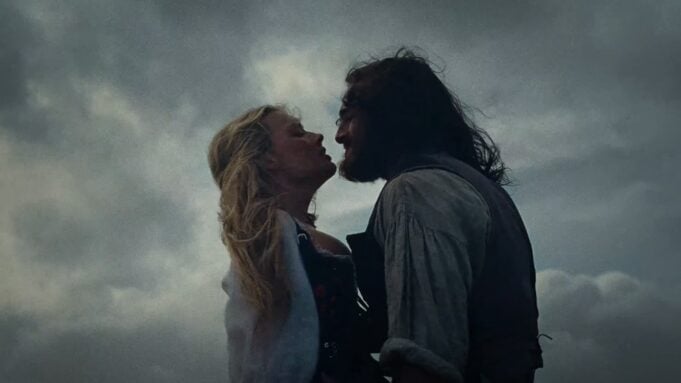
Research the ratings history of “Wuthering Heights” via the Motion Picture Academy, and you’ll see a progression in how Emily Brontë’s novel has been treated on-screen, evolving from tame to tawdry. The 1970 movie starring Timothy Dalton as Heathcliff earned an all-audiences-friendly G rating. Twenty-two years later, when Ralph Fiennes stepped into the role, the 1992 adaptation was rated PG. The made-for-MTV 2003 version, featuring a young cast in a high school setting (clearly influenced by “Clueless”), landed a slightly edgier PG-13. And now comes Emerald Fennell’s carnal reinvention, which merits a full-blown R.
Literary purists may object, but Fennell seizes on something passionate in the material that was always there but never made explicit, amplifying what has gone largely unrequited all these years: the physical desire, of course, but also the mind games by which power shifts between Catherine Earnshaw (“Barbie” star Margot Robbie) and Heathcliff (Jacob Elordi, fresh off “Frankenstein”). Evoking elements of bondage, the movie opens with the creaking of rope and what sounds like orgasmic gasping, and though Fennell plays a trick — the image doesn’t necessarily match what you imagine — she’s essentially planted an erotic suggestion from the start.
Ought this scene to be read as foreplay or foreboding? Why not both? If you studied “Wuthering Heights” back in high school, this is not the sort of film adaptation your 10th-grade teacher would have felt comfortable sharing in class. Fennell’s take is bold and engaging, which are qualities sure to inspire budding young readers, though the “Saltburn” director has her way with the iconic characters, as anyone might expect such a flashy director to do.
To situate it in terms of Emily Brontë’s sister Charlotte, Fennell’s approach feels more “Wide Sargasso Sea” than “Jane Eyre”: sophisticated fan fiction that revels in heaving bosoms, damp flesh and kinky sex (just not between Catherine and Heathcliff). There have been more than enough polite, repressive tellings of the classic Romantic novel, which centers on a young woman raised on the Yorkshire moors who betrays her heart — fearing ruin, she chooses the financial stability of a comfortable marriage over her wild-willed soulmate — and suffers for it in the long run.
In Fennell’s hands, the Earnshaw estate, which gives the work its title, looks like something Tim Burton might have dreamed up — an ominous black farmhouse set against a backdrop of jagged rocks, blasted by wind and storms — whereas Thrushcross Grange (where Catherine’s suitor, Edgar Linton, lives) could have been decorated by the “American Horror Story” crew, with its flesh-colored walls and blood-red floors. One’s a morgue, the other a bordello.
Taking Heathcliff out of the equation for a moment, Catherine has no choice but to marry Linton (Shazad Latif, so decent as to appear dull), lest she wither and die in the home her crapulent father (Martin Clunes) has all but lost to gambling debts. Many years earlier, in a fit of “charity,” Mr. Earnshaw brought home a dirty, illiterate street urchin to serve as his daughter’s “pet.” ’Twas young Catherine (Charlotte Mellington) who named him Heathcliff (Owen Cooper).
The girl is clearly spoiled, but also fiercely independent, seeing that quality (plus unyielding loyalty) reflected in Heathcliff — to the point that she eventually admits, “He’s more myself than I am.” Too bad the only part of that confession Heathcliff overhears (while eavesdropping on a private exchange between Catherine and her housekeeper, Nelly, played by Hong Chau) is the part where she says, “It would degrade me to marry Heathcliff now.”
Love Film & TV?
Get your daily dose of everything happening in music, film and TV in Australia and abroad.

Of all the visual flourishes Fennell allows herself, Heathcliff’s departure is the most striking: She frames Elordi, bearded and betrayed, in silhouette against a deep crimson sky. He appears at once shattered and defiant, like Scarlett O’Hara just before intermission in “Gone With the Wind.” It’s ridiculously overripe, but exquisite, the sort of indulgence that sets some viewers vibrating and others rolling their eyes. It’s also the clearest clue yet to Fennell’s operatic interpretation of the material, which finds its musical equivalent in Anthony Willis’ score and a handful of tortured-love songs from Charli xcx (of which “Chains of Love” most closely nails the film’s sadomasochistic subtext).
Ratcheted up to such heights, “Wuthering” risks smothering those whom “Saltburn” struck as too much. And yet, this is what a generation of moviegoers thrilled by the stylistic excess of A24 and Neon movies want from the big-screen experience. As in the scene where Nelly tightens Catherine’s corset till it nearly snaps her ribs, the movie is meant to evoke extreme sensations. For nearly two centuries, Brontë’s book has been a romantic fantasy for readers. Fennell treats it as an erotic one as well, leaning into all that is sensual: a bed full of broken eggs, a stable tryst involving whips and bridles, Catherine pleasuring herself en plein air. The list goes on.
Fennell ditches the back half of the book (pretty much everything that happens after a key character’s death), while reading a great deal of unspoken desire between the lines. The ultimate bad boy of Victorian literature, Heathcliff comes across less devilish here than he does in Brontë’s book, though there’s a deliciously naughty streak to the way he seeks revenge on Catherine, asking consent from Linton’s sister Isabella (Alison Oliver) to use her for this very purpose. It’s fascinating to see Elordi play this monstrous brute so soon after embodying Frankenstein’s creation, and surprising that there’s less flesh on display here, but no fewer scars.
Heathcliff needs no redeeming — his roguishness is half the appeal — and yet, Robbie’s emboldened Catherine assumes more responsibility for the couple’s unhappiness … and also more complicity in exploring what might have been. The trouble with letting these two to satisfy their lust is that it defuses the very dynamic that has gone so long unrequited.
After “Saltburn,” which climaxed with one character scandalously making love to another’s grave, Fennell had to shock us somehow. Instead of repeating herself (or earlier adaptations), the director cuts short the pair’s pleasure. But not ours.
From Variety US