





























Paul McDermott thought he’d found a fairly safe way to agree to making a film.
Ren Thackham had taken his idea and turned it into a nine-page script before he’d even gone to bed. He liked it. He also thought there was very little chance it would happen.
“I read the script and I thought, ‘There’s no way this is ever going to get made. It requires an entire audience and it requires a studio,’” he recalls when speaking to Paul McDermott Talks New Short Film ‘The Prize’. “So I sat back again and thought, ‘Nah, don’t worry about it. It’s not going to be made.’”
The next morning, Thackham rang. She had the studio and the audience.
“I thought, ‘This is insane,’” McDermott adds.
They had only met that October. By December, they were making “The Prize”, a seven-minute dark comedy starring the Umbilical Brothers’ David Collins as a real estate agent whose accidental appearance on a home-video television show gives him a taste of recognition he can’t quite leave alone.
For Thackham, there was something else riding on the shoot. She had admired McDermott since she was 14. Now she had an opportunity to work with him, and she wasn’t about to let the practicalities get in the way.
“This was the first opportunity to show him I could get to his level,” she says. “So I went all out for this one.”
She had spent years making theatre posters for Sydney Acting School without asking for anything in return. This seemed like a good time to call in a favour.
“I’m trying to impress my hero right now. Please give me your studio and all your students so that I can tell Paul I’ve got that sorted,” she recalls asking.
There was a short window over Christmas when she could shoot. Getting the hardest part organised would make the rest possible. Besides, she had already worked out something about her new collaborator.“If you get a yes out of Paul, you have to jump on it,” she says.
McDermott cheerfully describes himself as “very, very, very lazy”. His account of Thackham, however, is considerably more generous.
“We’re both drawers and we both make things, and I don’t think I’ve ever had a relationship with anyone over the course of my life — and I’ve known a lot of people that make things — but I’ve never met anyone that can make things as well as Ren and as efficiently and as quickly.”
It’s a significant endorsement from someone whose creative life has moved between comedy, music, television, writing and visual art. Thackham may have approached him as someone she had looked up to for years, but what emerged was a partnership with its own momentum.
First, they had to get through a shoot.
“This was just sort of proving to each other that we could get through a shoot without killing each other,” Thackham says. “And that was great. And we’re still friends on the other side of it.”
There were moments when the schedule tested that friendship. Most involved Collins, a trophy and McDermott’s willingness to let a funny performance keep going.
As Nicholas Flemp, Collins begins “The Prize” with an unexpected television win. Back at home, his celebration is brief on screen. On set, it became rather more elaborate.
“He did 12-minute takes of that because then he celebrated throughout the whole house and he jumped on the couch and he humped pillows and he danced,” Thackham says.
She was co-producing and co-directing, while somehow also taking on assistant-directing duties. Eventually, she found herself lying on the floor as McDermott enjoyed the show.
“Paul’s like, ‘Are you okay?’” Thackham laughs. I’m like, ‘Yeah, I just don’t understand why we keep doing these 12-minute takes. We don’t have time.’”
View this post on Instagram
“We had to do it because it made the crew laugh and they were quite tense,” McDermott replies.
There was plenty worth keeping. There was also far more than a seven-minute film could accommodate.
McDermott knew Collins through years of working around the Umbilical Brothers and hadn’t seriously considered anyone else for the role. His physical comedy was an obvious fit, but Flemp also needed to become someone the audience could feel for as his pursuit of another prize turned increasingly destructive.
Away from the sparkly television set, his ordinary life feels painfully small. Another win starts to look like a way out, even if getting there means hurting himself.
“Sadness is the companion of good comedy as well,” McDermott says. “A bit of sorrow and joy, you need those highs and lows to get the contrast.”
That combination has followed him since art school, before the Doug Anthony Allstars and the television career that made him familiar to audiences like Thackham.
“I used to make very pretty pictures, but they always had a dark aspect to them,” he says. “And I feel that’s the work I’ve done my whole life, just follows that idea, singing pretty songs with terrible, terrible lyrics.”
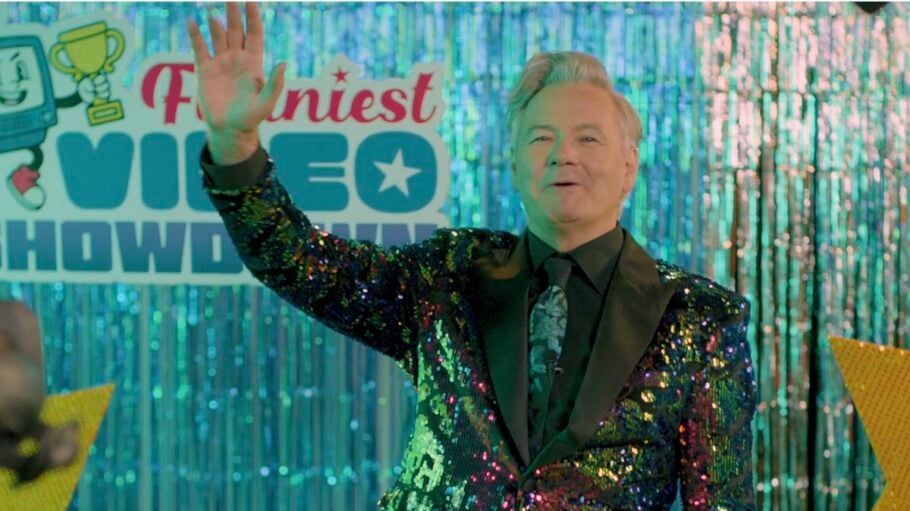
The Prize begins in a similarly bright place: a television appearance, a trophy, a little cash. The discomfort comes afterwards, when Flemp tries to recreate the experience.
The idea grew out of McDermott’s memories of “Australia’s Funniest Home Videos” and similar programs. Setting it in the 1990s gave the protagonist one specific place to seek approval, rather than an endless selection of social media platforms.
Thackham supplied his profession. A former real estate agent herself, she knew that someone accustomed to filming their work offered a straightforward explanation for how the first accident ended up on camera.
The broader implications became clearer as they made it.
“When Paul gave me the idea, he thought it would just be so funny to watch David Collins get hit in the balls a bunch of times,” she says. “As we were writing the script and even doing the production design, we talked about it a lot.”
What began as an opportunity for slapstick developed into something with more to say about attention, humiliation and the things people will do to feel noticed. The television format belongs to an earlier era. The appetite it taps into is still familiar.
McDermott has no trouble finding the cruelty beneath the laugh.
“I think most things you laugh at are generally at someone else’s expense,” he says. “So it’s a cruel world, the world of comedy.”
He plays the television host, a casting decision Thackham considered essential. Too young to have attended “Good News Week” tapings, and living elsewhere during “The Sideshow”, she finally got her own experience of McDermott in front of a studio audience — complete with a sparkly jacket.
Behind the camera, she watched him stay in character as Collins and the student performers gave him opportunities to react. Some of her favourite moments are small enough to miss: an expression after an unexpected hug, or McDermott sniffing a trophy winner who had no idea it was coming.
“He was staying in character and just trying to rattle everybody in a different way,” she says.
Finding room for those moments meant being ruthless elsewhere. Thackham, who studied under Robert McKee, approached the short with brevity in mind. McDermott brought advice he had received over a bar at Flickerfest years earlier:
“There’s no short film that has ever been made that couldn’t be shorter.”
He took it to heart. Thackham heard it repeatedly.
“It wasn’t the most profound thing I’ve ever heard,” she says, “but I’ll tell you, I heard it about 15 times while I was editing it. And I was like, ‘I know, but it’s good footage.’”
The finished film has since debuted at the Sydney Underground Film Festival, where it placed first, and received an acceptance into the Canberra Short Film Fest. It has also given the pair a reason to keep working. They have a writers’ room and are developing a feature for McDermott to direct. He is also cast in a separate feature Thackham is preparing, with “The Prize” cinematographer Dale Bremner also attached.
Their interests extend beyond film. There are prints, drawings and possible murals, although McDermott’s description of the latter as “graffiti” requires a quick clarification from Thackham that they mean the legal kind.
She spent years being too scared to send him a script. When she finally did, he called it “breathtaking”, and they started making things together. Now McDermott tells her they should have met earlier.
“I’m glad I got my own projects up before being too derailed,” she says.
For him, though, the timing was right. Other working relationships had shifted or wound down, leaving an opening he hadn’t had in decades.
“When Ren and the script came through, I was pretty free,” he says. “Freer than I’ve probably been in about 40 years. So it was perfect timing in many ways.”
There’s already a joke to be made about “The Prize” itself winning a prize. Thackham suggests they’ll now have to hurt themselves until they win another one. But the more lasting outcome seems to be the discovery that they want to keep making things together.
“There are a lot of ideas, a lot of plans,” McDermott says. “So this is just our little awkward beginning, but it seems to be going very well.”