





























Every awards season produces a movie that forces Hollywood to reconsider its own rules and bias. This year that movie did not arrive from a fall festival or a boutique label. It came from a YouTuber.
“Obsession,” the breakout horror sensation from writer-director Curry Barker, continues to do unprecedented business, posting $19 million in its fifth weekend of release. The more remarkable detail is that the low-budget film has now strung together four consecutive weekends larger than its already-impressive $17 million debut, a trajectory almost unheard of in the modern theatrical era. “Obsession” has generated $265 million globally, making it the highest-grossing release of all time for Focus Features. And that figure reframes the entire conversation, especially where awards are concerned. The question is no longer whether audiences are obsessed with “Obsession.” It is whether the Academy will be too.
For years, the genre-distribution conversation has been dominated by a single brand. A24 turned the elevated genre film into a prestige category unto itself. “Obsession” is, in many ways, the most non-A24 movie of the modern era: A broad, commercial and unapologetic crowd-pleaser that is making the money specialty labels rarely see.
That is why it matters for Focus. The success of “Obsession” offers the studio a chance to redefine what the brand can be. The old specialty playbook treats awards contenders as something you acquire or manufacture, the so-called “Oscar bait” assembled from prestige ingredients. You can discover a talent inside a genre movie and then morph that genre movie into an awards contender.
And there is a recent and instructive blueprint for exactly that move — Jordan Peele’s “Get Out.”
In 2017, a first-time feature director (with strong ties to comedy) made a $4.5 million horror movie that the industry initially filed under genre. By the following spring it was nominated for best picture, director, lead actor for Daniel Kaluuya and original screenplay. Peele won the screenplay prize, beating the eventual best picture winner “The Shape of Water” and its chief rival “Three Billboards Outside Ebbing, Missouri.” A horror movie did that.
“Get Out” proved the path from genre breakout to awards player exists. And if anything, Barker could find his way to the DGA first-time feature triumph that Peele, Bo Burnham and RaMell Ross have all enjoyed.
Love Film & TV?
Get your daily dose of everything happening in music, film and TV in Australia and abroad.

The timing could not be better. We’re fresh off the 98th Academy Awards, where horror took a deserved victory lap — walking away with eight wins, the most in horror’s history at a single ceremony. Ryan Coogler’s vampire epic “Sinners” led the field with 16 nominations, the most in Oscar shistory, breaking the mark of 14 once shared by “All About Eve,” “Titanic” and “La La Land,” and it converted four of them into wins. Guillermo del Toro’s “Frankenstein” followed with three, and the night’s first televised award went to Amy Madigan for her transformative turn as Aunt Gladys in “Weapons.”
Remember, just a few years ago, horror fans were lobbying for a single nomination. And social media was infuriated we couldn’t get the deserved recognition for worthy performers like Toni Collette in “Hereditary” or Lupita Nyong’o in “Us.”
Still, horror’s relationship with the Academy has always come with an asterisk. The genre’s winners have tended to be underdogs, outliers or one-offs, and many of the celebrated films are not “pure” horror at all.
Steven Spielberg’s “Jaws” is an adventure blockbuster with horror in its bloodstream, made by one of the masters of cinema. “The Silence of the Lambs” is a procedural thriller with a handful of genuinely terrifying scenes, carried by an overdue narrative for Anthony Hopkins. Even “Sinners” is as much a historical drama as it is a vampire movie, with Coogler behind the camera.
And who could forget Demi Moore, whose best actress victory for the body horror “The Substance” felt all but preordained, comeback narrative and all, before the prize slipped away to Mikey Madison on Oscar night?
Horror still tends to need a stamp of prestige to be taken seriously. It needs an auteur, a seasoned actor, a staggering box office or a blend of genres. That calculus might be slowly shifting, but it has not disappeared.

©Focus Features/Courtesy Everett Collection
But this is where “Obsession” gets interesting. It checks more of those boxes than its origins suggest. The film plays like a blend of “Get Out,” “Smile” and the 1993 thriller “The Crush,” with a splash of the 1992 obsessive film “Single White Female.” A loving throwback to the glossy, mean-spirited horror/thrillers of the ’90s. But more importantly, it has a director’s story (aka awards narrative) tailor-made for a campaign.
Should “Obsession” land a best director nomination, Barker would etch his name into the record books, sitting in the company of the youngest directors ever recognized in the category — behind only John Singleton, who was 24 years and 44 days old for 1991’s “Boyz n the Hood,” and Orson Welles, 26 years and 279 days old for “Citizen Kane” in 1941. By nomination morning, Barker would be 27, a YouTube creator within striking distance of a company most film school graduates only dream about.
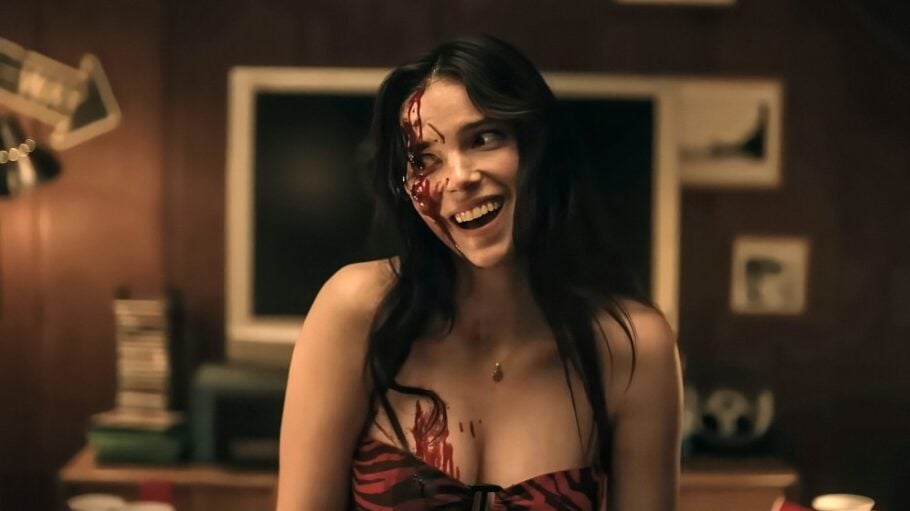
If “Get Out” had Kaluuya, “Obsession” has Inde Navarrette. The film lives and dies by its breakout star as Nikki, the co-worker, friend and would-be love interest. It is a physical, fearless turn, one whose behavior and mannerisms were built through collaboration between Barker and his star. The screams, contortions and vocal shifts were made without CGI or artificial intelligence, and that detail is its own form of campaign currency in an era when audiences and voters alike are increasingly skeptical of digital enhancement.
The movie is only Navarrette’s second feature, after “Wander Darkly” in 2020, following television roles including “13 Reasons Why.” Over the nearly century-long history of the Oscars, only six Latina women have ever been nominated for best actress: Brazilian icon Fernanda Montenegro for “Central Station” in 1998; Mexican star Salma Hayek for playing the painter Frida Kahlo in “Frida” in 2002; Colombian actress Catalina Sandino Moreno for “Maria Full of Grace” in 2004; Mexican actress Yalitza Aparicio for “Roma” in 2018; Cuban actress Ana de Armas for playing Marilyn Monroe in “Blonde” in 2023; and Brazilian actress Fernanda Torres — who joined her mother, Montenegro, as her country’s second nominee — for “I’m Still Here.”
Navarrette would add her name to that short list. Born in Tucson, Arizona, to an Australian mother and a Mexican father, the nomination would make the 25-year-old the youngest Latina performer ever recognized in an acting category.
The honest analysis is that the deck remains stacked against the film. Horror still fights for respect, box office success still gets dismissed as commercial rather than artistic, and a movie made by a YouTube creator will face every condescension the awards ecosystem can muster. The campaign will be an uphill battle.
But every one of those obstacles was once true of “Get Out.”
The ingredients are here. It’s a cultural phenomenon at the box office with a star-making performance, a director with a once-in-a-generation origin story and a distributor with everything to gain by betting on it. Focus Features has the highest-grossing release in its history. The smart play is to treat it like the contender it could become. Sources at the studio tell Variety a full-court Oscar campaign is being planned. Just to think — last year it was “Hamnet” and now, it’s “Obsession.”
And since we are on the subject, I would argue it should take the same, albeit slightly controversial, Golden Globes pathway and submit in the comedy category. The awkward humor warrants it.
Whether the Oscars will follow remains in the future. But for the first time in a long time, a horror movie this big is daring voters to look away. They may find they cannot.
From Variety US