





























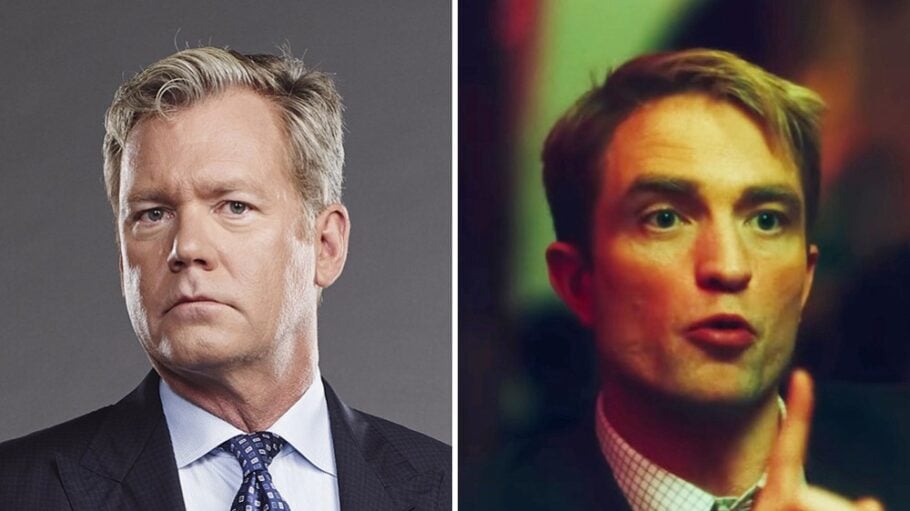
“Primetime” is a box office overachiever, but the subject of the A24 film calls it a “complete work of fiction.”
Lance Oppenheim’s movie centers on “To Catch a Predator,” the popular “Dateline” segment that ran from 2004 to 2007. In the show, an advocacy group with adult decoys posing as children would chat with online predators in order to lure them to a house, ostensibly to have sex with a minor. But instead of their prey, they would be met by host Chris Hansen (played by Robert Pattinson), who would interrogate the predators about why they were pursuing illicit and illegal affairs. The suspects were then arrested by law enforcement waiting outside the house.
The film is based more specifically on the 2009 Esquire article “Tonight on ‘Dateline’ This Man Will Die,” which chronicled an episode of the show involving Louis William Conradt Jr., an assistant district attorney in Murphy, Texas, who died by suicide after being caught in a police sting conducted in coordination with the “Predator” team.
Hansen is continuing his work on his media platform, TruBlu, which hosts shows such as the spiritual successor to “Predator,” “Takedown With Chris Hansen,” which launched in 2022.
Variety spoke with Hansen a few days after he watched “Primetime.” He discussed his perspective on its box office success, which parts are most upsetting to his former colleagues and what legal action he might take against A24.
Did you have the sort of mentorship with any of the decoys, as it’s portrayed in the movie?
No. The only elements of the movie that are not fictionalised are the fact that he uses my name and two or three catchphrases. Everything else is fictionalised. Yes, there was an assistant DA who tragically took his own life, but the circumstances surrounding it, the timeline, the events, it may be based on reality, but none of it is truthful. It’s a complete work of fiction.
The whole movie leads up to the 2006 suicide of Louis William Conradt Jr., and the movie version of Chris Hansen has a big meltdown after it takes place. What was going on in your head as that happened? Looking back on it now, are you processing it differently?
Look, nobody wants to see somebody take their own life. But in this case, you had a public official, an assistant district attorney who prosecuted criminal cases, who, according to the police and evidence gathered in the case, conducted sexually explicit conversations with decoys posing as two different teenage boys. In Texas, like many other states, that constitutes a felony. Now, he didn’t show up at the house, but the police made a decision to get a warrant based on probable cause. And I think if you were to talk to the police making those decisions, they would tell you that there was some concern that evidence might be destroyed and that they were going to go serve that arrest warrant at his home.
Love Film & TV?
Get your daily dose of everything happening in music, film and TV in Australia and abroad.

Now, obviously, we knew they were gonna do this, and we captured the action from the street. And when they went in, according to Murphy police, he had a gun in his hand. He said, “I’m not going to hurt you guys,” and took his own life. Later, Texas Rangers did an investigation, and they determined that on that computer from which he was trying to extract the hard drive, there was child sexually abusive material. As a prosecutor, he knew that in Texas, you could potentially face 10 years in prison for each of those images. So nobody can tell you exactly why Bill Conradt took his own life. Nobody wanted to see it happen. It’s tragic for his family. It’s tragic for him. But to insinuate that there was some push on our part to go arrest him or get him or to find him or to cajole him, it just didn’t happen. He surfaced like any other alleged predator did in an investigation. The decoys don’t go try to find them. They conduct the investigation, and they find us.
The rules on it are very, very explicit. But we have caught a number of high-profile people. We were in San Francisco on a sting last month, and an Ivy League-educated lawyer who ran a multimillion-dollar investment fund showed up in the middle of the day to sexually exploit a 6- and 13-year-old boy whose father he thought was going to take part in the sex act. We don’t look for people; they find us. The whole premise of the movie is false. It’s a fake narrative. It didn’t happen. If that was the case and the police wanted to make a big splash publicity-wise, wouldn’t you think they’d wait till Monday when he was sitting in his office at the district attorney’s office and barge in and get him and walk him out of there? That’s what they would have done. Everybody wants to say that this was done for clicks and ratings, and it wasn’t; it was just part of an investigation.
If anybody would take a moment, as some content creators have, and actually look at the story that we did on that particular case, and look at what we did on “The Today Show” the next morning, we were painstakingly transparent about what happened, how it happened and, as much as we knew, why it happened, as we have been with this franchise from the very beginning, continuing through today when we do these investigations which we now call “Takedown With Chris Hansen.” Any sense that anybody involved was pushing forward or that there was a ratings-hungry producer, none of that is true. Even the notion of the name of the film, “Primetime” — “Dateline” has always been on primetime television. It wasn’t like it was at 2 o’clock in the morning, and we were trying to get it on primetime. It was always on primetime. No discussion in that film ever happened.
“Predator” launched on “Dateline,” which is a journalistic platform, but do you look at your work as journalism or advocacy or something else?
There are people who think that we have historically worked too closely with law enforcement. But my argument is that’s the only way to be socially responsible and to ensure that there’s justice served in these cases. In the first two investigations, we didn’t collaborate with law enforcement. We didn’t know what was going to happen, but it became very clear in the third investigation that we needed to have a law enforcement presence. That has evolved over the past 22 years into what I think is the best possible way of doing this. That is to ensure justice and to ensure the chain of custody of evidence is secure. And also, look, it doesn’t matter how horrifying the crime is, everybody in this country is entitled to a vigorous defence. So the materials that we capture, obviously, everybody has access to that. Whether you’re the prosecutor or the defence, everybody deserves their fair day in court.
“Primetime” focuses on the show, but it dips into an understanding of your personal life and love life as seen through tabloid media. How did you feel seeing it in the film?
It’s par for the course. You know, even the filmmakers will tell you that this is fiction. And, you know, even when something reflects potentially a real-life event, the timeline has shifted around to make it work in the narrative of the filmmaker. But again, the timeline and the narrative and all of it is fiction. And so, the motives and everything that is detailed in the film, none of that actually happened the way it’s depicted. For them to do that, what’s the motive of making that film? A lot is being made of that right now. What does that say about Hollywood? If you’re gonna make a fictional film, why do you use my name?
The reason you use it is because I’ve spent 45 years creating a very valuable brand, and they wanted to exploit it. They know that if they use the name “Chris Hansen,” people will come to the movie. Most of them will understand the movie is fiction, and there’s a graphic at the end of the film saying so. But that’s not the way it’s portrayed in the beginning of the film. And because there was such an attempt to imitate — although I think it was way more dramatic and over the top — my mannerisms and my lines and things I’ve said over the years, they turned it into a science fiction film, almost, with the greens and the vampire look of the character. It’s just over the top. In fact, it was so over the top, I was left wondering, “What’s the point of this?” And again, I’m not objective, because they exploited me and my brand and my name image for commercial enterprise. But a lot of people don’t think that’s fair. A lot of people think that’s identity theft in one way or another.
What do you think the filmmakers’ larger point about media and Hollywood was?
I don’t know. I mean, I’ve invited the filmmaker, Lance Oppenheim, on my podcast to talk about the film. I’ve invited both him and Robert Pattinson to come on. And look, Robert Pattinson’s a very good actor. And I think a lot of people would find it flattering that this guy would be cast to portray me. But the way it was done is certainly not flattering. And so what’s the larger point for Hollywood here? I mean, there are people who would point out that this is an industry that was run by one of the most prolific predators who walked the planet, Harvey Weinstein. And so you can’t take that out of the equation. Maybe that was an influence, not Harvey Weinstein himself, but maybe that attitude in Hollywood was an influence here? Maybe not. I don’t know what the motive is. You ask Lance Oppenheim, and he’ll tell you that this is an interpretation of the internet’s interpretation of another interpretation of Chris Hansen. What does that even mean? I’m a pretty bright guy. I’ve been an enterprise reporter for 45 years, around the world in dangerous places, and had to unravel some very, very difficult mysteries. But I don’t know what he’s talking about. And I don’t think I’m the only one.
I think Hollywood gets in these circles of buying into what they think is some sort of brilliant creative take on something that’s very good and positive and has created a lot of awareness and dialogue in this world. And they’ve twisted it into something that it’s not. And when [Oppenheim] is asked about the ethics of using my name, image and likeness without any input or consult or consideration, he says, “They made ‘The Odyssey’ without talking to Homer.” And that’s what they’re going to go with. I mean, that’s kind of a stretch there. So that’s their belief. I think they get into this Hollywood mindset where “Guys, guys, I got an idea. Let’s do this.” “Oh my God, that’s genius.” And one thing leads to another. I’m not advocating that people don’t go see the movie. I’m just saying that they need to know that it’s completely fiction.
With the buzz around the movie, what’s the reaction you’ve heard from the general public?
I think people understand that the movie is fiction. When I went to go see the movie in New York at the theatre at Times Square, we interviewed moviegoers who were quite shocked that I was sitting in the back row of the theatre with them as they’re watching the movie, unbeknownst to them. It was an interesting moment. But the initial response is what the response has been all along, which is obviously this is fiction.
People often ask me, “What have you left on the editing room floor? What have we not seen?” My answer is “You’ve seen everything.” We’ve been painstakingly transparent about our methodology, from the very beginning, and continue to be today. So you see everything that happens, and nothing is held back. So you can make your judgment whether you like it or not, or however you feel about it, but we are honest about our methodology. Always have been, always will be.
The movie had a strong opening at the box office. How do you process that?
Look, I think A24 is a hot studio right now, and they had one of the most bankable actors in Hollywood today. So those two things are going to drive people initially, at least, to see the film. It doesn’t surprise me that it does well. Look, we bought ads for TruBlu that run in the theatres before that movie is shown in virtually every theatre in America. We spent a substantial amount of money to do it, but I think it’s paid off.
Are your friends and family seeing the movie?
Well, my wife went with me, and we watched it together. And the takeaway was it’s so bizarre and over-the-top fiction that it was hard to get upset about it, because it’s ridiculous in so many ways. My kids, I don’t think they’ve seen it yet. Maybe they’ll wait till it comes out on cable. The extended family, I don’t think they have feelings either way. They’ll maybe catch it, maybe not. They don’t like the way it was done, and I don’t think there’s a tendency to support somebody who would do that.
You’ve spoken about the Jeff Zucker cameo. Have you texted him to ask, “What was up with that?”
No, I need to check in with him. You know, Jeff was my first executive producer at NBC when I started there. And look, those conversations never took place. Jeff never said that. And I had nothing but a warm, constructive relationship with him his entire time at NBC. I’ve run into him socially a little bit over the years, and when he was at CNN, I was over there doing some stuff, but none of that ever happened. It was just silliness.
What was your departure from NBC like?
It was time to move on. I spent 21 years at “Dateline,” and I had an incredibly good run there. I think the show was changing into more of a murder mystery procedural. And they do a phenomenal job there. And [correspondents] Keith [Morrison] and Josh [Mankiewicz] and Dennis [Murphy] are all good friends of mine to this day. But I had opportunities to go do different things and explore other possibilities. That journey led me to essentially have my own network and my own platforms with three generations of followers, viewers and listeners. For a guy who’s been doing this as long as I have, it’s the absolute best-case scenario to have the exposure and the platforms I have. It’s very rewarding and gratifying that my work is still seen and respected and that we have the energy and passion to go out and do it, and I’ve got a phenomenal team at TruBlu with whom I do it.
Are there co-workers from the “Predator” days that have reached out in the wake of all this?
Oh yeah, they’re all upset.
What’s upsetting them the most?
It’s upsetting them that they’re unfairly portrayed, especially the producer, who NBC will not allow to talk about this. The press department won’t. But I mean, she’s understandably upset because of the way she’s portrayed and the way I was portrayed. I’ve never yelled at a colleague ever. I think that goes to why A24 never reached out. They had a vision of what they wanted this character to be, and they were afraid if they talked to me or talked to anybody who knew me well, they’d find out I’m a really nice guy who’s a good dad and goes out and works very hard every day to create content that’s important to people. That’s not what they wanted.
So that’s why, in spite of an outreach earlier by a colleague of mine who knew how to get in touch with Lance Oppenheim — he reached out, and Lance texted back that “It’s a love letter to Chris Hansen, and we’ll be in touch soon.” This was nine, 10 months ago. I thought after seeing the film, “If that’s a love letter, I’d hate to get a poison pen letter from this guy!” It ranges from just being wholly offended that anybody would portray us in that manner to my security guy, Ronnie Knight, saying, “I’ve never seen you drink from a straw” — from the silly stuff to the important stuff.
You’ve mentioned the potential of taking legal action against “Primetime.” Is that still being considered?
You know, look, it’s a full-time job being the real Chris Hansen. I haven’t really delved in. There are lawyers looking at it, and I think some of them are itchy to make a statement and challenge some things here, but there’s no rush to do that. I’ll have some meetings in the near term, and we’ll discuss it. But I’m really in a great place with everything I’m doing and in my life, and I don’t know how it could be any better. I’m blessed. So do you make that stand? I certainly wouldn’t have done it prior to the film, because I think part of their reasoning behind the way they’ve handled this was to try to get me to be upset and try to do something, and then it becomes “The movie Chris Hansen doesn’t want you to see!” There are those who think that was part of the promotional plan here. Again, it’s something I have not ruled out, but we’ll take a close look at it in the near future.
Has there been an influx of visitors to TruBlu in the wake of the film’s buzz?
In terms of people seeing the new work on TruBlu, yes, that’s happened. You know, they see the documentaries we produced on Roblox and sextortion, and there’s another documentary that was produced called “I’m Chris Hansen” which was in the works before the film. I cooperated in it, but I didn’t have editorial control over it. We knew about the film. And that should be out soon. But that’s more of a personal biopic documentary.
Have any former predators ever reached out to you and the team and said, “I feel like I’m rehabilitated, and I wanted to thank you for showing me rock bottom?”
Yeah, that has happened. In fact, it happened in Michigan with a doctor who was caught in a sting. He had engaged in a daylong chat with a decoy posing as a 15-year-old girl as he was seeing 18 patients. He sent explicit pictures, showed up at the sting house with wine and cookies and the whole thing, patted her on the behind as he walked in. And we confronted him. It was a very dramatic, long interview, and he had a health issue in the middle of it. And so EMS were brought in. After, he went through the criminal justice system. He got probation and registration as a sex offender. He sat down with me and did an hour-long interview. There’s the most recent example.
But yes, people have reached out, and some of them have not wanted to go public. I do two podcasts — one is “Predators Uncaught,” where we go back over these cases. And the other one is “Have a Seat With Chris Hansen,” where we do a lot of different topics. You can see that interview with the doctor, and he comes clean with his wife sitting in the room as he’s doing the interview. It’s quite something. Now, this is a guy who had no child porn on his phone. He had no previous history, but he talks in great detail about his porn addiction and how that led him down this road to the point of being arrested in a standing with the Genesee County Sheriff’s Office.
As someone who’s spoken to so many of these individuals, do you think there is a path to redemption for some of them?
I think for some people, if there’s an intervention when they’re young, if there’s a commitment to not reoffend, to dig deep in therapy, there is redemption. I hear stories about these people, and I have men reach out to me and say, “Look, you need to know that I was in this situation. I don’t necessarily want to go on your podcast and talk about it and be identified, but you need to know that this can happen.”
I believe for some people it can, but for the larger majority … Look, these guys are not all the same guy. We want one-stop, easy solutions in our society to say, “OK, lock them all up. In some states, castrate them in severe cases, life in prison, death penalty in Florida, severe child sexual assault case.” And all of that is warranted in different cases, but they’re not all the same guy. So the challenge for the criminal justice system is to determine who can be rehabilitated. And that’s why they have the sex offender registry, because at least when these guys finish with their punishment, you can track them and where they are, and they have to report, and they have to be held accountable. So it’s a system that usually works. It’s not perfect. But the unsung heroes on some of this are the parole and probation officers who’ve got to keep track of these guys. It’s a challenging job and it’s certainly not a glamorous job, but it’s an important job.
NBC did not respond to Variety‘s inquiry about Hansen’s assertion that its press department barred a producer from speaking out about the film. However, a spokesperson for the network shared a statement about the film: “The movie is a fictionalised portrayal of events from nearly two decades ago that were extensively reported at the time. Over its nearly 35-year history, ‘Dateline’ has significantly evolved along with the television landscape.”
This interview has been edited and condensed.
From Variety US