





























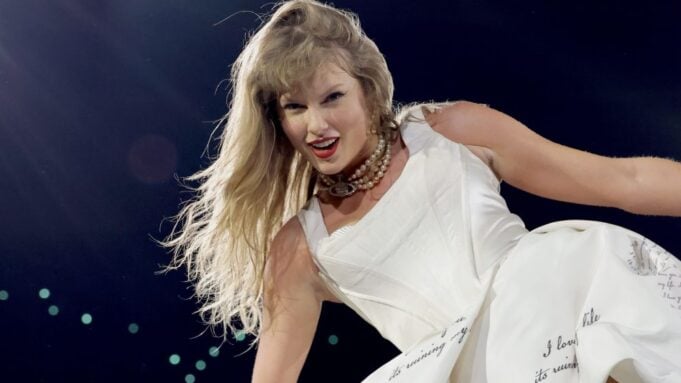
To first answer one of the most-asked questions about the two episodes of Taylor Swift‘s “The End of an Era” docuseries that have initially gone up for streaming: Is her NFL superstar beau in them? The answer to that is a very qualified yes: Travis Kelce in there as a sweetly disembodied voice on a speakerphone. Swift knows nothing if she doesn’t know how to pull off a good tease, and so any substantial material about the NFL player and the romance that developed during the Eras Tour is presumably being held back for episodes 3-6 (maybe as a Boxing Day present, since the final two air Dec. 26).
In the meantime, in this first pair of 45-minute segments, there is the sound, if not sight, of the lovebirds’ blossoming long-distance relationship, as America’s developing First Couple trades job notes. When Kelce waxes impressed at her gift for keeping three-and-a-half hours of nightly choreography in her head, she suggests that they share the same brain chemistry. “How do you remember 36,000 plays that are all tactical missions and then just go do it? It’s the same. It’s basically the same job,” Swift insists. “I got dance to remember, you got plays to remember. You got teammates, I got teammates. You’ve got Coach Reed, I’ve got my mom… I love you so much, man… Some people get a vitamin drip [before a show], I got this conversation.”
Or maybe Swift and her directors, Don Argott and Sheena M. Joyce — who presumably got hired because things went well on a previous project of theirs, the 2023 Prime Video documentary “Kelce” — are withholding actual footage of the fiance-to-be because they don’t want to get overshadowed by an arguably bigger star in the world of hardcore Swiftie-dom: Kameron Saunders.
The Eras Tour dancer is easily the MVP of Episode 2, at least, in a spotlight appearance that establishes just how well Argott and Joyce know to give the people what they want, which is “more Kam” and more about her dancers generally, who each have their own cults of personality. There’s so much about them in hour two, in fact, that Swift herself pretty much disappears for a large part of the episode in the service of letting the it-takes-a-hoofing-village theme play out. Imagine a self-produced documentary about another pop star of Swift’s stature, if there are any right now, and then imagine how long a stretch of airtime they’d be comfortable being off-screen for a segment on their dancers. That imagining goes at least a tiny way toward lending credence to the oft-stated maxim that there is something bigger than just Swift about the Eras Tour. (Even a warmed-over platitude, like a broken clock, can be right twice a day.)
Saunders is the plus-sized dancer — not that it takes much to count as that in the dance community — who emerged as a fan favorite early in the nearly two-year history of the Eras Tour. It didn’t hurt that Swift gave him something none of her other dancers get in the show: a line. (His task during “We Are Never Getting Back Together” each night is to deliver a variation on the single word “never” during a moment when the music stops, albeit Taylor-ed for where the tour is on the itinerary, whether that’s in a foreign language or with some other local flair.) When the segment on Saunders begins in Episode 2, it’s with a discussion of how he had given up hopes of ever having a career beyond being an instructor, when he answered a blind ad looking for non-traditional dance casting, and it suggests that, yes, we’re about to be in for a lesson on how DEI is still cool, kids. But by the time the episode gets to a nicely drawn-out conversation between Saunders and his supportive mom, your emotions will likely have overtaken any hesitations you might have about the docuseries taking time out for a moral lesson. There’s certainly no more stirring moment in either of the first two episodes than the editors repeatedly coming back to Saunders’ mom in the stands, waiting for her boy to get his “never” moment in the spotlight, and the roar that entails.
Yes, even Andrea Swift gets to be overshadowed, on the mom-dotage front, in “The End of an Era,” and it feels so good.
Saunders turns out to be one of two dancers spotlighted in Episode 2 who thought their on-stage careers were over before they got thrust into as big a limelight as show business has ever seen as part of the Eras Tour. The other is Amanda Balen, who was already hired as the assistant to lead choreographer Mandy Moore before the light was seen and she was drafted to take part in the execution as well as plotting. “As much as you want it to last forever, dance isn’t a forever career,” Balen says. “The demand on your body is not sustainable.” And the toll taken on hers had included two labral tears and broken-down hip flexors, but at Swift’s behest she put herself through that extra wear-and-tear for what is presumably a last hurrah. Of course, Moore is a big name here — being known primarily for film and TV work like “La La Land,” not having committed herself to pop-star touring work before — and so the scenes of her and Balen alone in a ballroom late at night, working out the moves they will take to the star next day, are as watchable and fascinating as any that have Swift in them.
Love Film & TV?
Get your daily dose of everything happening in music, film and TV in Australia and abroad.

But seeing Swift encourage and then integrate herself into the dancers as these steps are unveiled are, no pun intended, a kick. And the star makes a candid admission that will get a good laugh out of the fans watching at home:
“Everybody’s got their things they’re good at. It’s taken me a really long time to be even fine at choreography.” She explains how her learning process has to do with staying connected to the heart of the songs she’s written. “Mandy knows how to approach teaching me choreography from a lyrical perspective,” Swift says. “I don’t do eight counts. I learn based on what syllable of the lyric I’m attaching a movement to, and I can’t really learn any other way.”
The reason that “fine” comment will get a chuckle is that there has been an entire worldwide internet discourse going on for years, and especially these last two and a half, about whether Swift is a good dancer or not. (To the point that — unmentioned in the doc — the New York Times’ dance critic had to weigh in with a column, once the paper’s pop critics had had their way with her.) Whether Swift ever had Rockette potential can be debated, but there’s an athleticism on view here that surely matches Kelce’s in its 210-minutes-a-night way. These first two episodes only skirt the edges of getting into the regimen that went into making those marathons work over a period of close to two years. For now there is merely a mention that Swift began her process of physical training six months before the first tour rehearsal. It will be valuable if the remaining four episodes take us further into that torturous process; that may depend on whether Swift really wants to let us see her sweat.
It’s mostly veritable perspiration that we get in these first couple of hours. Episode 1 is largely about her sweating the big stuff — like how you react when your shows are canceled because of a terrorist plot. The series begins with some predictably celebratory footage and comments… a montage of hands and friendship bracelets across the world… before cutting to the chase and getting to some of the toughest stuff that will come up in. Namely, the thwarted terrorist plans that caused all three shows to be canceled in Vienna, and the deeply anxious effect that has on the star going into the following run of shows in London. And, also, the deadly assault on a Swift-themed children’s dance class in Liverpool that left three dead.
“We dodged a massacre situation,” Swift says of the Vienna near-miss… and then she breaks down acknowledging that there were casualties in Liverpool, unconnected to the tour itself but still seen as an assault on the global, female-first joy that it represented. (The fact that Swift met with families and survivors of that attack is mentioned, but the cameras do not go inside those rooms.)
After telling her mother that she has shaky hands and raw nerves going into the London shows, enhanced world-class security measures notwithstanding, Swift gets a nice pick-me-up from Ed Sheeran riding to the emotional rescue to do a duet of their long-ago “Everything Has Changed” as a surprise for the first London audience. For viewers who actually care about the musical aspects of all this, and how Swift prepared all the one-offs that took place each night on the tour, these will be quietly absorbing moments — Swift singing along with a recording of herself in the car to refamiliarize herself with the tune, then sitting with Sheeran backstage with a pair of acoustic guitars as they remind themselves exactly how this ancient number they’re dusting off goes. He remembers a couple of chords she’s having a hard time recalling, and they’re off to the races. For a few minutes, they could be preparing to go on at a hootenanny instead of preparing to plop a spontaneous moment into the most rigorously planned and elaborate show in the business. (What would have happened if those lost chords remained irretrievable to Ed, too, we’ll never know.)
There are a lot more chuckles in Episode 2, not just because there is no longer a terrorist subplot and its resulting anxiety to be grappled with, but because Florence Welch, of Florence + the Machine, makes for such a sweet comic foil, of sorts. She arrives to take her turn as a guest at one of the subsequent London shows, recreating their duet of “Florida!” as a one-time-only performance on the tour. There is no stinting on the production values for this number, even if it will never be repeated; we see the band working out the arrangement but, more importantly, the choreographers figuring out elaborate dance moves that Swift and Welch will have to integrate themselves into. And Welch’s nonplussed reactions to the scale of a tour she had only imagined up to this point make for some comic relief.
“My first lift!” Welch exults, crouching beneath the stage as she waits for her magic pop-up moment. Later, she says, “The feeling of coming up for the first time in that lift was kind of like landing on Mars… it’s like you see this cultural moment from the outside and I suddenly was like inside a bit. It was wild, but it was, it was really fun and completely terrifying. Also, Taylor’s my friend, and I know her as this very cozy person, and then I came out and I was like, ‘Oh my God, it’s fucking Taylor Swift.’”
Watching this series, you may know exactly how Welch feels, if you haven’t already been feeling it for the last two decades or so, give or take a couple of years. It’s a given that anyone who has made it even halfway to Swift’s level of popularity has the determination and drive, along with the artistic temperament, that makes them a freak, if not an alien, among human beings. (See: “Anti-Hero.”) Yet maybe the weirdest thing about her is how she still gives off regular-person vibes from within the kind of cultural-imperialist bubble that is meant to bred evolutionary levels of diva-dom. The entire world will have an opinion on whether she is still as proletariat on the inside as she has always seemed to be, or whether she has mastered the fine art of faking sincerity.
Obviously, directors Argott and Joyce will have an interest in cutting “The End of an Era” so as to put Swift’s best foot forward. They capture moments that could be seen as altruistic but that Swift cynics will surely say is self-serving… like when she writes out personal notes to each of her crew members to go with their bonus notes, then seals the envelopes with a wax stamp, which is such a perfectly Taylor Swift thing to do. Headlines are repeated about how she gave out $197 million in bonuses to the folks working the tour at the end of 2024… a model of how to be a boss in show business that has been widely adopted by all of the CEOs in the entertainment industry this Christmas. (Kidding, of course.)
Regardless of whether your natural inclination is to view that kind of benevolence as performative or actually good-hearted, there is one thing on view throughout “The End of an Era” that would be very tough to feign, and that is the looks on the faces of her dancers, interacting with each other and with her, captured in not just a few nights of filming but across the 21-month lifespan of the Eras Tour. They seem freakishly relaxed, and not in that laugh-at-the-boss’s-jokes-for-the-cameras way we sometimes see in pop documentaries, but like they’re having the time of their lives as citizens in the Republic of Swift… and maybe not teammates exactly in the way that Kelce has teammates, as she said to him on the phone, but close enough for rock ‘n’ roll. They’ve put a lot of 10,000-hour increments to be this good and this at ease in a situation where much is expected of them. But one of the many joys of the Eras Tour was the joy of seeing backup talent feeling free to gleefully express themselves in individual ways without any fear of pissing off the world-dominating boss. Swift made her dancers and band look and feel like a gang, for all the worship she individually receives, and that was one of the Eras Tour’s greatest triumphs. Getting a closer look at those teammates here — with the assumption that there might be some more of this in episodes to come — is one of the best reasons to watch “The End of an Era.” Because you get the sense that there could be a pretty good six-episode documentary made about the tour even if Swift didn’t appear in it at all.
The best moment along these lines may come when Swift and her choreographers are in a typically top-secret rehearsal with Welch, trying to figure out what the two stars will do, as top-liners, and then what the backup dancers will do, standing in a lineup far behind them, on rising and falling blocks in the middle of the ramp. Only there’s one problem. Swift likes the moves that her hoofers have been given so much that she feels it’d be a shame not to have it as foreground.
“I hate that it’s happening without us there. It’s so epic back there… I’m worried if me and Florence are (up) here… no one’s gonna look at it, no one… I almost wish that me and Florence could be in that. I mean, that would be fucking amazing.” Swift gets her wish, and she and Welch are pushed back into the chorus line — emblematic, in its fashion, of how, at the Eras Tour, everybody was a star, audience included. If only the entire world was entering into its there’s-power-in-sharing era.
From Variety US