





























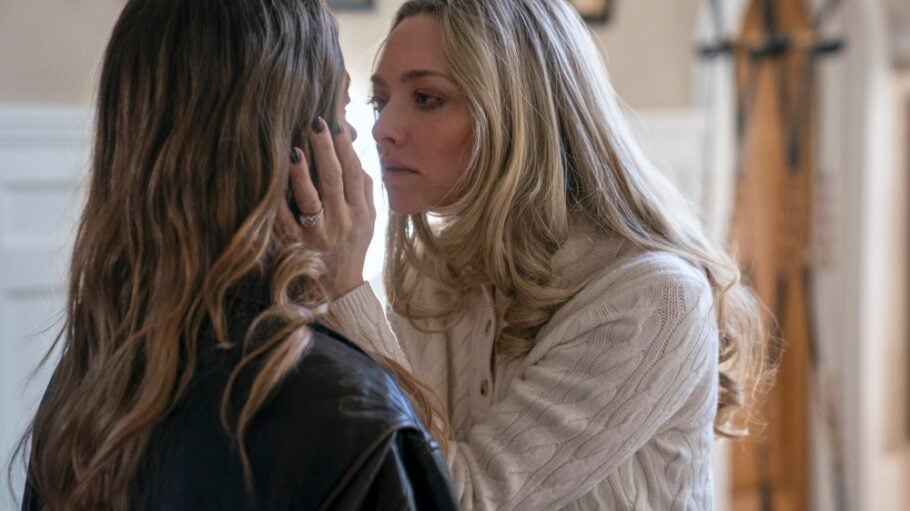
“The Housemaid,” a screw-tightening domestic thriller, is nothing more (or less) than a garishly fun and effective piece of postfeminist pulp. Directed by Paul Feig, from a script (by Rebecca Sonnenshine) based on Freida McFadden’s hugely popular 2022 novel, the film goes right over-the-top, but it does so in a way that’s unusually clever and knowing. And as a sign of how movies are changing now, inching ever closer to fantasy over reality (even when they present themselves as taking place in “the real world”), “The Housemaid” almost feels like it could be a bit of a landmark.
A few decades ago, a movie like this one would have been about a deceptively innocent housemaid who gets hired by a pampered princess of a wife and mother. The housemaid, in that movie, would start off as nice, then begin to toy with situations in a sinister way, only to be revealed as a raging psycho. I’m talking about the genre of films like “The Hand That Rocks the Cradle” and “Single White Female.”
The first way “The Housemaid” fools us — it won’t be the last — is by pretending, for a few scenes, that it fits snugly into the interloper-from-hell genre. When Millie, played under a mane of shaggy rumpled curls by Sydney Sweeney, shows up to be interviewed for a live-in housekeeper position at the suburban palace of Nina (Amanda Seyfried), who runs her home in Great Neck, N.Y., with the cool hauteur of an efficiency expert, Millie comes on as all sweetness and light, peering through her I-wear-these-to-look-smart glasses, communicating how eager she is to get hired and do a great job. But after the interview, as she’s driving away, she takes off the glasses, and a look of grim resign crosses her face like a cloud. The specs were a prop; her whole invitingly abashed personality was, perhaps, an act. We feel like we’ve been here before.
Millie lands the job, of course. And a scene or two later, after she once again pulls through the big metal front gate marked with a W (for Winchester) and into the private driveway, Nina shows her around the splendid, airy, sprawling three-story mini-mansion, with its chandelier lamp and chic dark-wood spiral stairway and endless tasteful trappings (her husband, a tech executive, designed every inch of the place). Millie’s bedroom will be the renovated attic — one of those A-frame chambers that’s either claustrophobic or cozy, depending on your vantage. Millie thinks it’s heaven. As we learn, she’s been living out of her car and has served time in prison; she needs this housemaid job like a life raft. Will she turn out to be crazy?
The first place the film turns the tables on us is when Nina, the movie’s Real Housewife of Great Neck, turns out to be the one who seems nuts. In the morning, Millie discovers an unholy mess in the kitchen, and after she dutifully cleans it up, Nina accuses her of having thrown out the notes she made for her upcoming speech to the PTA. Those ’90s thrillers used to build tension slowly, but not “The Housemaid.” Aghast at losing the notes for her speech, Nina throws a plate-smashing tantrum, screaming out her rage, and we think: “Uh, maybe Millie should just quit?” But according to the movie, she can’t quit. She’s got a parole officer who wants her to walk the straight-and-narrow, and threatens her with a return to prison if this job doesn’t work out. That actually makes no legal sense, and feels like a rather junky contrivance. But you spin past it, because “The Housemaid” is one of those movies you go with. It’s too stylized, too entertainingly extreme, for you to get hung up on whether it all tracks.
Paul Feig is best known as a director of comedy (“Bridesmaids,” the “Ghostbusters” remake), but he straddled the line in the “Simple Favor” films, and here he straddles it in a new way, making a straight thriller with a hyperbolic edge. Feig, like a high-concept George Cukor, is drawn to bringing out female actors who go to operatic extremes, and in “The Housemaid” he builds a perfect stage for Sydney Sweeney and Amanda Seyfried to play a duet that keeps on giving because it keeps evolving.
It starts off as a class war of the New Gilded Age, with the wealthy Nina practically lording it over the fact that Millie has nothing. Sweeney knows how to play a “nice girl” with a hint of not-so-nice layers, and she draws us into Millie’s victimhood so that we’re entirely on her side, even as we’re wondering how much of a manipulator there is at work in her. Sweeney is quite good (warm, distraught, quietly cunning), while Seyfried is nothing short of startling. She’s a great actor who’s usually intensely sympathetic, but in “The Housemaid” she comes on as a haughty harridan with some serious issues, and in a cold-as-ice way she’s hypnotic.
Love Film & TV?
Get your daily dose of everything happening in music, film and TV in Australia and abroad.

It’s not as if Nina’s craziness is a total secret. Her backbiting friends on the PTA gossip about it, and about her highly dysfunctional backstory. All this despite the fact that Nina’s husband, the burly, bearded, pin-up-handsome Andrew (Brandon Sklenar), appears to be the soul of virtue, with a winning smile for everyone. He and Millie start off friendly, then more, and we see why — in addition to looking like hook-up material, they’re the only two sane adults in the household. And when they drive into the city to use the Broadway tickets that were purchased by Nina (it turns out that she had to go on a trip that day — which didn’t stop her from reaming out Millie for ordering them), we think we know just where this is heading: into “Fatal Attraction” territory. The surprise is that the twisty, and twisted, thriller gamesmanship is only just getting started.
I feel compelled to reveal no more of “The Housemaid.” It’s a movie of diabolical developments, and that’s what’s captivating about it. That, and Elizabeth Perkins’ droll performance as a mother-in-law from WASP hell, and the fact that in following the ins and outs that made the novel such a hit, the film creates an ideology of male-female relationships that’s at once timely, glibly mythological, and born to be milked by a Hollywood thriller. There’s a note of pop sadism at work in the material; “The Housemaid” features scenes of people terrorizing each other in violently gaudy ways. Yet the scenes don’t feel exploitative, because they express the characters’ drives, and the audience is hanging on the outcome. In the thick of awards season, when those of us in the media are busy nattering on about prestige films, this is the kind of stylishly tricky high-trash movie that can steal some of the limelight.
From Variety US