





























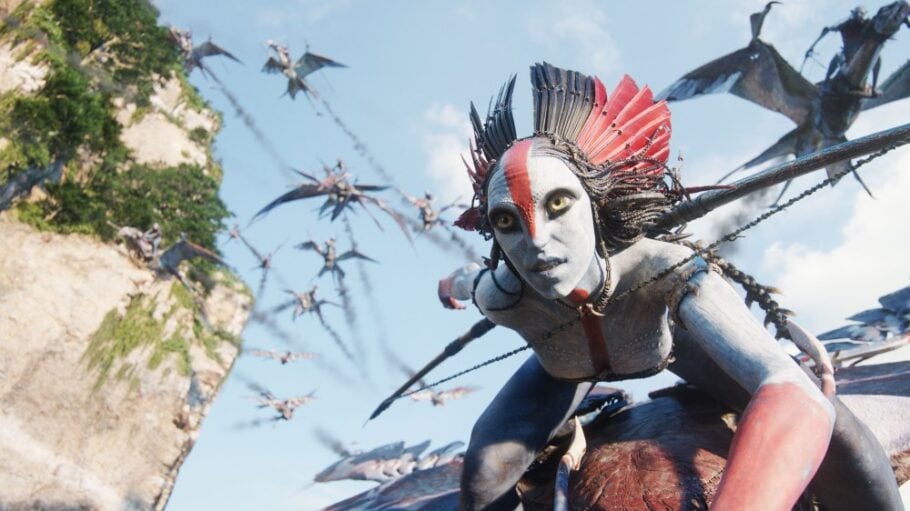
For 16 years, James Cameron has sustained the excitement surrounding the “Avatar” franchise. When a new sequel arrives, you don’t just feel like you’re going to a movie. It’s more like looking forward to a drug trip. But can a third ride on this eyeball-tickling action psychedelic still provide the shock of the new? How high will we get this time?
The first “Avatar” (2009) had that shimmering iridescent wonder as it ushered us into the extraterrestrial jungle-and-hanging-rock View-Master universe of Pandora. It also tantalized us by holding out the promise that we were getting our first real glimpse of the movies of the future. By the time “Avatar: The Way of Water” (2022) came out, that promise had lost its luster — in those 13 years, Hollywood’s 3D “revolution” melted away — but the sequel still bedazzled, with underwater sequences so sculpted and tactile that on the level of a virtual-reality theme-park ride the film was a hypnotic feat, even if was getting harder to pretend that we were overly invested in the fate of Pandora and its tall blue humanoid-meets-gazelle denizens.
Coming just three years after “The Way of Water,” “Avatar: Fire and Ash,” whose title suggests that Cameron is working his way through the classical elements (can “Avatar: The Apex of Air” be far behind?), has a higher bar of novelty to clear, since at this point we’ve been through a whole panoply of experiential “Avatar” trickery. The new movie, for all its inevitable Breathless Technological Advances, doesn’t feel as visually unprecedented as the last one did. If anything, though, it’s a better film — bolder and tighter, with a more dramatically focused story — and it certainly has its share of amazements.
This time, the 3D announces itself with less showiness. The cavalcades of flame (of which there are plenty) don’t pop out at us quite the way the life of the oceans did last time. Where you get that immersive “Avatar” rush is in the extraordinary action sequences, like one where Jake Sully (Sam Worthington) and his allies zip on those flying griffins through the industrial lattices of the military compound where the Rasta-haired surfer bro Spider (Jack Champion) is being held captive. (His biological father is the dastardly Quaritch, played by Stephen Lang in full-throttle mean machismo mode.) No one stages action with the blend of vastness and logistical detail that Cameron does. It’s as if we were watching mystic beasts from “The Lord of the Rings” fly through the sets of “Blade Runner,” and the miraculous thing is that not a moment of it feels staged. It’s a twisting-and-turning-in-the-air hurtling existential war.
Cameron has been spreading the gospel of how much he disapproves of AI, and the screening of “Fire and Ash” I attended was preceded by a taped video message in which the director declared, with pride, that not a single moment of the movie was created by “generative AI,” that it was the actors who put “life and blood into each of those characters.” Okay, but who’s kidding whom? The “Avatar” films aren’t AI-generated, but as much any film franchise in history they point to a future of screen acting that melds the human and the synthetic. They have plenty of AI spirit, even as there’s no debating that the looks and personalities of the actors shine through (as has been standard with motion capture for a long time). The story and characters of “Fire and Ash” work fine, though it says a lot that the film’s universe is one in which the serviceable Sam Worthington can seem as interesting as any actor around him.
His Jake is angry this time. At the end of “The Way of Water,” he’d lost his eldest son, Neteyam (Jamie Flatters), and he wants revenge, even though that’s not the Na’vi way. He is now into arming his holistic bow-and-arrow clan with machine guns, which feels like the equivalent of the rifles that Native American tribes used to brandish in certain Westerns. Lo’ak (Britain Dalton), Neteyam’s brother, feels his loss most acutely, and his grief is our entry point into the story, which picks up one year after Jake and Neytiti have settled in with the Metkayina clan.
The conflict now centers on Spider, who is Jake and Neytiri’s adopted human son. Neytiri, played with a volatile charge by Zoe Saldaña, wants to cut him loose from the family (she thinks he’s putting them in danger), and when the children are stranded in the jungle and Spider acquires the ability to breathe without a mask (because his body has been invaded by mycelium — don’t ask), that proves to be the pivotal plot point. If Quaritch can capture Spider, and his scientists can reverse engineer what happened to Spider’s body, they can then swarm Pandora with humans and ruin it.
Love Film & TV?
Get your daily dose of everything happening in music, film and TV in Australia and abroad.

Cameron hasn’t lost his zesty storytelling brio, even if the story he tells is starting to feel like his version of the “Star Wars” prequels. As in: It’s fine, but do we actually care about it? Cameron himself has a sixth sense for when to break up the windy chronicle of Pandora with a squid attack, characters leaping across floating rocks like something out of “The Super Mario Bros. Movie,” or the introduction of a sinister new Na’vi clan: the ash-skinned, volcano-dwelling Mangkwan, whose leader, the witchy Varang (Oona Chaplin), suggests one of Andrew Lloyd Webber’s Cats crossed with Marilyn Manson. She forms an alliance with Quaritch, based mostly on a slightly campy mutual attraction. John Waters has said that he dropped acid so often in the ’60s and ’70s that he had to stop tripping because it had begun to seem like reruns. That’s a feeling that has the potential to set in with the “Avatar” films. The good news is that the series hasn’t reached that endgame…yet.
From Variety US