





























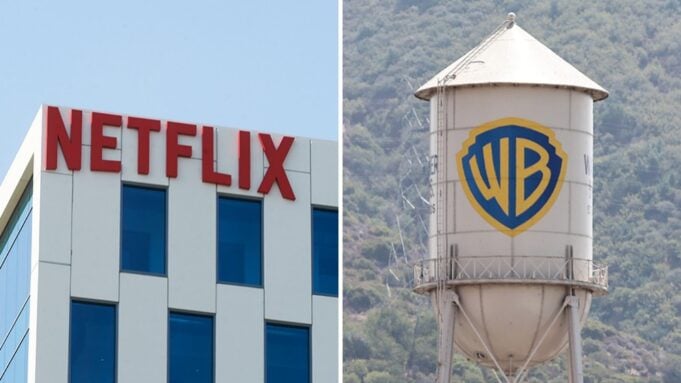
Netflix’s stunning $83 billion takeover of Warner Bros., announced on Friday, sent French exhibitors into high alert in a market where Warner Bros. — alongside Disney and Universal — drive the local box office.
France is simultaneously one of Netflix’s strongest international markets and one of its most combative, shaped by the country’s tough regulatory environment for streamers. The windowing rules, which force Netflix to wait 15 months after movies are theatrically released before being able to roll them out on its platform, have long caused tensions with French exhibitors. It’s also the reason why the streamer deserted Cannes after the 2017 edition, when the festival set theatrical requirements that effectively keep Netflix films out of competition. France is, in fact, the only market in the world where Netflix might be prevented from launching “Narnia” in Imax theaters due to local regulations.
The windowing system, hailed as the backbone of France’s film economy, stands out as the next battleground. Netflix has already appealed to France’s Council of State in a bid to shorten their window to access movies sooner. That bid now carries far greater weight with one of France’s most powerful purveyors of U.S. blockbusters under Netflix’s control. But Richard Patry, president of France’s National Exhibitors Association (FNCF), made clear the guild “will fight back” in an interview with Variety.
Patry was among the first to sound the alarm on how the takeover of Warner Bros. by Netflix could impact the core of France’s theatrical ecosystem, even if Ted Sarandos said on a conference call with investors and press on Friday that Netflix has no “opposition to movies in theaters” and “expects” to release Warner Bros. films theatrically. “We’re hopeful that the antitrust boards in the U.S. and in Europe will examine very carefully the potential consequences of this deal,” Patry said, reflecting widespread concern inside a sector already weakened by declining theatrical admissions.
Marc-Olivier Sebbag, the FNCF’s general delegate, stressed that today’s competitive market amplifies the risks. “The landscape today is very different from what it was when Disney and Fox merged; Netflix has a big chunk of the streaming market and Warner Bros. Discovery is already a consolidated giant,” he noted.
Patry, who sits on the Cannes Film Festival board, played a significant role in the launch of a rule in 2017 that demanded that every movie playing in competition gets a theatrical release in France, which effectively pushed Netflix out of the competition.
“We waged a battle against Netflix at Cannes so that every movie in competition gets released in cinemas without exception, and we got a lot of pushback on it,” he said. “But we’re seeing now that even Cinema United is sharing our concern over the need to protect theatrical exhibition.”
Love Film & TV?
Get your daily dose of everything happening in music, film and TV in Australia and abroad.

In France, Warner Bros. holds a special place not only as a source of tentpoles but as the most “European” of the American studios, says Patry. Indeed, it’s the studio which was led in France for many years by now-Cannes president Iris Knobloch. During her tenure at the helm of Warner Bros. France, Knobloch greenlit Michel Hazanavicius’s silent film “The Artist,” which world premiered at Cannes and went on to win five Oscars, including best picture, in 2012.
“Warner Bros. has always had a well-defined editorial line and they deliver blockbusters that appeal to cinephiles,” Patry said. “They’re the most European of all the biggest U.S. studios.”
What worries French exhibitors is not just the future of new U.S. tentpoles but also Warner’s library of classics, a crucial resource for heritage screenings and youth education initiatives — areas where France remains uniquely committed, Patry says. “Warner Bros. has been generous in letting French cinemas screen iconic movies from their library to educate youths, and now with Netflix we don’t know if this tradition will be perpetuated,” he continues.
Amid the sector-wide alarm, Pathé Cinéma managing director Laure de Boissard sounded more upbeat about the prospects. “I’m optimistic,” she tells Variety, “because a move of this scale shows that Netflix still fundamentally believes in the value of cinema in movie theaters.”
“Netflix’s message with this acquisition is actually quite clear: the theatrical business remains a strategic pillar,” she said. De Boissard also pointed to recent lessons from Disney’s streaming-first phase. “When the launch of Disney+ led them to pause theatrical releases for a while, they quickly realized with their full 360-degree view that it simply didn’t make economic sense,” she said. “They understood they had to put theaters back at the center of their strategy — even purely from an economic standpoint.”
She says, “Netflix is a financially disciplined company. They will see the impact of this shift from the front row.” She added that she’s even hopeful that “some films that today go straight to the platform might, along with the Warner titles, benefit from theatrical exposure under this broader economic vision.”
Hours after news broke of the deal, James Cameron was on the stage of La Scene Musicale in Paris to present the European premiere of “Avatar: Fire and Ash” and paid tribute to France’s unique cinema ecosystem. In a speech that felt particularly timely, Cameron said, “We need to honor the nation that has more cinephiles per capita than any other country in the world,” before adding: “The thing that I love about France is that in this country, it is a moral obligation to support the arts.”
Patry, who may have been in the audience, will almost certainly deploy Cameron’s speech as fresh ammunition in his next Netflix showdown.
From Variety US