





























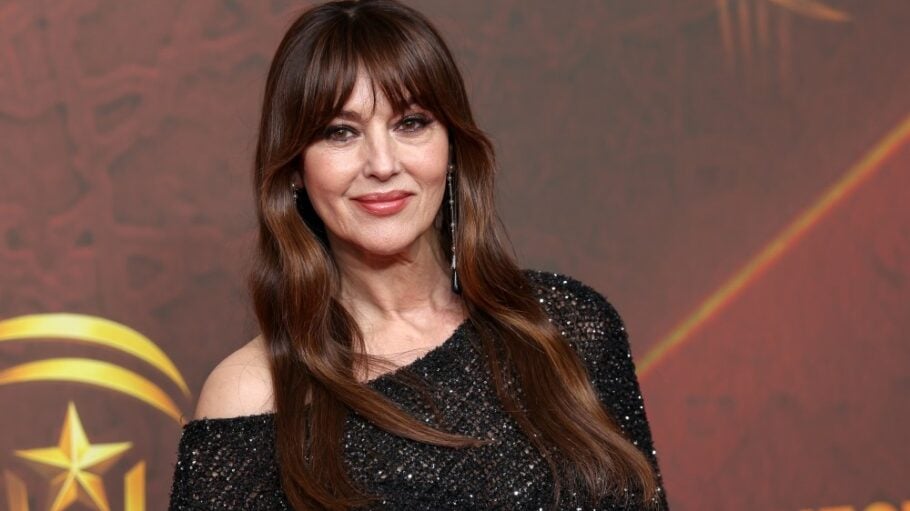
But rather than marking the twilight of her career as a Hollywood sex symbol, the movie ushered in a new chapter for Bellucci whose career has been enjoying a second wind in recent years.
During a candid, wide-ranging masterclass moderated by Variety at the Marrakech Film Festival, Bellucci recalled that Mendes really “wanted to show a mature woman, and I thought it was a beautiful idea.” “He told me, ‘Listen, I have a strong and unusual role that’s going to be surprising, a little revolutionary,” she said. “I was 50, and I had never seen a 50-year-old Bond woman. So I think I’m the oldest James Bond woman, lady or girl that we’ve ever seen,” Bellucci said with a laugh in front of a huge crowd of locals and film students who queued for over two hours to get in.
Ultimately, “Spectre” and Emir Kusturica’s “On the Milky Road,” in which she starred opposite the Serbian filmmaker, came at a pivotal moment in her life.
“Suddenly, I had two very strong roles. Those two films helped me get through the transition of turning 50, which wasn’t easy for an actress,” she said.
Bellucci, whose body of work has largely been shaped by celebrated male auteurs — from Francis Ford Coppola to Giuseppe Tornatore, Gaspar Noé and David Lynch — also noted that she has enjoyed working with more female directors in recent years. She cited Alice Rohrwacher with her Cannes-prizewinning “The Wonders,” Rebecca Miller with “The Private Lives of Pippa Lee,” Kaouther Ben Hania with “The Man Who Sold His Skin” and Léa Mysius’ “Birthday Girl,” which competed at this year’s Cannes.
“When I was younger, there weren’t as many female directors as there are today. It’s new to have so many female directors, screenwriters and even technicians on a set, so many women. We’re witnessing something completely new,” she said.
“It’s another way of telling stories, sometimes another vision. And between women, sometimes there’s this ‘je ne sais quoi,’ as we say in France. Suddenly, we look at each other and, without words, we express ourselves and we understand each other. So I also really like working with women whenever possible.”
Love Film & TV?
Get your daily dose of everything happening in music, film and TV in Australia and abroad.

Bellucci said the roles she is being offered have also evolved as she’s gotten older, allowing her to explore facets of herself that she couldn’t have accessed earlier in her career.
“Our body is our working instrument. So the instrument changes and, consequently, the roles change. It’s another part of ourselves that’s expressing itself,” she said. “As we get older, we also gain experience, and we have another way of telling the story of life.”
Bellucci, who made her debut on stage in 2019 with the solo show “Maria Callas: Letters and Memoirs” — which she toured in different countries and played in French, Italian and English — said she felt lucky that “times have changed and there’s a lot of respect for women in cinema.”
“In the ’40s, ’50s and ’60s, it was very difficult for a woman over 40 to have a career, even if she was very talented and still had everything it took. And today that has changed.” She cited Susan Sarandon, Judi Dench, Jamie Lee Curtis and Meryl Streep as actors who have paved the way for women to continue playing compelling roles as they age. “There are magnificent actresses who are absolutely fearless,” she said, singling out Streep. “She’s so fearless and she’s incredible. There are several actresses who are free in that sense.”
Bellucci also reminisced about her defining role in Giuseppe Tornatore’s 2000 drama “Malena,” which earned two Oscar nominations. Bellucci plays a young woman whose beauty triggers desire and eventually violence in a small Sicilian town during World War II.
Bellucci, who says she was already a film buff from a young age “watching three films a day,” had met the Oscar-winning director of “Cinema Paradiso” during her modelling years in Italy and worked with him on a commercial for Dolce & Gabbana. Four years later, while Bellucci was shooting “Under Suspicion” with Gene Hackman and Morgan Freeman, Tornatore called to offer her the lead role which he wrote for her.
“The script was already very powerful because it tells the story of women living in a man’s world, the difficulty of those relationships, the violence. It’s about a woman who finds herself alone in a man’s world and has to deal with it. Ultimately, it’s still a very contemporary film,” she said.
At the time, Bellucci had already broken through in France with “L’Appartment,” starring opposite Vincent Cassel, and “Malena” represented a daring role which required a great deal of nudity and some intimate scenes with a teenage actor. She said approached these scenes “very naturally.”
“I came from fashion, so I had a freedom with my body that came from the work I had done before,” Bellucci said. “Even today, I think nudity can serve to bring a character to life. When I see films like ‘Anora’ or ‘Poor Things,’ these are films where the actresses’ bodies are very important in bringing the characters to life.”
“When you play a role, if nudity is part of that role, it’s simply a working tool. It’s not a way of exposing yourself. In fact, it’s like a costume that brings a role to life.”
During the conversation, Bellucci also talked about her experience shooting Mel Gibson’s highly controversial blockbuster “The Passion of the Christ,” in which she portrayed Mary Magdalene.
“I had another action film at the same time, and I chose ‘The Passion of the Christ’ because I wanted to work with Mel Gibson. I’d seen films of his that I liked, and it was an experience I wanted to have.”
She said she had no regrets about making the 2004 biblical epic, which sparked controversy over its graphic violence and portrayal of Jewish figures, and went on to gross over $611 million worldwide.
“I think every time a film sparks a discussion, it means it was important to make it. Because discussing and exchanging ideas — that’s the power of cinema,” she said.
She said she approached the role Mary Magdalene as “a simple, human woman who experiences something greater than herself, something she can’t really explain. There is a form of spirituality in everyone.” Although the film didn’t bring her closer to her Catholic upbringing, she said she felt “there is never anything bad in religions. It’s the political use of religion that is dangerous.”
Bellucci also praised Gibson for being “really incredible with actors on set” and revealed she had talked to him about the two-part follow-up, “The Resurrection of the Christ,” which he’s currently filming. “Yes, we spoke,” she said of the sequel, adding: “I think he’s a great director.”
During the masterclass, Bellucci also revisited the memorable scene in “The Matrix Reloaded” in which her character, Persephone, demands that Neo — played by Keanu Reeves — kiss her as if he were kissing Trinity (Carrie-Anne Moss) in exchange for her help.
Asked whether she had to do numerous takes of the kissing scene with Keanu Reeves, Bellucci quipped, “It’s not tiring, is it? You can do it.”
“He’s someone who is very gentle, respectful. We met on ‘Dracula’ and saw each other again years later on ‘The Matrix,’“ she said of Reeves.
Despite landing supporting roles in several Hollywood movies at the height of her international breakthrough, Bellucci said she never felt the desire to relocate to the U.S.
“I like America. I love all these possibilities, all this energy, the possibility of making big films as well as independent films. And I like going there. But I feel profoundly European. I live between Paris and Rome, and I love that,” she said.
“The more time passes, the more I realise that I adore my profession and I still have that passion. But I also love the real things in my life. I love having my friends, I love my family. I also love having a kind of everyday life, something that keeps me connected to something real,” she said. “I like cinema, but I prefer life.”
Among her more recent Hollywood outings was Tim Burton’s “Beetlejuice Beetlejuice,” in which she plays Delores, Beetlejuice’s vengeful, soul-sucking ex-wife who comes back from the dead to hunt him down.
Bellucci said Burton’s drawings of Delores helped her envision the character. “He expresses so many things through his drawings and he had made a magnificent drawing of this character. I was already really inspired by that,” she said.
“With all her scars, Delores is a bit of a parody of existence, a metaphor for life,” she said, adding that the role necessitated three hours of makeup every day. “We all have scars. We have to face them, continue to live with them and move forward.” Speaking of the scene in which she reassembles her body, she said “there were special effects, but it was also a bit like a macabre dance.”
Bellucci, who also worked with Ben Hania and Moroccan-Belgian directing duo Adil El Arbi and Bilall Fallah on “Seven Dogs,” was also upbeat about the new generation of Arab filmmakers.
“There’s a lot happening. This festival is proof of that, isn’t it? All these first and second films, these incredible young filmmakers, beautiful films like ‘Adam’ and ‘The Blue Caftan.’ Beautiful things are reaching international audiences, the Cannes Film Festival and beyond. Long live cinema!“
She concluded the masterclass with a rallying cry for the moviegoing experience. “I hope cinema will never disappear because I truly believe in cinema as one of the cultural elements that are essential to humanity,” she said.
From Variety US