





























“I turned the corner, and I was like, ‘Hi, Alex!’ and I went bright red because my brain couldn’t compute what it was seeing,” Debicki tells Variety, sitting alongside Skarsgård and their co-star Olivia Colman in a hotel suite at the Chateau Marmont in L.A. “I was just like ‘Oh my God! Welcome to Budapest, I guess.’”
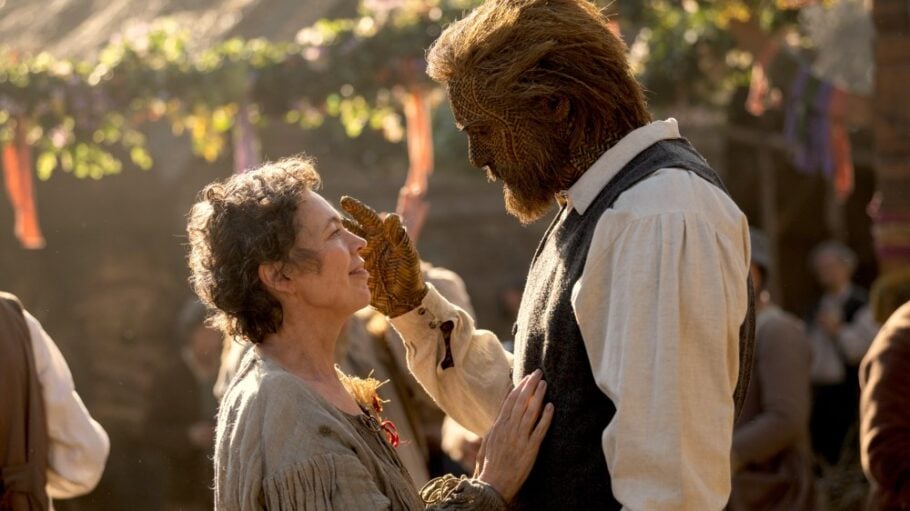
From married filmmakers Eleanor Wilson and Alex Huston Fischer, “Wicker” follows the relationship between an ostracized fisherwoman (Colman) and her fantastical husband (Skarsgård), who is handcrafted for her by the local basket weaver (Peter Dinklage). When the wicker husband proves to be a better man and partner than the rest of the married men in the village, jealousy erupts, and the unlikely couple must figure out how to preserve their simple life amid the chaos and vitriol. (And yes, Straw-Skarsgård is on full display in the Black Bear film, now playing in theaters.)
While Debicki needed a moment to grapple with the sight of a naked wicker man, Colman’s reaction mirrored her character falling in love at first sight.
“It was amazing because we’d all been looking at images for 18 months or so, and then to see it in the flesh, it was amazing,” Colman said. “That [feeling] of, ‘Oh my god, it’s going to work!’
The Oscar winner was the first to see Skarsgård in his full wicker suit and prosthetic makeup. The prototype had been sculpted after Skarsgård’s features, but when the Weta Workshop artists tried it on someone else in New Zealand, it almost worked, but not quite.
“If it doesn’t quite work, it looks like a horror film because it looks like you cut someone’s face off and glued it onto your own, and that wasn’t quite the tone we wanted to go for here,” Skarsgård explains. “So, it was a lot of anticipation and excitement and a lot of nerves because it was like, ‘Oh shit! If it doesn’t work, then we’re kind of screwed.”
Thankfully, Colman’s exuberant reaction eased any of Skarsgård’s fears. “It was an incredible day that I’ll never forget. Putting it on and then it helped me find the physicality of the character and then stepping out of the trailer and having Olivia outside going [gasps],” he recalls. “You can see how intricate and how beautiful the work was, and the fact that once it was glued onto my face, it actually moved with my movements. It’s even better than we imagined.”
Love Film & TV?
Get your daily dose of everything happening in music, film and TV in Australia and abroad.


The cast’s multilayered reaction is exactly what moviegoers can expect when watching “Wicker.” The film is intended to warm your heart and make you laugh, but it’s also guaranteed to make you blush. Audiences got their first peek at the film with a steamy three-minute trailer filled with sexual innuendo and hard-as-wood jokes. Since then, the marketing for the Black Bear film has taken on a life of its own, with playful promotional products like hand-woven nipple pasties, a popcorn bucket shaped like the wicker man’s torso and splinter removal kits.
But the film itself dares to go much deeper. “It’s not just a slapstick or sex comedy,” Skarsgård says. “They did an amazing job with this, and I hope and think and believe that people will go on this journey, be excited with all the twists and turns.”
In an era of box-office unpredictability, the “Wicker” cast isn’t worried about moviegoers embracing the film’s big swing. The stars believe the fanciful romance’s originality is enough to attract moviegoers to the theater — as evidenced by the post-trailer buzz. “Wicker” captured fifth place with $5.75 million from 1,471 locations, a “strong start” for the low-budget indie, according to Variety‘s Rebecca Rubin. (Black Bear acquired the movie for $2.5 million after it generated buzz at Sundance Film Festival earlier this year.)
The movie is so much fun, but there’s also a lot of serious moments, and a good balance of raw emotional scenes. I wasn’t expecting it to be such a tender love story. How did you establish that balance?
Colman: That was all in El and Al’s [Eleanor Wilson and Alex Huston Fischer’s] beautiful script. They just got the tone. So, you just had to follow it, and you couldn’t really go wrong. It can be hard to go from very silly to really heartbreaking, but because it was all done with realism, it worked better.
In my saddest moments in my life, I’ve definitely found myself laughing hysterically as well, which is a very human thing, pain and recovery, all those things. And El and Al just nailed it. It made our journey, our job easier.
What message about marriage and romance do you want audiences to take away from this?
Colman: Think wisely. Hopefully, the love you choose enhances your life, not diminishes it.
Debicki: It’s such a beautiful examination of the idea that loving someone is really looking in a mirror of yourself. You know that’s what’s so frightening. But I always think of the line when Olivia said, “Well, what does he know about love?” And the basket maker says, “Well, I imagine he learned it from you.” That’s what we do in life. We are constantly learning from each other. It’s also a really beautiful examination of the institution of marriage.
And a lot of this film is looking at what patriarchy does to women, the messaging of women needing to compete. That there’s a kind of scarcity complex that you must do it this way, and she rethinks the system and creates it in the image of herself that’s authentic, and in that she thrives, and that’s a really good conversation to have for women.”

What do you think it says about audiences that they’re willing to come out and root for a wicker husband and a wife?
Colman: I think people are excited about something that’s original and different. I think audiences get patronized a bit like, “Oh, they like that film. We’ll do another five like that,” and there’s space for that. But there’s also space for something totally original and different. And El and Al had control of this.
Skarsgård: The fact that they did have complete creative control and they could have the freedom to make their own movie the way they wanted to make, without lots of chefs in the kitchen or with lots of nervous financiers being like, “Well, are we sure this is going to work?” It was really exciting to be part of that journey. Like we’re making something quite unique here. There’s freedom in that.
Debicki: We’re in a very difficult time for women. If you look at women in this country and patriarchal systems, a woman’s right to choose what they do with their bodies, and how they live their lives, and just pay disparity in general since the dawn of time. I mean, women rightfully are questioning things, and this movie is refreshing because it’s looking at these issues in a way that’s really accessible and entertaining, but there’s some serious conversations in this movie. I think it’s important to talk about that.
People have been having so much fun with their promo and the products that they’re making. What fun merch have you guys been into or seen recently?
Skarsgård: We got a splinter removal kit. And those 3D-printed wicker husband torsos. They’re popcorn buckets, and then you fill them with popcorn, popcorn out of like a wicker basket.
What about all the wicker puns? When have we reached the end?
Skarsgård: We have a good one.
Colman: 50 Shades of Hay.
Skarsgård: It’s been a lot of fun watching this. We all love the film and were very excited when the trailer came out, but you never ever expect that kind of reaction. I’ve never had a movie with that kind of reaction. It’s been really thrilling, and we’re excited to now share the whole movie, more than just those three minutes, with the world.
From Variety US