





























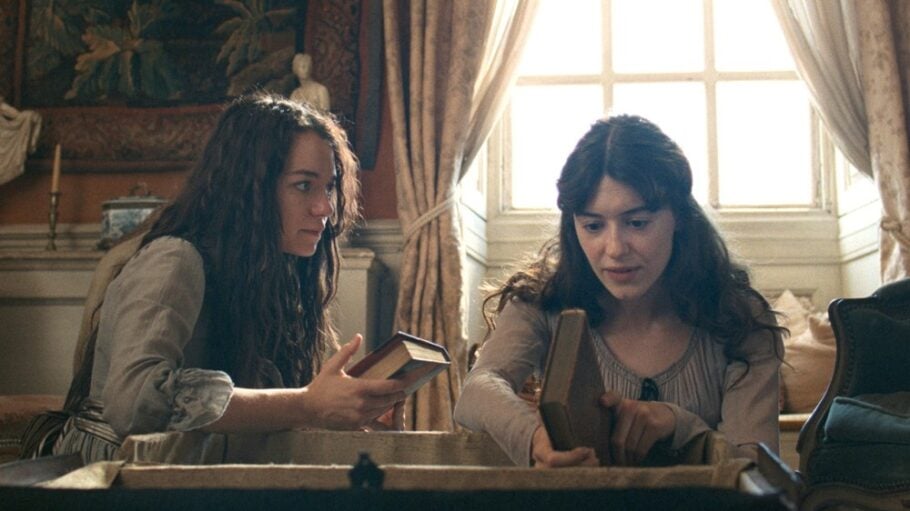
The screenwriter for Georgia Oakley’s 2026 adaptation starring Daisy Edgar-Jones and Esmé Creed-Miles grew up watching the 1995 version, from screenwriter and star Emma Thompson. When she was initially pitched the idea to create her own interpretation, she wasn’t sure it could be done because of the success of the earlier adaptation. But she went back to the original text and found the heart of what she felt hadn’t been said on screen before: the love story between the Dashwood sisters.
Reid, who is primarily a novelist, took on her first screenplay from that perspective. In the process of adapting Jane Austen’s 400-plus-page novel into a just-over-two hours film, there were some scenes or characters left on the cutting room floor in order to leave room for the sisters to flourish. Reid was careful to make changes with integrity, not simply because she wanted her version to be different from the 1995 film.
“Sense and Sensibility” is now in theaters. While in Santa Fe, N.M. to be recognized as one of Variety‘s 2026 Screenwriters to Watch, Reid spoke with Variety about the book-to-screen changes, adapting a classic novel for a modern audience and why she thinks Austen is “almost like Shakespeare.”
How did you approach the project?
I’m a huge fan of the 1995 film. I grew up watching that film. When my producer India [Flint] suggested we try “Sense and Sensibility,” my instinct was that it couldn’t be done because that film had done it perfectly. So, I went away and I reread the book and I rewatched that film, and I had to satisfy myself that I had something to say in the book that I didn’t think had been said on screen before. And I was actually surprised, to be honest, that I did find that in the book. When I reread the book, I was so struck by the extent to which it’s really a love story between two sisters. I wanted to make sure that in the film, that always the spine of the narrative was their relationship. Then, having decided that yes, I would attempt it, it was a process of really paying attention to what resonated with me in the original, the elements of the novel that just almost didn’t require any adaptation at all, that just leap off the page, and making sure that they were really prominent, and then also being honest with myself about the bits that I felt didn’t track as well for a modern audience, and then thinking about how we could massage them while still remaining true to the spirit and the themes of the novel. From that, I worked out what I wanted to change, and then that gave me a structure, and that was what we pitched to Working Title. That’s the lovely thing about basing it on a really good book. The characters are so fleshed out, so once you’ve pitched it and you have an idea for the structure, when Working Title said yes, I was able to just start at the beginning and then right to the end, and then I edited it.
What were those keystones that you knew you weren’t changing?
One thing that really struck both me and my producer was the Willoughby character and the relationship he has with Marianne. It’s actually extraordinary, when you reread the book, how modern that is, and we track it pretty closely, beat for beat. It’s interesting because we have a totally different vocabulary now around those behaviors. But what he does to Marianne is so textbook. He love-bombs her and then ghosts her, and the behaviors are identical to phenomenons that we experience today. I feel like I’ve had those experiences or friends of mine have had those experiences. That was one that leapt off the page. Similarly, I think Marianne’s character in the book, she’s almost ahead of her time. She’s a character that I think tracks very easily for modern audiences because her impulsivity and her passion is something that we really respect in this day and age. And then maybe there were three things that I felt I needed to massage. One was, and again, this goes to Marianne’s character in the book.
I think there’s a reading of the book where it’s a tale of sensibility yielding to sense, and Marianne, who’s the passionate sister, almost gets crushed by a society that is so oppressive and rigid, and by the end you almost feel like she’s lost some of her wonderful impulsivity and passion. And in this version, I love the idea that maybe there was a way to make it more symbiotic, so that it wasn’t about sensibility yielding; it was more about achieving a balance between the two. I just thought that was such a lovely, elegant structure, if you could set up this antithesis of sense and sensibility, and then have them combine by the end, or have them synthesize. That was another change, Elinor learning from Marianne as well, and then both coming of age at the same time. And then the final thing was there are just some features of the original plot that are hard to square with modern morals. The main one being that Colonel Brandon, in the book, is 35 and Marianne is 16, and he has a daughter who’s the same age as her, which I find as a modern reader that’s a hard hurdle to get over in terms of investing in that romance because he’s such an explicitly paternal figure. We did make some changes to his backstory to try to keep what was important about that, which is that he’s more experienced than Marianne, and he’s seen more of the world, but deprive it of the icky paternal quality.
Love Film & TV?
Get your daily dose of everything happening in music, film and TV in Australia and abroad.

You mentioned that you loved the 1995 version, which I think so many people do. Was there anything that film changed from the novel that you wanted to keep or anything they changed that you didn’t want to change?
That film is so phenomenal. It’s funny because they actually do make quite a few changes from the novel. I think because it’s become such a high watermark for a faithful, wonderful period adaptation, people almost forget that it is also an adaptation, and they have made changes. It’s funny when you’re working in the shadow of such a brilliant text because you do try to make everything original, and in some ways that was a helpful constraint. When we were working on the film, we were always thinking, “How can we liberate it from what people have seen before?” That inspired some of the additions we made. There’s like a critical scene that we set at a party instead of a picnic because we were like, “Well, people have already seen the picnic. How can we do it differently?” But then there were some things that were unavoidable. When you condense a 400-page book into a two-hour film, there are certain things that have to be cut, and we’ve cut some of the same characters and some of the same plot beats. And I think that it’s unfortunate that they’re the same. In our film, Edward’s mother doesn’t appear, and Lucy Steele’s sister doesn’t appear, and there’s a whole sequence where Edward visits them at the cottage, which doesn’t appear in either film. You try to keep it all different. But then when you’re going through the book, you’re like, “Ah, Emma Thompson was right. That scene isn’t necessary, and I’m not going to put it in just for the sake of being different, when it objectively just isn’t necessary, or that character’s not doing anything.”
The fact that Edward doesn’t visit the cottage is a really effective change, to have him just write and say, “I’m no longer coming to visit,” but it hurts every time.
I did a lot of work on that Edward and Elinor relationship. The way I thought about it was, in the novel, so much of the drama is her genuinely not knowing how he feels about her and her wringing her hands, being like, “What does this man want?” I think because that’s such an internal drama, it actually doesn’t play well on screen. I think what’s tense on screen is knowing that two people love each other, but that question of will they, won’t they? It’s not do they want to? It’s will circumstances conspire to keep them apart? That was how I tried to structure that Elinor-Edward relationship, like it’s clear to both of them, from the moment she gets to London, that he does love her. But it’s just a question of whether they’ll be allowed to act on that love. I just think that plays on screen so much better because it’s less dependent on internal states. It’s more about the alchemy of what’s happening between two people. Him coming to Barton and her just being like, “What do you want?” It’s amazing in a novel, but it’s just not cinematic, I don’t think.
Are there other things that you have to change how it’s staged when you’re taking something from a book to what will play well on screen?
There’s a lot of that. I should say, this is the first screenplay I’ve ever written, but I’ve published three novels and I’ve written four. Got another one coming out, so I’m primarily a novelist. I think in some ways that was helpful because I’m sensitive to the benefits of both mediums. The two things I’d say: One is that in a novel, someone’s backstory can feel very compelling because you’re already having to visualize everything for yourself anyway. So, a character telling you a story that’s about something that happened in the past feels just as immediate as anything else that’s happening on the page, but in a film where you’re seeing everything, if you have a character explaining something that happened off screen, it really loses a lot of potency. In the book, there were a few things, like there was a duel that Brandon mentions happening with Willoughby, but it’s not in the action of the novel, and we put it on screen because I was like, if you don’t see it, it’s almost like it doesn’t happen in a film. And then similarly, Brandon has a whole complicated backstory that in the book he relays to Elinor, and I just felt like, as I said, in film, a character telling you about something loses a lot of potency unless you feel like it’s the person who’s telling it to is really significant. It needs to move the relationship that’s on-screen forward. So, we move that conversation so that he has it with Marianne instead of Elinor, because then it became not just about the content of the backstory, but then it’s about him being vulnerable with Marianne and her learning about him, and it’s about the progress of that relationship in the scene that you’re watching on screen.
I want to talk about the ending and how we don’t really end with a wedding scene. It’s a little less structured.
In the book, they do both get married, but not at the same time. In the final chapter when Austen’s wrapping it all up, she says that a few years after Elinor and Edward get married, then Marianne warms to Colonel Brandon, and then they marry. This goes to what I was saying before about when you’re writing something that’s already been adapted. Austen has been endlessly adapted, not just this particular text. You are always thinking, “How can I show them something they haven’t seen before?” I think that was good because it pushed us to think about how we could end it differently. And then I came up with this idea that I liked the idea that structurally we could show how Marianne and Elinor have taken from each other because Marianne was the typical romantic, and she was the one who wanted this big romantic life, and Elinor was always the more quiet one. And then at the end, Elinor gets the textbook rom-com ending of the chase to the love of your life, and what Marianne gets is something that is still really rich, but it’s much slower and calmer. I loved that idea that the structure of the film was mimicking the way that they’ve swapped. We actually shot an additional scene, which was like a coda. It was months in the future, and Elinor and Edward were already married, and it was the morning of Brandon and Marianne’s wedding day, and it was on the beach, and it was the two couples just hanging out. It still finished on a final shot of the sisters, like it was still about their relationship, but it was to show the audience, “See, they’re all happy. They’re married, they’re paired off.”
It was one of the last things we shot. It was one of everyone’s favorite days of filming. It was a beautiful, sunny day. I’d love to see the footage. Everyone was so happy. But then we watched that scene of [Brandon] and Marianne by the river, where she sort of confesses her love to him, and their performances were just so amazing. And we just felt like the audience didn’t need another scene because you could tell from the way those two spoke to each other that they were going to be OK, and that there was such a river of compassion and love, and there was so much depth there, and that Marianne had grown up. So that’s why we ended it just after Elinor runs for Edward.
What do you think it is about something like “Sense and Sensibility” that makes it possible to adapt to a modern screen but also makes it compelling? Why do you think this is possible, and people will come back to watch another adaptation of it?
Great art is just endlessly adaptable. I do think that Jane Austen has achieved that status where she’s almost like Shakespeare. It’s almost like she’s moved beyond being cultural property, such that I don’t feel any ownership over her, just because I’ve done one adaptation. I accept that there will be endless adaptations, and this is just my version, and someone’s probably already working on another version. I think that when characters achieve that level of cultural resonance and universality, then it opens it up to any generation and anyone who connects with the text to bring a bit of themselves to it. I just think that so few artists achieve that kind of universality. What a gift, and how incredible that no one’s trying to be definitive. Everyone’s just participating in this long chain of connected human experience with this novel that we all love. In terms of why her, like how has she got to that incredible, very rare status? I think it’s almost a unique combination of cynicism and romanticism. I think Jane Austen is so cynical about social structures and the way that people can be almost oppressed by being a social person. But then she’s so romantic about how love can be a site of agency and authenticity, and how finding someone who sees you for who you are can liberate you from those very oppressive structures, and I just think that’s a story that we’re always going to want to tell.
This interview has been edited and condensed for clarity.
From Variety US