





























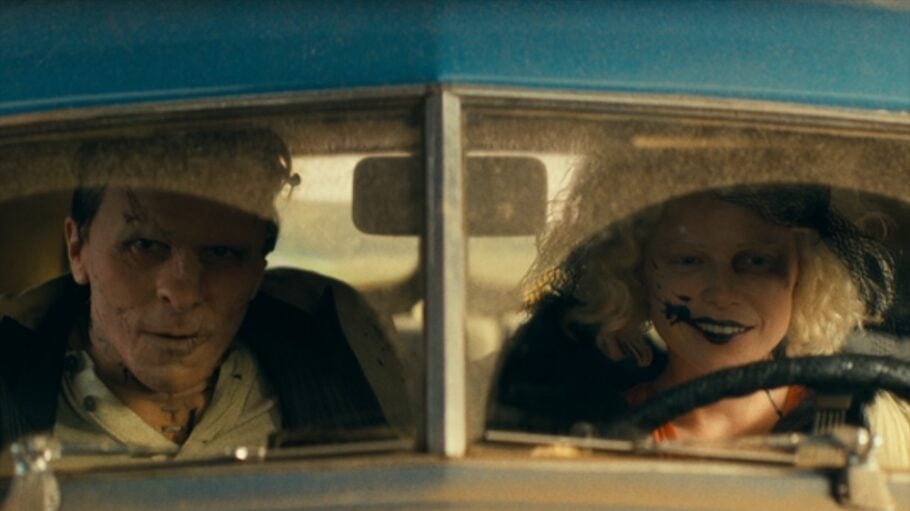
It’s alive! I’m talking about the legend of “Frankenstein.” I thought the reanimated corpse of it came close to slipping off life support in Guillermo del Toro’s “Frankenstein,” a movie that, to me, was all baroque production design and no pulse. It was so top-heavy with lavish retro pomposity that it made me never want to see another “Frankenstein” movie again.
But here we are, half a year later, with Maggie Gyllenhaal’s “The Bride!” Is it a horror movie? Not quite. An awards movie? No way. A potential hit? I doubt it. It’s a scrappy punk feminist tragicomedy of l’amour fou, a renegade take-off on the “Frankenstein” myth. And while the movie doesn’t quite work — it lumbers along and blows fuses; it has lots of flesh and blood but not enough storytelling spine — there’s a spark of audacity to it. It’s alive in ways that del Toro’s “Frankenstein” was not. In her second feature, Gyllenhaal, the actor-turned-writer-director (“The Lost Daughter”), has come not to embalm the “Frankenstein” legend in stately good taste but to reimagine its perversity. “The Bride!” is a bit of a pastiche (it echoes movies from “Joker: Folie à Deux” to “Thelma & Louise”), but it’s also a debauched fairy tale with teeth.
And it is most definitely a sick-joke love story. Mary Shelley published her world-shaking novel, “Frankenstein; or, The Modern Prometheus,” in 1818, when she was just 20, but the film, for no good reason, is set in 1936, when Frankenstein’s monster shows up in the neon-lit gangland metropolis of Chicago. He’s been wandering the planet for too many years and looks it. He’s got a crown of grimy staples circling his forehead, a diagonal scar that points to a lump of flesh on his nose, and a body that looks like it was pieced together out of decaying cow hides by a drunken auto mechanic. In other words: He’s someone born to be played by Christian Bale.
Bale makes him winningly dim but just aware enough to have a conversation, with a sluggish, post-lobotomy voice that sounds like Bale doing his impersonation of how Willem Dafoe would have played the part. The character, known as Frank, arrives at the studio of Dr. Euphonious (Annette Bening), who is friendly in a wisecracking enough way that she doesn’t exactly fit our image of a mad scientist. But that’s what she is. She’s on hand to give Frank what he needs — a friend and partner, someone to love. And this is where the movie takes off from retro mythology to become its own slovenly mod thing.
Some think James Whale’s “The Bride of Frankenstein” is a greater movie than “Frankenstein” (it was certainly hipper, which is saying something for 1935), but Elsa Lanchester’s title character, with her lightning-streaked beehive and scowl of adoration and fear, only came to life in the last 10 minutes. “The Bride!” devotes its entire two-hour-and-six-minute running time to the relationship between Frank and Ida (Jessie Buckley), who starts off as a 1930s party girl.
We meet her when she’s out having drinks, surrounded by a circle of rapacious men, one of whom (Matthew Maher) forces her to eat an oyster that she regurgitates right back at him. That same spirit will live on in her after she dies — which she does, shortly, after getting thrown down a flight of stairs. She’s the corpse that Frank and Dr. Euphonious fish out of the ground, bringing her back to life with a variation on the standard electromagnetic gimcrackery.
Love Film & TV?
Get your daily dose of everything happening in music, film and TV in Australia and abroad.

But this is not your mommy’s monster bride. Ida, who can’t remember her own name, is a spaced-out rebel with a mind that keeps changing channels. A kewpie-doll version of the living dead, she has Jean Harlow’s thick curtain of blonde hair, wears a silk orange flapper dress, and has a permanent stain of black blood-barf on the side of her mouth that looks like spilled ink; it matches her black lips and tongue. She’s a walking mannequin of darkness, played by Buckley in a magnetic daze of innocence and anger.
This bride is a wise angel and full-tilt loon — she’s alive, but doesn’t quite know who she is. But then she’ll start declaiming in a British accent, as if she were channelling someone; it might be her creator, Mary Shelley, who Buckley plays as well in the film’s black-and-white framing device, speaking to the audience as an aristocratic hellion. Shelley introduces the story by saying that it was too forbidden for her to publish at the time. But now the tale can be told. Teasing the danger, she says, “Here comes the motherfucking bride!” I was shocked to see that line on a poster for the movie. But that’s a sign of how yesterday’s edge can become today’s educated marketing. And one clue as to why “The Bride!” lacks storytelling verve is that Gyllenhaal seems to think putting a motherfucking bride onscreen is drama enough.
As Ida and Frank get to know each other, they become soulmates of damage, the actors grooving to their stunted monster rhythms. The two have monster sex (which doesn’t look too different from regular sex), and they approach the world with no desire to hurt anyone. But then they run into a pair of predatory goons, who Frank takes care of, smashing in one of their faces with his boot. From that point on, the two are wanted criminals. “The Bride!” turns into a stitched-skin-and-black-lipstick version of an outlaws-in-love saga. It’s like “Joker 2” starring a grunge version of the Munsters, with dollops of “Sid and Nancy” and “Natural Born Killers.”
Except that the movie doesn’t move. I had no desire for “The Bride!” to be action horror, but too many of the scenes have a murky, static rhythm that feels semi-improvised (even if they’re not). It’s fun to see Buckley, after the sincerity of “Hamnet,” giving a performance of what-the-hell schizoid fury. The line that Ida treats as a mantra comes from Melville’s “Bartleby, the Scrivener”: “I would prefer not to.” She’d prefer not to do what she’s told to do to conform to a man’s world. So she becomes a feminist avenger, inspiring a wave of revolution. Women everywhere rise up, signifying their sisterhood with black-ink mouth tattoos.
But the revolution, as presented, is never quite colored in; it’s abstract. And so it feels didactic. Frank, who is always going to the movies, is obsessed with a ’30 song-and-dance star — a dapper matinee idol named Robbie Reed (played by the director’s brother, Jake Gyllenhaal), who’s the image of perfection he can’t be. Frank and Ida wind up in a nightclub, where Gyllenhaal stages an old-fashioned razzle-dazzle dance number, incorporating “Puttin’ on the Ritz” (a good joke, since the reference is to “Young Frankenstein”). The scene has an intoxicating snap. But then “The Bride!,” for all the appeal of its actors, returns to its fluky, morose aimlessness. It’s alive, but it could have used more juice.
From Variety US