





























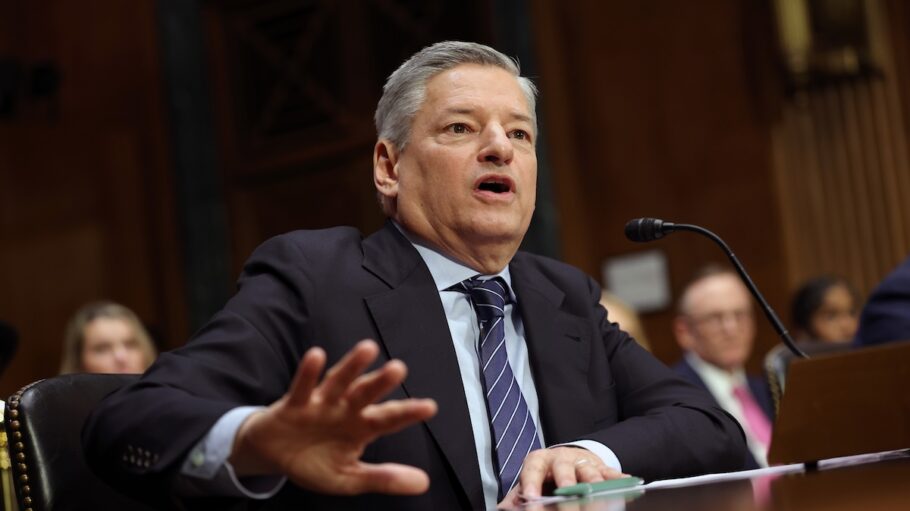
At a Senate antitrust hearing on Tuesday, Netflix Co-CEO Ted Sarandos declined to give a “yes or no” answer when asked if he would commit to “full residuals” for union workers.
Sarandos was at the Capitol to answer questions about Netflix’s proposed merger with Warner Bros. Sen. Josh Hawley, R-Missouri, asked him to make a series of labor commitments, including a pledge to increase the studio’s domestic production workforce.
Sarandos was happy to commit to that, and to maintaining a 45-day theatrical window. But he was a little flummoxed when asked to commit to “full residuals.”
“I would like to tell you this is a very complicated answer, because we prepay,” Sarandos said.
As Hawley pushed for a yes or a no, Sarandos noted that the major studios are just days away from sitting down with the entertainment unions for bargaining, where this will be an issue.
“You’re disappointing me,” Hawley said. “That’s a complicated, long ‘no.’ I was really hoping it would be yes.”
Sarandos gamely tried to reframe the question.
Love Film & TV?
Get your daily dose of everything happening in music, film and TV in Australia and abroad.

“Are you asking me to commit to residuals in the traditional form?” he asked. “I don’t think that applies in many cases.”
But Hawley was ready to move on. “I think you’ve got some work to do on that,” he said. “I would hope you reconsider your position.”
Streaming residuals are indeed complicated — and unions are very concerned that Netflix residuals don’t pay as well as traditional broadcast and cable residuals.
But Sarandos could have simply said “yes,” because Netflix does pay the “full” residuals that the unions are able to win in collective bargaining, and the U.S. Senate is not a party to that deal.
A Netflix spokesperson sought to clean up the answer moments later.
“Netflix is part of the AMPTP, and AMPTP-Guild agreements have provided payments, called residuals, for reuse of motion pictures in additional distribution platforms such as cable, syndication, DVDs, producers of streaming content and other media,” the spokesperson said. “Netflix and streamers pay residuals — according to the WGA, residuals have reached an all time high of $493.9M (up 5% from ‘20 to ‘23) — streaming accounts for ~45%, of which the lions’ share comes from Netflix.”
Sarandos’ answer also appeared to be trying to address a separate concern about backend compensation, which is different from residuals. Netflix does pay higher up-front fees — “top of market payment,” as Sarandos put it — in lieu of profit participation for the key creative talent.
But Hawley was asking about residuals, not backend compensation, and so Sarandos could have stuck to that.
From Variety US