




























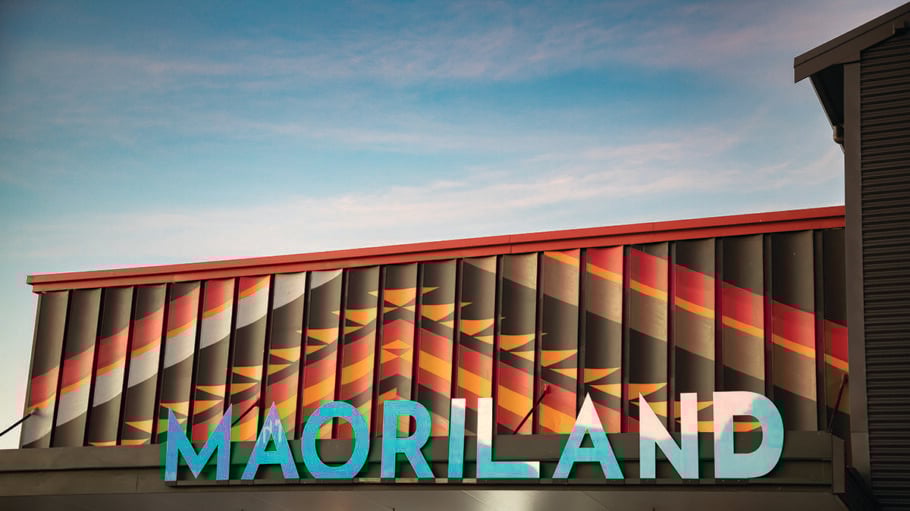
The world’s largest Indigenous film festival will return to Aotearoa later this month with a sweeping showcase of global storytelling, as the Māoriland Film Festival prepares to host its 13th edition in the coastal town of Ōtaki.
Running March 24–28th on the Kāpiti Coast, the Māoriland Film Festival (MFF) will present 108 films representing 130 Indigenous nations across 27 countries, further cementing its reputation as a major international platform for Indigenous cinema.
Founded in 2014, the festival has grown rapidly from a grassroots initiative into what is widely regarded as the world’s largest Indigenous film festival. This year’s program includes 19 feature films, 89 short films and 34 curated thematic programs, with works presented in 70 Indigenous languages and a strong emphasis on emerging voices, including 28 first-time filmmakers and 52 films directed by wāhine.
Festival director Madeleine Hakaraia de Young says the 2026 edition is guided by the theme He taonga tuku iho te rama ataata — “the light that reveals our legacies” — a concept that reflects the power of Indigenous storytelling to illuminate history while imagining different futures.
“The films in this year’s programme draw strength from their Indigeneity,” de Young says. “These are stories that shine in the darkness — that transform, that heal, and that remind us we should never accept that this is just how things are.”
The festival opens with the Māoriland Keynote address delivered by Māori actor and producer Te Kohe Tuhaka at Rangiātea Church. A graduate of Toi Whakaari and a prominent advocate for Māori storytelling both on and off screen, Tuhaka will offer a personal reflection on filmmaking and Indigenous narrative traditions.
Opening night screenings will then begin with “Uiksaringitara – Wrong Husband”, directed by renowned Inuit filmmaker Zacharias Kunuk. Set in Igloolik, Nunavut in 2000 BCE, the historical drama follows Kaujak and Sapa, who were promised to one another at birth before tragedy forces a new marriage alliance that changes the course of their lives. The film blends supernatural elements with an epic Arctic love story, unfolding as a tale of survival, resistance and cultural continuity grounded in Inuit language and cosmology.
Love Film & TV?
Get your daily dose of everything happening in music, film and TV in Australia and abroad.

Across the broader program, the festival spans an expansive range of Indigenous perspectives, from intimate family portraits to meditative documentaries and visually inventive animation.
One of the standout selections highlighted by de Young is “Endless Cookie,” an animated documentary by brothers Seth and Peter Scriver from Shamattawa First Nation. What begins as an earnest documentary project in the Canadian Arctic soon evolves into something far more unpredictable.
“’Endless Cookie’ is one of those films that completely disarms you,” de Young says. “It begins as a seemingly earnest documentary set in the Canadian Arctic, with two brothers trying to tell a ‘serious’ story.
“But what unfolds is something far richer and more chaotic. It becomes an honest, funny and deeply moving portrait of Indigenous family life.”
She adds that the film’s playful animation style, reminiscent of “Rocko’s Modern Life” and “Regular Show”, transforms family stories into a visually inventive and emotionally engaging experience.
Another feature drawing attention in this year’s lineup is “La Hija Cóndor (The Condor Daughter)” from Bolivian director Álvaro Olmos Torrico. Set high in the Andes, the film follows a young woman raised to become a traditional midwife while quietly questioning the life expected of her.
“’Condor Daughter’ is an absolutely beautiful film,” de Young says. “Set high in the Bolivian Andes, it follows a young woman raised to become a traditional midwife for her people while quietly grappling with her desire to see the world beyond her community.”
“Between the vast landscapes, extraordinary cinematography and the gentleness of the performances, it’s a film that lingers with you,” she adds. “It’s tender, reflective and deeply human — a story about duty, longing and identity, with this youthful energy that makes you, too, want more.”
Elsewhere in the program, Sámi filmmaker Egil Pedersen’s “My Fathers’ Daughter (Biru Unjárga)” explores questions of identity through the story of a teenager whose assumptions about her absent father are challenged when he unexpectedly appears in her life. Meanwhile, Darlene Naponse’s documentary “AKI” offers a contemplative meditation on land and sovereignty, unfolding without dialogue and guided instead by the rhythms of the natural world.
Métis filmmaker Gail Maurice will also premiere “Blood Lines”, a personal and multilingual drama centred on a fiercely independent Métis woman whose life is disrupted by the return of her estranged mother and the arrival of a stranger searching for their own cultural roots.
Short films remain a cornerstone of the Māoriland experience, with curated programs designed to showcase emerging filmmakers and thematic storytelling from across the globe.
“Short films are one of my favourite parts of the festival,” de Young says. “They take you on a complete journey in a short space of time, guided by the theme of each programme. It’s such a satisfying way to experience the diversity and creativity of Indigenous storytelling.”
Among them is the Tiaho program, which gathers stories that move between contemporary perspectives and echoes of ancient mythology.
“Tiaho is an incredibly powerful programme,” de Young says. “These are epic Indigenous stories from around the world that verge on magical realism — films that feel both ancient and contemporary at the same time.”
“The name of the programme Tiaho means ‘shining light’, and it speaks directly to the heart of this year’s festival theme — the light that reveals our legacies.”
Other programs embrace a more playful approach to audience engagement. The returning Bingo Shorts series pairs comedy short films with rounds of bingo, transforming screenings into an interactive experience.
“Bingo Shorts is always a crowd-pleaser,” de Young says. “We pair comedy short films with rounds of bingo, creating this joyful, slightly chaotic, interactive experience where the audience becomes part of the programme.”
“It really captures the essence of Māoriland — a festival where filmmakers and audiences share space, laugh together and connect in ways that feel genuine and fun.”
Beyond film screenings, the festival also expands into the streets and creative spaces of Ōtaki through exhibitions, music, food trucks and artist talks. A new initiative this year, the Māoriland Sharing Ground, will bring together weavers, carvers, musicians, filmmakers and fashion designers in a collective creative hub.
“The Māoriland Sharing Ground is something we’re really excited about,” de Young says. “It’s inspired by the idea of reclaiming traditional trading posts — a place of dynamic exchange where ideas, culture and creativity flow freely.”
The festival will close with “Mārama”, the debut feature from Māori filmmaker Taratoa Stappard. Set in 1859, the gothic drama follows a young Māori woman summoned to England, where she uncovers the violent truth of her colonial heritage and sets out on a path of reckoning and resistance.
For de Young, the spirit of Māoriland ultimately extends beyond the films themselves.
“What the world needs now is more places to gather and share stories,” she says. “That’s what Māoriland is about — creating space for people to come together, to listen, to celebrate, to engage with storytelling and to see themselves — and others — reflected on screen.”