





























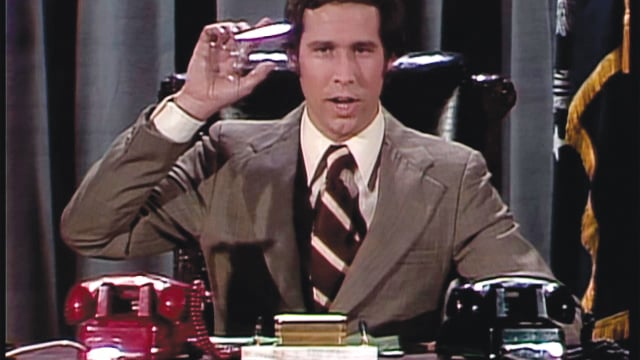
When you watch “I’m Chevy Chase and You’re Not,” Marina Zenovich’s spry and fascinating dark-side-of-a-comedian documentary, you hear countless tales of Chevy Chase’s casual cruelty and too-wise-for-you attitude and devotion to behaving badly — or, at least, mouthing off so rudely that it became a form of behavior. If you go into the movie wanting to be shocked and appalled, you won’t be disappointed. Off camera, a lot of comedians have prickly and difficult personalities. But there’s prickly, and then there’s the unique drive-by karma of Chevy Chase, a comedian who helped to invent “Saturday Night Live,” who proved to be a singular and hilarious master of ironic barbed detachment, who became one of the most celebrated movie stars of the 1980s, and who was such a famously nasty and unpleasant person to deal with that the word “asshole” followed him around as if it was his middle name.
The stories are legion, and they all get told here. According to Chase’s old friend Peter Aaron, who met him at Bard College in 1965, Chevy, in the dining-hall commons, would pull stunts like reaching for the salt and knocking a glass of water over onto someone’s lap. He was a jerk, yet in his way he was already warming up for “Saturday Night Live.” Ten years later, as “SNL” was being pulled together, Lorne Michaels wanted him to be a writer, but Chase insisted that he be on camera. We see his audition tape, and two things strike you about it: that he was shockingly tall and handsome for a comedian, with a puckishness that someone this good-looking wasn’t supposed to have, and that the hostility came off him like plumes of electro-static. Backstage, he was so high-handed that he took it upon himself to give the other cast members notes.
After becoming a movie star, Chase gave Mike Ovitz a Cartier clock engraved on the back with “Keep getting me the $6 million.” John Carpenter says that working with Chase on “Memoirs of an Invisible Man” (1992) was so hellish it made him want to quit the business. And when Chase hosted “Saturday Night Live” in 1985, he fastened on Terry Sweeney, the show’s first openly gay cast member, and baited him for being gay, suggesting that in the midst of the AIDS epidemic there might be a comedy routine in Sweeney getting weighed each week.
“I could see right away,” recalls Dan Aykroyd in the documentary, “that this guy was simultaneously talented and very dangerous.” Alan Greisman, a film producer who became a friend of Chase’s (even though Chevy, on the set of the 1981 movie they made together, “Modern Problems,” did as much cocaine as the burnout character he was playing), says, “I don’t think he consciously wants to be an asshole. I think the asshole version of him is somebody who is desperate for something he either lost or doesn’t have.” Based on what we hear in “I’m Chevy Chase and You’re Not,” to say that Chase acted like an asshole doesn’t do justice to his distemper. He was a passive-aggressive bully who perfected his own sadistic brand of Zen flippancy. He was a person who would bait you to your face, then add insult to injury by implying that it was all a joke.
It seemed, at the time, an attitude that was quite contempo in its heartlessness. But Chase’s sense of humor was actually based on something that had its roots in the 1960s. At the time, it was called the put-on. You say something, you don’t mean it (except that maybe, deep down, you do), and it’s all an act of thinly veiled aggression, because you’re putting one over on The Man, or someone you don’t like, or a person who doesn’t deserve to be talked to straight. But Chase ratcheted up the put-on in two ways. He made it crazy and surreal, and unlike Bill Murray, who had an affectionate counterculture shagginess, Chase stripped the put-on of any vestige of social-political morality. He was putting on just because…he wanted to fuck with you. And that became his entire personality.
As a documentary filmmaker, Marina Zenovich has long been drawn to difficult celebrities, like Roman Polanski (she made two films about him) and Robin Williams, but it’s not just because she sees the drama in their turbulence (though that’s part of it). She also wants to grapple — and does, brilliantly — with what you might call the primal issue of politically incorrect artists. Namely, what are we supposed to do with these figures who create extraordinary things, who are cherished by people around the globe, yet have seriously problematic lives and personalities? Zenovich isn’t doing a harangue against “cancel culture.” She’s asking, in a far more ingenuous and exploratory way: What do we think about someone like Chevy Chase? How do we square his offscreen cruelty with his laid-back comic artistry, especially when you can see a distinct glimmer of the former in the latter?
Zenovich interviews the 82-year-old Chevy Chase today, seated at a table in his comfy suburban home in Bedford, NY, and the interview, in its way, is a performative psychodrama. Chevy wants to be honest, he wants to tell it like it is, but he’s also a compulsive cut-up and control freak whose guardedness takes the form of lashing out. “This is the way I am, at my age,” he says after telling an X-rated joke about Bill and Hillary Clinton. “Just a child. An angry child.” He knows himself too well. A child is exactly what Chase is. He won’t grow up. Early on, Zenovich tells him that she’s simply trying to figure him out. “No shit!” he says, adding, “It’s not going to be easy for you.” Why not? “You’re not bright enough. How’s that?” Then he gives her a frozen smile of triumph. “My answer is: I’m complex, and I’m deep, and I can be hurt easily, and I react spontaneously to people who want to figure me out.”
Love Film & TV?
Get your daily dose of everything happening in music, film and TV in Australia and abroad.

The film shows you how he got to be this way: raised by a mother with possible schizophrenic tendencies who would wake him up by slapping him, and by an abusive stepfather. His childhood was a hellhole. His entire “I’m Chevy Chase and you’re not, and by the way go fuck yourself” personality is a damaged person’s defense mechanism. So maybe it’s no surprise that while the Chase we see here is undeniably a dick (at this point it’s his brand), he also has disarming spasms of vulnerability and guilt, and when he wants to be he’s quite sweet. He’s someone who made the choice, over and over again, to be an asshole. Yet his fans adore him. He gets a large bag of fan mail each week, all of which he answers by signing photographs, and we see him at holiday time, going on his annual jaunt to speak at local showings of “National Lampoon’s Christmas Vacation,” a movie as beloved by children of the ’80s as “A Christmas Story” is. He treats his fans with grace and something like modesty. He has also been married, for 43 years, to Jayni Chase, an agile sweetheart who appears devoted to him. Does any of this give him absolution? No, but it does make him a complicated asshole.
Fifty years later, the extraordinary rocket ship of Chase’s career is still a marvel to behold — how he helped to define “SNL,” inventing Weekend Update as a showcase for his WASP-on-nut-pills aggro deadpan, and how he left the show way too early, because Hollywood was calling (and because his second wife, Jacqueline Carlin, refused to move from L.A. to New York). Over the last year, I’ve called both “Annie Hall” and “When Harry Met Sally” the launchpad of the revival of the romantic comedy, but “I’m Chevy Chase and You’re Not” made me realize I was wrong. Both those films were instrumental, but the launch of the cheeseball genre that the rom-com became really goes back to Chase’s first big movie, “Foul Play” (1978), a film that looks better in hindsight. He and Goldie Hawn had a skewed chemistry in it, and Hawn is on hand in the doc testifying to how much the asshole could, at moments, be a mensch.
But Chase, as Mike Ovtiz explains quite accurately, didn’t run his career in a logical fashion. He was sublime in “Caddyshack,” but he didn’t make good on his leading-man promise. The “Vacation” films saved him, of course, and he was vintage Chevy in them, but by the mid-’80s his shtick had begun to lose its surprise. You could feel that in “Deal of the Century” and “Three Amigos!” and “Spies Like Us,” where the Chase mystique was running on fumes. Even after his career wound down, he never stopped popping up in movies, though by the late ’90s and 2000s none of his supporting turns could match the comic drama of his contentious appearances on “The Howard Stern Show.”
“I’m Chevy Chase and You’re Not” devotes its second half to Chase’s troubled childhood, and to how he cleaned himself up after too many years in the drug wilderness, and also to the extraordinary war zone that “Community,” the NBC sitcom that revived his career, became. The young cast of “Community” resented his entitlement; he was 66 years old and still irascible. And when the tension exploded in Chase using the N-word on set, as he was trying to explain how he would use it with Richard Pryor on “SNL” (the doc includes their famous racial-epithet sketch, perhaps the ultimate example of you-could-never-do-that-today), the series became a meltdown. After all of this, is Chevy Chase chastened? Yes and no. You can see that he knows he sometimes went too far, yet during the 50th anniversary show of “Saturday Night Live,” when he was not invited to perform, even for one moment, that was basically the entertainment industry blackballing him for 50 years of snark-fueled transgression. He admits on camera how much it hurt. You could say, in that way, that he has paid his dues. He’s still Chevy Chase, but by the end of this movie you’re almost grateful you’re not.
From Variety US