





























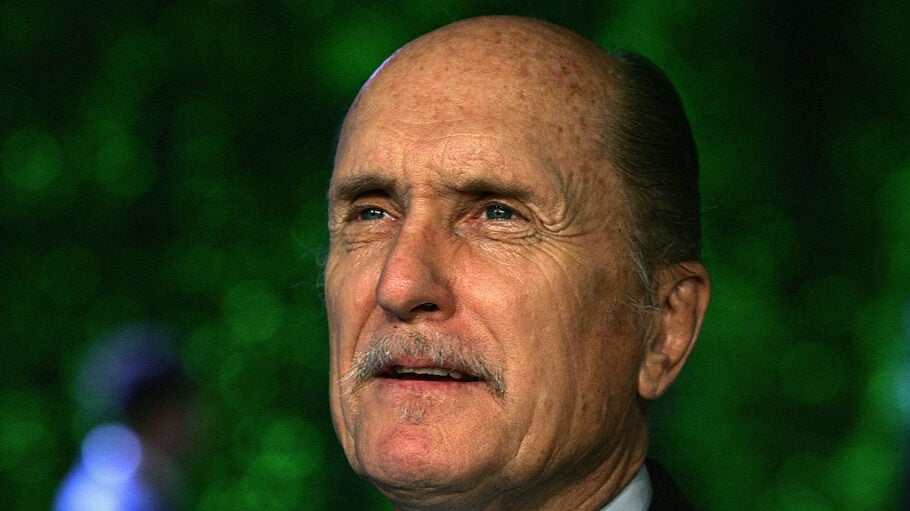
Robert Duvall, who won an Oscar for “Tender Mercies” and was nominated for his roles in films including “The Godfather,” “Apocalypse Now,” and “The Great Santini,” has died. He was 95.
Duvall’s death was announced on Facebook via a statement from his wife, Luciana Duvall.
“Yesterday we said goodbye to my beloved husband, cherished friend, and one of the greatest actors of our time,” she wrote. “Bob passed away peacefully at home, surrounded by love and comfort. To the world, he was an Academy Award-winning actor, a director, a storyteller. To me, he was simply everything.”
She continued, “His passion for his craft was matched only by his deep love for characters, a great meal, and holding court. For each of his many roles, Bob gave everything to his characters and to the truth of the human spirit they represented. In doing so, he leaves something lasting and unforgettable to us all. Thank you for the years of support you showed Bob and for giving us this time and privacy to celebrate the memories he leaves behind.”
Duvall’s gruff naturalism came to define the acting style of a generation that included Robert De Niro, Dustin Hoffman and Gene Hackman in such films as “Network” and “The Apostle,” which he also directed.
And while he may never have been as big a star as DeNiro, his unshowy ability to fully embrace the characters he played earned him respect both from his peers and from critics. As Francis Ford Coppola once told the New York Times, at a certain point, it’s “hard to say the difference between leading men and great character actors.”
He was an actor’s actor who drew seven Oscar nominations but also found time to shine in TV vehicles such as “Lonesome Dove” and “Broken Trail,” drawing a total of five Emmy nominations and winning twice.
Love Film & TV?
Get your daily dose of everything happening in music, film and TV in Australia and abroad.

His first big-screen role, and one of his most memorable, was the scary Boo Radley in 1962’s “To Kill a Mockingbird.” While Duvall’s career took some time to get off the ground despite the strong start, by the early to mid-’70s he had come into his own, combining the abilities for seamless character acting with occasional strong forays into larger roles.
In 1969, he paired with a young director, Francis Ford Coppola, onthe intimate drama “The Rain People,” and the next year got the juicy role of Frank Burns in Robert Altman’s “MASH.” He also starred in George Lucas’ experimental “THX 1138.” And the actor was doing interesting work onstage.
But the movie that turned it all around was 1972’s “The Godfather,” in which he played the patient and sly consigliere Tom Hagen, the role that brought him his first Oscar nomination. He reprised his role as Hagen in “The Godfather: Part II” in 1974. He also appeared in Coppola’s “The Conversation” and as Dr. Watson in Herbert Ross’ “The Seven-Per-Cent Solution.”
In 1976, he had a memorable role as a ruthless television executive in “Network,” and three years later, as Colonel Kilgore, he uttered the memorable “I love the smell of napalm in the morning” line in Coppola’s “Apocalypse Now,” walking off with a second Oscar nomination.
In 1977, he and Ulu Grosbard paired to bring David Mamet’s “American Buffalo” to Broadway to mixed notices. The same year he made a rural documentary called “We’re Not Jet Set” and in the early ’80s directed the small, finely observed “Angelo, My Love.”
It was not, however, until “The Great Santini,” in which he played the title character, a blustery, militaristic father, that he established his leading man credentials on film, garnering his first Oscar nomination as best actor in 1980. The following year, he won kudos at the Venice Film Festival opposite Robert De Niro in “True Confessions.”
Then, in 1984, his quiet, detailed performance in “Tender Mercies,” written by Horton Foote and directed by Bruce Beresford, brought him the Oscar as best actor.
Thereafter, however, he often received top billing for secondary or co-lead roles, as in “The Natural,” “Colors,” “Days of Thunder,” “Rambling Rose,” “Geronimo: An American Legend” and “Deep Impact.”
Duvall received considerable attention for his 1997 film “The Apostle,” which he directed and toplined. He was Oscar nominated for best actor for his role as a womanizing Texas preacher who must start again after committing an act of violence. At the Independent Spirit Awards, “The Apostle” took best picture and twin nods for Duvall as actor and director.
Duvall drew an Oscar nomination for supporting actor the following year for his role as a brilliant but eccentric lawyer who is attorney John Travolta’s nemesis in the courtroom drama “A Civic Action.”
Other efforts included the Nicolas Cage actioner “Gone in Sixty Seconds” and Arnold Schwarzenegger sci-fi thriller “The Sixth Day”; sports pic “A Shot at Glory” in which he tried a Scottish brogue and hostage drama “John Q.”
Duvall wrote, directed and starred in the enigmatic 2003 film “Assassination Tango,” about a hitman with obsessive tendencies who’s sent to Argentina and becomes involved with a dancer.
He returned to the Western genre in Kevin Costner’s 2003 film “Open Range,” then the actor portrayed Gen. Robert E. Lee in “Gods and Generals,” and starred in “Secondhand Lions,” a small film in which he and Michael Caine got to riff off each other as a pair of eccentric great-uncles to young Haley Joel Osment.
Duvall was a crusty cop in James Gray’s “We Own the Night,” but the actor had some fun lampooning his notoriously crusty characters in small roles in “Four Christmases” and the 2005 satire “Thank You for Smoking.”
The actor did not slow down as he neared his 80th birthday: In 2009 he appeared in John Hillcoat’s “The Road”; starred in the small but well-liked “Get Low,” in which he played a bearded hermit who is, to use Roger Ebert’s phrase, “a sly old twinkler”; and did a supporting turn in and produced “Crazy Heart,” which reminded many of Duvall’s “Tender Mercies.”
The actor reunited with “Lonesome Dove” screenwriter Bill Wittliff for 2014’s “A Night in Old Mexico” and the same year starred in “The Judge” as a jurist accused of a hit-and-run murder and defended by the son (Robert Downey Jr.) who represents everything he despises about the law. The film, said Variety, “pivots on a simple yet inspired stroke of casting, pitting Duvall’s iconic gravitas against Downey’s razor-sharp wit, and then supplying no shortage of opportunities for both men to chew the scenery.”
Duvall drew his seventh Oscar nomination for his work in the film.
In 2015, the actor’s first directorial effort since 2002’s “Assassination Tango,” the ambitious indie feature “Wild Horses,” premiered at SXSW.
One of his final screen roles came in Scott Cooper’s “The Pale Blue Eye” in 2022.
Born in San Diego, Duvall was the son of a Navy rear admiral and grew up in various parts of the country, but especially Annapolis, Md., site of the U.S Naval Academy. It was actually at the insistence of his parents and teachers that Duvall began to study drama. After graduating from Principia College and the completion of his military service, Duvall studied under Sanford Meisner at New York’s Neighborhood Playhouse.
He hung out with friends like Robert Morse, Hackman and Hoffman. A one-night only performance of Arthur Miller’s “A View From the Bridge” in 1957 directed by Grosbard led to television work on “Naked City” and guest appearances on “The Defenders,” “Armstrong Circle Theater,” “The FBI” and other shows.
Through the ’60s, even after the enormous success of “To Kill a Mockingbird,” he subsisted on character roles in films including “Captain Newman M.D.,” “The Chase,” “The Detective,” “True Grit” and “Bullitt.” And he was a staple in Westerns such as “Lawman,” “The Great Northfield Minnesota Raid” and “Joe Kidd.”
But he was also doing fine work in the theater in “Mrs. Warren’s Profession,” “Call Me by My Rightful Name,” “The Days and Nights of Beebee Fenstermaker” and a full-fledged Off Broadway production of “A View From the Bridge” in 1965, co-starring Jon Voight and Susan Anspach.
Urban crime dramas were his other staple along with Westerns. They included, during the 1970s, “Badge 373,” “Breakout” and Sam Peckinpah’s “The Killer Elite.”
TV occasionally offered the actor a juicy, fully dimensional role. In 1979, he starred in the TV movie “Ike” as General Dwight D. Eisenhower. Ten years later, he starred in the highly praised CBS miniseries “Lonesome Dove,” picking up an Emmy nomination. He starred as the Soviet dictator in the 1992 HBO film “Stalin,” for which he earned a second Emmy nom. In 1997, he drew an Emmy nomination for his role as the title Nazi in “The Man Who Captured Eichmann”; and in 2006, he not only toplined but also exec produced the miniseries “Broken Trail,” whose success put cabler AMC on the map as a producer of original content — and earned Duvall two Emmys, one for his performance and another, shared with the other producers, for outstanding miniseries. For HBO, he appeared in the 2012 telepic “Hemingway and Gelhorn,” in which he played a Russian general.
He is survived by his fourth wife, Luciana Pedraza, with whom he starred in “Assassination Tango.”
From Variety US