





























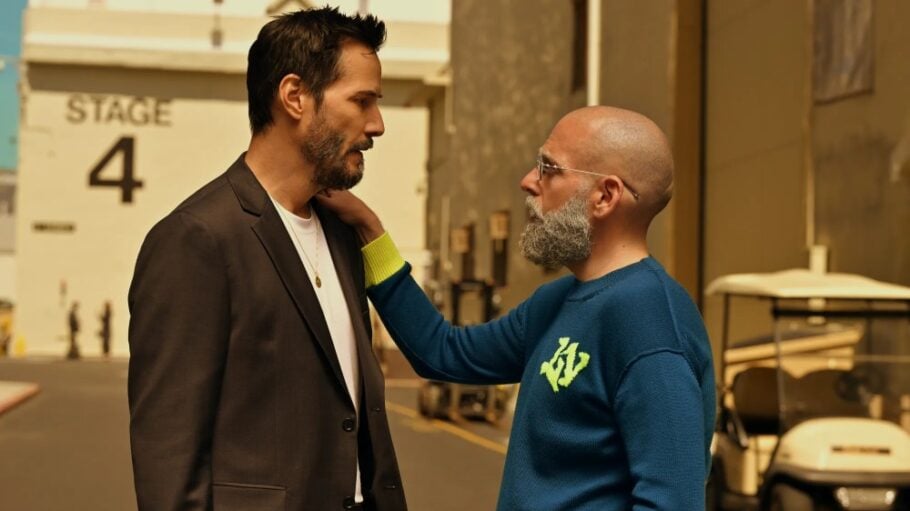
If the bona fide movie star really is a dying breed — as countless doomsaying editorials in this age of franchise-led studio cinema insist is the case — films like “Outcome” won’t encourage many aspiring actors to repopulate the firmament. Arriving mere months after “Jay Kelly,” Noah Baumbach’s self-pitying ode to the nobly receding likes of George Clooney, Jonah Hill‘s second fiction feature as writer-director likewise paints a picture of modern Hollywood celebrity as a gilded cage, centered on a movie star — the absurdly named Reef Hawk — supposedly adored by an invisible public, and scorned by most in his immediate orbit.
That Hawk is played by Keanu Reeves, one of the most generally well-liked men in the business, is an irony that doesn’t overly flatter the actor. A generally brittle, distant affair, “Outcome” largely saps Reeves of his genial, unaffected charisma, leaving him to play the carapace of a man who’s lost any real sense of who he is when not in character. Pointedly, we never see so much as a glimpse of Hawk’s film work, underlining that disconnect: It’s hard to imagine this mumbling, shambling man holding multiplex masses in his thrall. As such, he’s a poignant void, but a void nonetheless, and even at a slim 84 minutes, Hill’s doleful film can’t keep us interested in his plight.
A less intended irony, perhaps, is that this semi-meta portrait of a big-screen icon is slipping directly to streaming on Apple TV this week — just as “Jay Kelly,” for all its fealty to old-school Hollywood, was bound to Netflix. Not that “Outcome” is itself especially cinematic, bar its unexpectedly lush shadows-and-neon lensing by ace DP Benoît Debie, regular collaborator of Gaspar Noé and Harmony Korine. Otherwise a small, muted enterprise playing out mostly as a series of seated conversations, it’s a less dynamic directorial outing from Hill than his 2018 debut “Mid90s,” though both films feel personal to the filmmaker in tonally opposite ways: Where “Mid90s” was warmly nostalgic, his latest is a sour rejoinder to the present.
It’s certainly hard to keep Hill’s recent private troubles — including allegations of emotional abuse made by an ex-partner — entirely out of mind in a story centered on an actor rehabilitating his image with an apology tour for past misconduct, while a crack legal team comes to his aid with a lesson in “victim capitalism.” Hill himself smarmily plays Hawk’s crisis lawyer Ira, an opportunistic cynic whose office is lined with framed portraits of Kevin Spacey and Kanye West — the latter a reference to a past social-media skirmish between Hill and the antisemitic rapper — and whose car bears a “honk if you can separate the art from the artist” bumper sticker.
Such allusions might be all be terribly fascinating to Hill’s most invested fans, but they do turn “Outcome” into the most airless and insular of inside-baseball games, built around a protagonist who’s barely playing. We first meet Hawk — a two-time Oscar winner, we’re told, and the world’s biggest box office draw — preparing for the publicity circuit after a five-year hiatus, during which he beat a heroin addiction still hidden from the public. Though his oldest friends Kyle (Cameron Diaz) and Xander (Matt Bomer) have remained loyal to him, he’s otherwise short on close allies; when he’s blackmailed with an anonymous threat to release a compromising video, the list of plausibly vengeful foes is far longer.
Cue a round of peacemaking visits to various parties wronged by the star over the years, from a quietly seething ex (Welker White) to his ice-queen reality-star mother (Susan Lucci, wittily cast) to the paternalistic manager he abandoned after his child-star days. The latter is played, in the film’s most humane and gently modulated turn, by one Martin Scorsese; counter to the character’s struggles, “Outcome” is nothing if not a display of how many obliging A-list friends its maker has in the business. (Drew Barrymore turns up in a suitably tongue-in-cheek cameo as herself.) Diaz, in her second screen appearance since ending her own acting hiatus, is welcome if hardly tested as a long-suffering bestie, while Bomer scores the film’s few straightforward laughs as her dim-bulb sidekick.
Given atmospheric dimension by Debie’s eerily saturated compositions, domestic scenes in which the three friends passive-aggressively spar and finally air long-held grievances play more honestly and authentically than those where the film shifts into caustically satirical mode, usually when lawyers enter the frame. While Hill is humble enough to play Ira as an unadulterated skeeze, Laverne Cox is saddled with a grandstanding but somewhat dated monologue about the soullessness of celebrity in the Kardashian era: “You don’t have to do anything special to be famous,” she says. “You just have to be.” “Outcome” is packed with talent that can confidently claim to be above that level. Whether they’re doing anything special here is another question.
Love Film & TV?
Get your daily dose of everything happening in music, film and TV in Australia and abroad.

From Variety US