





























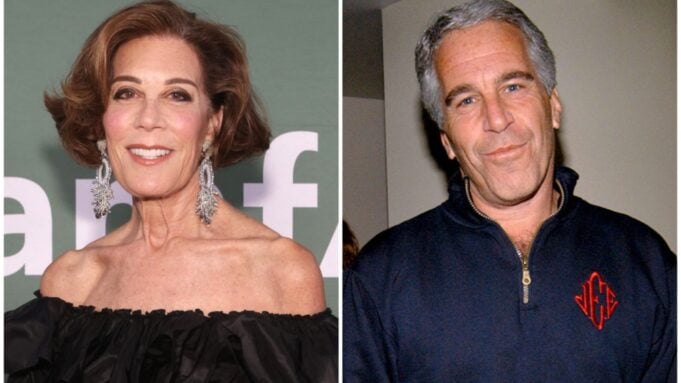
On July 22, 2009, Peggy Siegal, one of New York’s cultural ringmasters, welcomed Jeffrey Epstein home from prison.
How did it feel, she asked, “to fall asleep on 100% Egyptian cotton again? Exactly how long was your first freedom shower? What did you have for breakfast? Caviar, smoked salmon, eggs benedict?”
Siegal was “working away” in St. Tropez — but wearing stripes in celebration of Epstein’s release. He had served 13 months on child prostitution charges — and it would be Siegal’s task, over the final decade of Epstein’s life, to help reintegrate him into high society. She worked primarily for studios, throwing lavish parties for films with Oscar aspirations. But Epstein was also an important client — he had funded her trips to Cannes.
“I have no idea what the reaction will be to your re-entry into society,” she wrote him a year later. “But take it slow and stay quiet. Your friends are there for you … and at least the house is drop dead gorgeous.”
Siegal took on the challenge with her usual panache. She suggested that Epstein leverage his seven-story, Upper East Side mansion to host intimate dinners (“but not too small as the house is too big”) and get “top political and military minds to speak.” Salons were her thing. Studios hired Siegal for her Rolodex, which she used to arrange clubby luncheons and receptions at the Four Seasons, La Grenouille or other hot spots, filling the room with film stars and Oscar voters, as well as thought leaders and artists, ranging from Julian Schnabel to Charlie Rose to Gay Talese.
In December 2010, Siegal arranged one such event for Epstein, helped curate a guest list that included Rose, Woody Allen and his wife Soon-Yi Previn, George Stephanopoulos and Katie Couric for a dinner with Epstein’s friend, Prince Andrew. And in the following years, Siegal played a role in determining Epstein’s social calendar when he was in New York, inviting him to a flurry of screenings and events. Their relationship, at least the one that comes through their extensive correspondence in the files released by the Justice Department, was chatty and catty, at times warm and affectionate, at other moments transactional. Some emails contained bizarre requests for Siegal to arrange for Anne Hathaway to have coffee with Epstein and Bill Gates; others include a back-and-forth about what type of private jet would be appealing enough for Epstein to convince Hathaway, Hugh Jackman and Jessica Chastain to travel with him to the 2013 Oscars. “Can I say biggest most luxurious private plane,” Siegal wrote. (Neither the coffee nor the private flight ever took place.)
Siegal also commiserated with Epstein as he navigated the media, advising him on how to respond to articles in The Daily Beast and Newsweek about his earlier conviction. In one March 2011 message, she asked Epstein how he could “neutralize” Tina Brown, the editor of both publications, later venting about Brown’s “fury about punishing you.” A week later, Siegal urgently reached out to Epstein to warn him that the press was “talking about you” at a panel discussion hosted by Brown that she was attending.
Love Film & TV?
Get your daily dose of everything happening in music, film and TV in Australia and abroad.

Epstein coached Siegal on how to handle a Daily Beast profile about his social rehabilitation, suggesting she should say, “I would tell you that both I and many others that know him, describe him as brilliant.” That line was attributed to Siegal nearly verbatim in the story.
Weeks later, she provided a similar statement to the writer Jesse Kornbluth, who was working on a piece for the Times, saying that while Epstein was not among the five wealthiest people in New York, “there is a broad consensus that he is one of the smartest.” (Though she was polite to Kornbluth, she trashed him in an aside to Epstein, saying he “could never make a dime” and was an “angry loser.”)
She explained to Kornbluth that Epstein had “paid a large price” for his crime.
“The quaker-inspired method of shunning and shaming was replaced hundreds of years ago by the more benevolent practice of forgiveness,” she wrote. “His friends were asked for theirs and he received it.”
In a statement to Variety, Siegal says she went to Epstein’s house twice “socially,” for the Prince Andrew event and for a Yom Kippur dinner. She also says she knew nothing about “underage girls” and that when she read the 2011 articles documenting the allegations of child prostitution, she “could not comprehend” that they were true. Siegal argues that the press attention she has received is unfair.
“As a working woman, considered, ‘low hanging fruit’ on the scandal of the decade, it is tragic I am again humiliated by the media and ostracized by friends,” Siegal says. “Six years is a lifetime of constant apology. Time to focus on the bad GUYS.”
Siegal benefitted financially from her association with Epstein. She says their relationship began nearly 20 years ago when he gave her a “Cartier travel clock.” In addition to receiving “unsolicited” gifts, Siegal billed the financier for unspecified work, for instance, invoicing him for $50,000 for five months of services in 2011. In 2010, she sent him a $37,600 budget for her trip to Cannes, which included $13,700 for her hotel, $12,000 for a car and $7,000 for airfare. Epstein gave Siegal $30,000 as a birthday gift in July 2018. In between, there were invoices for airfare and other travel, some of which Epstein refused to pay. At other points, Siegal turned to Epstein for advice on everything from a dispute over her inheritance to untangling her personal finances to dealing with a rival to her publicity business. “Instead of calling you in a panic about this nasty fag who has tried to steal my business for two years,” Siegal wrote Epstein in 2009,. “I am thinking about a way — besides working harder (impossible) and doing a great job and being very nice to people to compete with him.”
They were so familiar that Epstein asked her to find a woman to have his child.
“If I wasn’t 102, I would take that job in a nano second,” joked Siegal, who was 64 at the time.
“I need great genes, smart pretty, funny,” Epstein wrote. “If you were fifty years younger , whoops … forty.”
Siegal promised to search for a “European intellectual,” perhaps a full-time student. “A wannabe socialite is NOT the way to go,” she wrote. “Looking and looking.”
In 2017, the elite world that Siegal moved in was rocked by the #MeToo movement, which took down powerful figures such as Harvey Weinstein, Matt Lauer and Rose, who were staples of New York society. Epstein’s days were numbered. He would die in prison less than two years later and Siegal would be forced to close her business due to her association with him. But for the moment the risk felt remote. In fact, Epstein wrote, compared with others, “jeffrey is looking better and better.”
“I know!!!!” she responded. “The world is topsy turvy. That has been going on since the beginning of time (and that is not an excuse) has suddenly erupted in our day of massive global information as a new moral code of behavior.”
A more pressing concern that fall was making sure that Epstein would attend the Gotham Awards — one of New York’s premier film events, to which he had donated $10,000.
“Every year I beg you to come and every year you don’t,” she wrote. “I will sit with you this year.”
Her entreaties worked. “I’ll be there,” Epstein wrote, later confirming that he would bring “two girls” along.
From Variety US