





























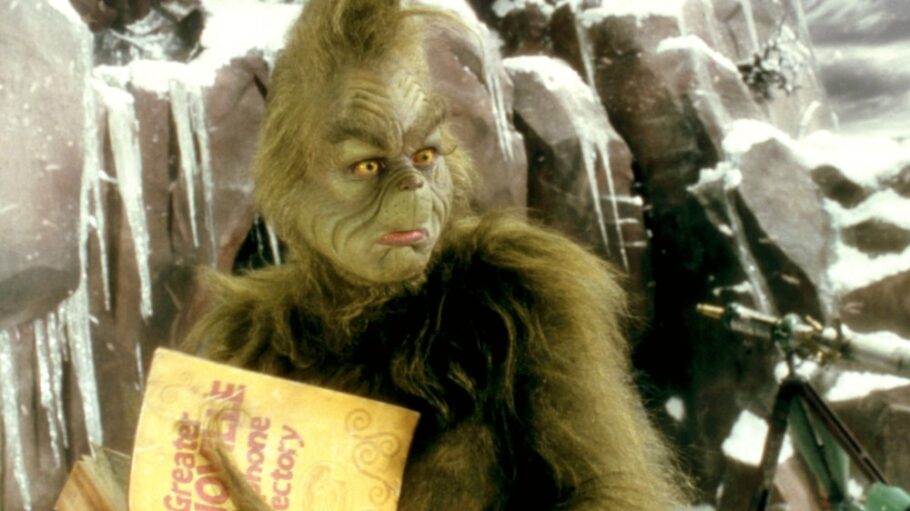
Jim Carrey recently joined Vulture for an oral history to mark the 25th anniversary of “How the Grinch Stole Christmas,” Ron Howard’s 2000 film adaptation of Dr. Seuss’s 1957 children’s book. The movie was a giant box office hit, earning $346 million worldwide and becoming the highest-grossing film of 2000 domestically, but it was also a tortuous experience for Carrey given the grueling transformation process. Carrey has been honest in previous interviews about how “excruciating” it was to play the Grinch under heavy makeup and prosthetics, but he revealed wild new details to Vulture about the process.
Rick Baker, the legendary make-up effects artist who won an Oscar for his work on “How the Grinch Stole Christmas,” told the publication that the studio originally offered to just have Carrey painted green as the Grinch.
“The studio said, ‘We’re paying Jim $20 million, and we want to see him. Just paint him green,’” Baker said. “But it’s not ‘How the Green Jim Carrey Stole Christmas.’ It’s ‘How the Grinch Stole Christmas.’ He should look like a fantasy character.
“There was a popular movie website at the time, Ain’t It Cool News, and the guy who ran it was a fan of my work, and I contacted him,” Baker continued. “I said, ‘Listen, Universal wants to paint Jim Carrey green. I feel it’s a major mistake. I did a test on myself of what I think it should look like. Can you somehow say that you saw this test and that Universal is making a major mistake and they don’t know what the fuck they’re talking about?’ And he did. And it was outrageous responses from everybody. ‘What the hell is wrong with these people at Universal? I don’t want to see green Jim Carrey. I want to see a Grinch!’ Blah, blah, blah. So they finally caved in.”
Carrey was also adamant about undergoing a full transformation into the character, much to his own detriment.
“When it came down to actually designing the Grinch to look like the Grinch, they had to put the tip of my nose on the top of the bridge of the Grinch’s nose,” the comedian explained. “So, all of the rest of it was covered and I couldn’t breathe through my nose, and they had a real problem trying to get holes in the mask that could allow me to breathe through my nose. Ultimately, I ended up mouth-breathing through the entire movie.”
Carrey continued, “The suit was made of unnervingly itchy yak hair that drove me insane all day long. I had ten-inch-long fingers, so I couldn’t scratch myself or touch my face or do anything. I had teeth that I had to find a way to speak around, and I had full contact lenses that covered the entire eyeball, and I could only see a tiny tunnel in front of me.”
Love Film & TV?
Get your daily dose of everything happening in music, film and TV in Australia and abroad.

The film’s producer, Brian Grazer, revealed to Vulture that the team originally offered Carrey the option of using digital special effects to turn his eyes green. But Carrey “didn’t want to do that. He wanted to have green eyes. They were like Frisbees in his eyes. He was in so much pain.”
“It was something that I asked for that I can’t blame on anyone but myself,” Carrey admitted. “You’ve got to be careful what you ask for. You don’t think about it when you see an actor do a part that is about excruciating pain or whatever. But that actor has to live in that feeling. They don’t just go home and suddenly stop feeling it.”
Director Howard said Carrey “started having panic attacks” during the early days of filming because of how uncomfortable the transformation was on his body, adding: “I would see him lying down on the floor in between setups with a brown paper bag. Literally on the floor. He was miserable.”
Carrey threatened to quit the movie after his first day of filming required eight hours in the makeup chair, with Howard revealing: “He was ready to give his $20 million back! I mean, he was sincere.”
A solution came in the form of “a guy who trained the military on enduring imprisonment and torture,” who was brought on to the film’s set to prevent Carrey from quitting the movie and to teach him how to endure the hardship of his Grinch transformation.
“Richard Marcinko was a gentleman that trained CIA officers and special-ops people how to endure torture,” Carrey said. “He gave me a litany of things that I could do when I began to spiral. Like punch myself in the leg as hard as I can. Have a friend that I trust and punch him in the arm. Eat everything in sight. Changing patterns in the room. If there’s a TV on when you start to spiral, turn it off and turn the radio on. Smoke cigarettes as much as possible. There are pictures of me as the Grinch sitting in a director’s chair with a long cigarette holder. I had to have the holder, because the yak hair would catch on fire if it got too close.”
“Later on I found out that the gentleman that trained me to endure the Grinch also founded SEAL Team Six,” Carrey added. “But what really helped me through the makeup process, which they eventually pulled down to about three hours, was the Bee Gees. I listened through the makeup process to the entire Bee Gees catalogue. Their music is so joyful. I’ve never met Barry Gibb, but I want to thank him.”
Carrey told ComicBook.com last year that he would be interested in playing the Grinch again if he was able to do it through motion capture technology and not makeup.
“Oh, gosh, you know, if we could figure out the Grinch,” Carrey said at the time. “The thing about it is, on the day, I do that with a ton of makeup and can hardly breathe. It was an extremely excruciating process. The children were in my mind all the time. ‘It’s for the kids. It’s for the kids. It’s for the kids.’ And now, with motion capture and things like that, I could be free to do other things. Anything is possible in this world.”
Special effects makeup artist Kazuhiro Tsuji worked with Baker on applying Carrey’s makeup every day and once revealed that he checked into therapy after working with Carrey because the actor was so difficult in the makeup chair.
“In the makeup trailer he just suddenly stands up and looks in the mirror, and pointing on his chin, he goes, ‘This color is different from what you did yesterday,’” Tsuji once told Vulture. “I was using the same color I used yesterday. He says, ‘Fix it.’ And okay, you know, I ‘fixed’ it. Every day was like that.”
Head over to Vulture’s website to read the full “How the Grinch Stole Christmas” oral history.
From Variety US