





























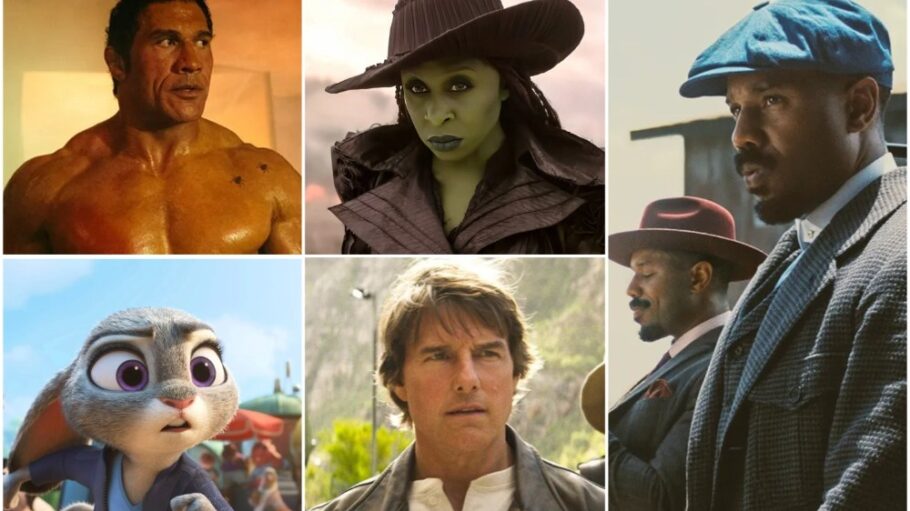
Family films flourished, video game adaptations triumphed, and superheroes flew too close to the sun. Welcome to 2025 at the multiplexes!
It was a roller-coaster year at cinemas and for the studios tasked with keeping their screens filled. Warner Bros. enjoyed an epic run at the box office, fielding hits as diverse as a vampire flick set in the Jim Crow South (“Sinners”), an old-school star-driven racing drama (“F1: The Movie”) and a sandbox-game-turned-big-screen-smash (“A Minecraft Movie”). Meanwhile Paramount, which spent hundreds of millions of dollars on yet another “Mission: Impossible,” barely released anything that turned a profit.
And then there’s Disney, which backed three movies that topped $1 billion (we’re assuming that will be the case with “Avatar: Fire and Ash”) and stands out as the only studio to cross a combined $6 billion globally. But the studio also distributed nearly twice as many big-budget duds (“Elio,” “Snow White” and “Tron: Ares,” to name a few). More troubling, Marvel, once Hollywood’s biggest hitmaker, struggled to regain its mojo. It’s all coming down to next year’s “Avengers: Doomsday” to get the franchise back on course.
Our annual report card includes the five major studios as well as A24, which is nominally an indie, but spent lavishly on “The Smashing Machine” and “Marty Supreme.” But it doesn’t include streamers such as Amazon and Apple, which didn’t release enough movies in cinemas for us to judge their slate. Come on, guys, start spending those Bezos bucks!
As 2025 draws to a close, it’s time for Hollywood to get its report card. Some of you may not want to hang it on your fridge.
Disney
Highs: “Lilo & Stitch” ($1.03 billion against a $100 million budget), “Zootopia 2” ($1.31 billion against a $150 million budget), “Freakier Friday” ($153 million against a $42 million budget), “Avatar: Fire and Ash” ($506 million and counting against a $250 million+ budget)
Lows: “Captain America: Brave New World” ($415 million against a $180 million budget), “Snow White” ($205 million against a $250 million budget), “Elio” ($154 million against a $150 million budget) “Tron: Ares” ($142 million against a $180 million budget), “Predator: Badlands” ($181 million against a $105 million budget), “Ella McCay” ($4 million against a $35 million budget)
Takeaways: Disney deserves props for fielding two (and likely three after “Avatar: Fire and Ash” gets through the holiday season) billion-dollar hits, a feat that illuminates the chasm between the studio and its rivals, none of whom had a single film cross $1 billion since 2023. Yet almost nothing else worked for Disney beyond the live-action “Lilo & Stitch” remake, “Zootopia 2” and “Avatar 3.” Marvel continued its lousy streak, producing three consecutive commercial duds in “Captain America: Brave New World,” “Thunderbolts” and “The Fantastic Four: First Steps.” (Next year’s Sony-produced “Spider-Man: Brand New Day” and “Avengers: Doomsday” can’t arrive soon enough.) “Elio” underscored Pixar‘s continued struggle to launch original animation. Meanwhile, “Snow White,” “Tron: Ares” and “Predator: Badlands” proved that some aging properties are better left in the vault. That’s a problem for Disney, which relies almost entirely on recycling what’s worked in the past. Let it be a mantra for Hollywood: Brand recognition doesn’t equal box office dollars.
Grade: B
Paramount
Highs: “Smurfs” ($124 million against a $58 million budget), “The Naked Gun” ($102 million against a $42 million budget), “Regretting You” ($90.4 million against a $30 million budget)
Lows: “Mission: Impossible – The Final Reckoning” ($598 million against a $400 million budget), “Roofman” ($33 million against a $20 million budget), “The Running Man” ($68 million against a $105 million budget)
Takeaways: In its defense, Paramount spent most of the past year stuck in a painful limbo as it waited for government regulators to approve its sale to Skydance. That left studio executives — many of whom correctly deduced they’d be shown the exit as soon as David Ellison’s crew took over — punching the clock. Paramount did write a blank check to Tom Cruise, only to find that he had embarked on one impossible mission too many. It also gambled that Edgar Wright and Glen Powell could crack “The Running Man,” the second adaptation of the Stephen King novel; the first attempt flopped when it hit theaters with Arnold Schwarzenegger. Sadly, the pair shouldn’t have bothered lacing up their sneakers. Paramount fielded a few cost-effective hits, like “Smurfs” and “The Naked Gun,” but these are not the kind of modest successes one expects from one of Hollywood’s most storied studios. Will the new management fare better?
Grade: C
Love Film & TV?
Get your daily dose of everything happening in music, film and TV in Australia and abroad.

Sony
Highs: “Demon Slayer: Infinity Castle” ($664 million against a $20 million budget), “Chainsaw Man” ($153 million), “One of Them Days” ($51 million against a $14 million budget), “Karate Kid: Legend” ($117 million against a 45 million budget), “28 Years Later” ($151 million against a $60 million budget), “I Know What You Did Last Summer” ($64.8 million against an $18 million budget), “Materialists” ($71 million at the international box office)
Lows: “Caught Stealing” ($32 million against a $40 million budget), “A Big Bold Beautiful Journey” ($20 million against a $45 million budget)
Takeaways: Sony didn’t have any home runs, but it also avoided any strikeouts. It wasn’t a terribly strong year for the studio, to be sure. But we’re grading based on what’s been released and not what could have been. Anime was a massive boon, with Crunchyroll’s “Demon Slayer” and “Chainsaw Man” scoring back-to-back wins while demonstrating a voracious appetite for manga adaptations in the U.S. The studio also kept the theatrical comedy alive with the Keke Palmer and SZA-led “One of Them Days,” and turned A24’s romantic drama “Materialists” into an international hit. Neither “Karate Kid: Legend” nor “I Know What You Did Last Summer” were necessary sequels, but both films scraped together modest grosses. As for “A Big Bold Beautiful Journey,” the collective wattage of Margot Robbie and Colin Farrell couldn’t overcompensate for terrible reviews and bad buzz. Star power only gets audiences to theaters if the movie is, ya know, good.
Grade: B
Universal
Highs: “How to Train Your Dragon” ($636 million against a $150 million budget), “Jurassic World Rebirth” ($868 million against a $180 million budget), “Black Phone 2” ($132 million against a $30 million budget), “Wicked: For Good” ($488 million and counting against a $150 million budget), “Five Nights at Freddy’s 2” ($206 million against a $36 million budget)
Lows: “Wolf Man” ($34 million against a $25 million budget), “Love Hurts” ($17 million against a $18 million budget), “M3GAN 2.0” ($39 million against a $25 million budget), “Him” ($28 million against a $27 million budget)
Takeaways: Sequels and reboots delivered in a big way for Donna Langley and her team. On paper, rebooting “Jurassic World” a mere three years after the last installment in the “when dinosaurs attack” franchise might have seemed like a bad idea. But it turns out people really like watching velociraptors dine out on some pesky humans, especially when Scarlett Johansson is trying to avoid becoming dessert. The studio also scored with follow-ups to “Wicked” and “Five Nights at Freddy’s” that won’t do anywhere near the same business as their predecessors but should turn a tidy profit. There were flops, of course. But failures like “Wolf Man” and “M3GAN 2.0” didn’t cost much to produce. The main issue that Universal faced is that Blumhouse, which made both those films, was uncharacteristically inconsistent. “Five Nights at Freddy’s 2” and “Black Phone 2” helped the company get back on track, but it needs to deliver new franchises instead of just servicing old ones.
Grade: B+
Warner Bros.
Highs: “A Minecraft Movie” ($958 million against a $150 million budget), “Sinners” ($367 million against a $90 million budget), “Final Destination Bloodlines” ($315 million against a $50 million budget), “F1: The Movie” ($631 million against a $250 million+ budget fronted by Apple), “Superman” ($616 million against a $224 million budget), “Weapons” ($268 million a $38 million budget)
Lows: “Mickey 17” ($133 million against a $118 million budget), “The Alto Knights” ($10 million against a $50 million budget), “One Battle After Another” ($204 million against a $140 million budget)
Takeaways: It’s the comeback of the year. After a rough end to 2024 (“Joker: Folie à Deux,” anyone?) and a rocky start to 2025 (“Mickey 17” and “The Alto Knights” were pricey bombs), the studio rebounded the old-fashioned way — by banking on bold directors and new ideas at a time when reboots and sequels reign supreme. Seven consecutive releases, from video game adaptation “A Minecraft Movie” and Ryan Coogler’s vampire thriller “Sinners” to the Brad Pitt-led sports drama “F1: The Movie” and Zach Cregger’s genre-bending mystery “Weapons,” opened above $40 million domestically, a first in Hollywood history. Although Paul Thomas Anderson’s comedic adventure “One Battle After Another” isn’t in danger of turning a profit against its hefty $140 million budget, the film surpassed the $200 million mark and achieved a milestone by getting adult audiences to theaters for original fare. Plus, “One Battle” could be valuable beyond the balance sheet as a major Oscar contender. This might be Warner Bros.’ last year as a stand-alone studio. If that’s the case, it went out with a bang.
Grade: A
A24
Highs: “Materialists ($104 million against an $18 million budget), “Bring Her Back” ($39 million against a $10 million budget), “Friendship” ($16.5 million after being acquired for $3 million), “Eternity” ($28 million against a $12 million budget)
Lows: “The Smashing Machine” ($21 million against a $50 million budget), “Eddington” ($13 million against a $25 million budget), “The Legend of Ochi” ($4.9 million against a $10 million budget), “Warfare” ($33 million against a $20 million budget), “Death of a Unicorn” ($15 million against a $15 million budget)
Takeaways: The indie studio is trying to play with the big boys by moving beyond its low-budget roots. But it found out the hard way that spending more money doesn’t always result in bigger profits. Benny Safdie’s “The Smashing Machine,” featuring a change-of-pace performance by Dwayne “the Rock” Johnson as a troubled MMA fighter, was too dark for the actor’s fans and failed to earn the critical acclaim it needed to pack in art-house audiences. Oh, and it cost $50 million to produce and millions more to market, making it one of the year’s bigger bombs. The same was true of Ari Aster’s “Eddington,” a political satire set during COVID that discovered that most moviegoers would rather memory-hole the pandemic. A24 did score with “Materialists,” a starry rom-com from Celine Song that became a true mainstream hit. And it has a chance to end things on a high note with “Marty Supreme,” a table-tennis drama starring one-man hype machine Timothée Chalamet. If it scores, A24 deserves some extra credit.
Grade: B-
From Variety US